
Michigan is one of the largest adult-use cannabis markets in the country and easily one of the most price-competitive. Retailers moved roughly $3.17 billion in 2025, about $113 million less than 2024, while selling 260,000 more pounds of product. That is the whole Michigan story in one statistic: demand keeps growing and price keeps falling. The average ounce of flower hit an all-time low of $58.22 in December 2025 and was still only $59.05 in April 2026.
Then, on January 1, 2026, a 24% wholesale tax took effect on top of the existing 10% excise tax. It is being collected, it is being challenged in court, and it lands on a market that was already thin.
None of which means Michigan is a bad place to open. It means Michigan is a bad place to open sloppily. The operators doing well here are efficient by design.
The Short Version: You apply through the Cannabis Regulatory Agency (CRA): a $3,000 prequalification fee, a $15,000 annual retailer license fee, and a typical 3 to 6 month path from prequalification to opening. Only about 30% of Michigan municipalities allow adult-use retail, so local approval is your first real gate. The underrated operational detail: deli-style, weigh-on-demand flower sales are a Michigan norm, and most POS platforms handle them badly.
This guide covers the licensing requirements in brief, then the systems that decide whether your store survives Michigan margins: deli-style operations, your POS and Metrc stack, security and SOPs, staffing, your menu, delivery, and the operating discipline this market demands.
In This Post
- Understand Michigan Cannabis Licensing Requirements
- Develop a Security Plan, Store Layout, and SOPs
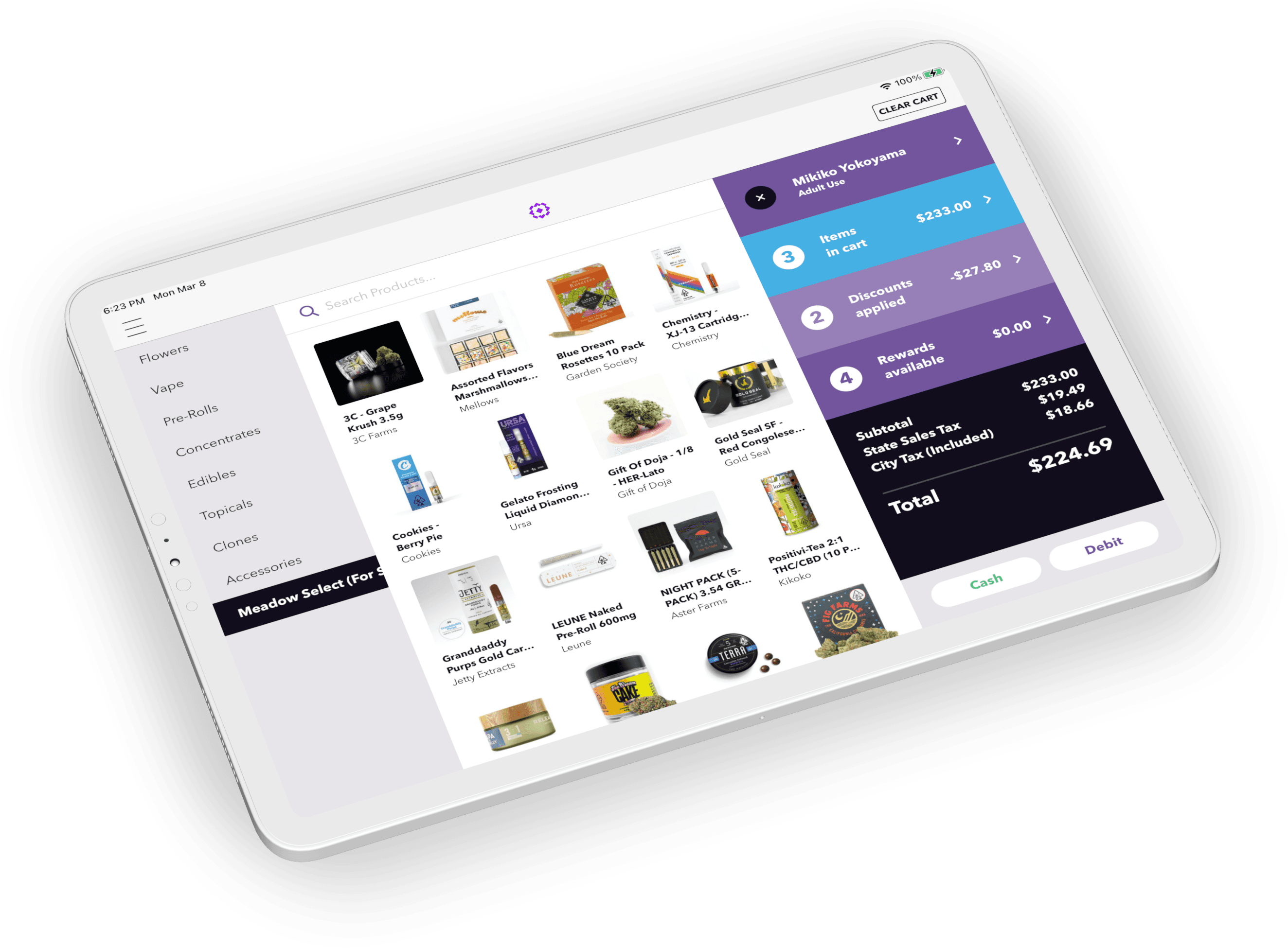
- Choose a Cannabis POS Built for Michigan
- Hire and Train a High-Performing Team
- Launch Your Website and Online Menu
- Build Delivery Into the Plan From the Start
- Streamline Operations With API Integrations
- Market Your Dispensary Within Michigan Ad Rules
- Set Your Dispensary Up for Long-Term Success in Michigan
- Michigan Dispensary FAQs


Understand Michigan Cannabis Licensing Requirements
Michigan's process is cleaner than most states', with one hard constraint up front: your municipality has to want you there.
Who Regulates Cannabis in Michigan
The Cannabis Regulatory Agency (CRA) issues licenses, writes and enforces the rules, and runs the state's Metrc track-and-trace program. The CRA uses a two-step structure that separates business qualification from facility readiness, so you clear background and entity review before your build-out is ever inspected. Start with current guidance at michigan.gov/cra.
License Types and Fees
The license types most retailers consider, with fees per the CRA's published schedule:
- Prequalification (application): $3,000, nonrefundable, and the same across license types.
- Marihuana Retailer: $15,000 initial and $15,000 annual renewal. The standard storefront license.
- Marihuana Microbusiness: $8,300 initial and annual. A smaller-scale pathway that combines limited cultivation, processing, and retail.
- Class A Marihuana Microbusiness: $18,600 initial and annual, for the higher plant-count tier. Beyond the fees, an application needs a defined business entity and ownership structure ready for prequalification, a compliant location with municipal approval, documented capitalization and proof of funds, and a compliance, security, and operations plan.
Social Equity Program Discounts
Michigan's Social Equity Program reduces application and licensing fees by up to 75%, and the reductions stack. A disproportionately impacted community, in the state's definition, is one with above-median marijuana convictions and at least 20% of residents below the federal poverty line.
The individual criteria: 25% off for having lived in a disproportionately impacted community at least 5 cumulative years in the past 10, 25% off for a marijuana misdemeanor conviction, 40% off for a marijuana felony conviction, and 10% off for having been a registered primary caregiver under the Michigan Medical Marihuana Act for at least two years between 2008 and 2017.
One sequencing detail that costs people time: if you intend to use the program, you must apply to the Social Equity Program before submitting your Step 1 prequalification application. Doing it in the wrong order means reapplying.
The Municipal Opt-In Comes First
Michigan municipalities choose whether to allow adult-use businesses and how many, and only about 30% have opted in. This is the single most important fact in Michigan site selection, and it is where new operators lose the most money.
Some opted-in markets are saturated or capped. Others actively court operators. Before you sign anything, confirm four things about your target city or township: that it permits adult-use retail, whether it caps the number of licenses and whether that cap is full, what the local approval process and fees look like, and how its zoning treats your specific parcel.
The requirement is specific, not general. The municipality has to have adopted an ordinance authorizing your particular facility type, so a town that permits cultivation is not necessarily a town that permits retail. Verify it with the local clerk directly rather than inferring it from the fact that a grower operates down the road.
A great location in a municipality that has not opted in is not a location. It is a lease you cannot use.
The Application Process, Step by Step
- Confirm the municipal opt-in and understand local requirements, caps, and zoning.
- Complete CRA prequalification for the entity and its owners, covering background and financial review. The $3,000 fee applies here.
- Secure a compliant location and complete the establishment (Step 2) application.
- Pay the license fee and submit to the CRA.
- Build out and pass inspection. The CRA typically inspects within 60 days of a completed Step 2 application, so do not submit until you can genuinely pass.
- Receive your license and open under your operating conditions. Expect roughly 3 to 6 months from prequalification to license issuance, gated by municipal approval, CRA review, build-out, and inspection.
What prequalification actually involves. This step catches more people off guard than the build-out does. Prequalification is not one application, it is one from the main applicant plus one from every supplemental applicant, and who counts as a supplemental applicant depends on your entity structure. LLCs, corporations, partnerships, and trusts each have their own definition, and the CRA publishes a separate guide for each. Only the main applicant pays the $3,000; supplemental applications carry no fee.
Everyone disclosed goes through a background check, and fingerprinting is arranged by the CRA through local law enforcement. You cannot submit prints on your own and have them count, so build the scheduling into your timeline.
The practical lesson is to map your ownership structure honestly and early. An undisclosed party discovered later is a materially worse problem than a disclosed one reviewed on schedule, and a structure you simplify before applying is a structure you do not have to explain.
One timing rule worth respecting. The CRA advises against submitting your Step 2 application more than 60 days before the facility is genuinely ready for inspection. Submitting early to feel like you are making progress usually just means being inspected before you can pass.
Costs, Timeline, and the Tax Picture
Fees are the small line. Budget for real estate in an opted-in municipality, build-out and security to CRA standards, opening inventory in a price-competitive market, technology, and working capital sized for Michigan margins rather than optimistic ones.
Then there are two tax layers, and both matter more here than almost anywhere else.
The 24% wholesale tax. Effective January 1, 2026, Michigan applies a 24% wholesale marijuana tax on top of the existing 10% retail excise tax. As of the writing of this article it is being collected, but it is not settled: two constitutional challenges are pending, one arguing the Legislature amended a voter-approved initiative without the required three-fourths supermajority, the other arguing the stacked taxes amount to unconstitutional pyramiding. Both are widely expected to reach the Michigan Supreme Court. Early collections have also come in far below projection, roughly $34 million against an expected $420 million annually, partly because retailers have been selling through inventory bought before the tax took effect. Build your model on the tax as it stands today, and watch the litigation.
Section 280E. Federal law still disallows ordinary business deductions for anyone trafficking in a Schedule I or II controlled substance, and it applies in full to adult-use retail. The 2026 federal rescheduling action moved marijuana to Schedule III for two narrow categories only: cannabis in FDA-approved products, and cannabis sold under a state medical marijuana license. Adult-use was explicitly excluded and remains Schedule I. If you also hold a medical provisioning center license, that side of the business may see real relief, which makes how you allocate shared costs between the two a conversation worth having with a cannabis-experienced CPA. Either way, cost of goods sold is the one deduction 280E does not touch, so track it with discipline.
If you are building a Michigan pro forma right now, your margin math is only as good as the system enforcing it at the register. Meadow's team works with Michigan operators on deli-style pricing, Metrc sync, and reporting, and can tell you what to plan for. Book a Call to Learn More
Develop a Security Plan, Store Layout, and SOPs
The CRA inspects this, and your loss-prevention posture depends on it long after the inspector leaves.
Security Plan Requirements
CRA administrative rules set requirements for alarm systems, video surveillance, limited-access areas, and secure storage of both product and cash. Your establishment application and your inspection both turn on getting this right. Design it alongside the floor plan rather than after, because retrofitting camera coverage into a finished build is expensive and rarely as clean.
How to Build a Dispensary Security Plan covers what inspectors look for and how to document it.
Store Layout Considerations
Michigan's price competition puts unusual pressure on throughput, so design for compliance and speed at the same time.
- A controlled entry. One point where every ID is checked before anyone reaches product.
- Sight lines across the floor. Fixtures that create visual pockets create shrink.
- A restricted back of house, with POS permissions matching the physical access list.
- Camera coverage without gaps, including register, safe, storage, and receiving.
- A deli-style station that works. If you are selling weigh-on-demand flower, the scale, the jars, the packaging, and the register need to sit in one motion. A budtender walking three steps per transaction is a throughput problem at Michigan volumes. Dispensary Loss Prevention 101 goes deeper on the shrink patterns specific to cannabis retail, and deli-style adds a few of its own.
Standard Operating Procedures
Write SOPs before you hire, so training has something to teach from. The set worth having on opening day: open and close, cash handling and drops, ID verification and refusal of sale, intake and manifest receiving, deli-style weigh-out and packaging, inventory counts and variance investigation, Metrc adjustment and reconciliation, recall response, security incident response, and delivery dispatch.
Keep them short enough that people actually read them, and store them where a budtender can pull one up mid-shift.

Choose a Cannabis POS Built for Michigan
Michigan has a software requirement that most states do not, and it catches operators after launch rather than before.
Deli-Style Pricing Is the Michigan Test
Deli-style, or weigh-on-demand, flower sales let a customer buy flower by weight, priced at the moment of sale rather than in pre-packaged eighths and quarters. Michigan's price competition made this a norm rather than a novelty, and customers here expect it.
It is also where POS platforms fail. Weigh-at-sale means the system has to price at gram-level granularity, capture the actual weight at the counter, deduct from a bulk package rather than a unit count, and push all of it to Metrc in real time. Plenty of platforms were built around pre-packaged units and bolt deli-style on as an afterthought, which shows up as reconciliation drift, slow checkout, or a manual workaround your budtenders resent.
Test it in the demo. Ask to see a weigh-out from a bulk package through to the Metrc entry, not a slide about it. And confirm your scale setup meets Michigan weights-and-measures requirements for selling by weight.
💡 How Meadow handles this: Meadow supports deli-style pricing for Michigan dispensaries, with weigh-on-demand sales syncing to Metrc automatically rather than through a workaround. Deli-Style Pricing for Michigan Dispensaries →
Key Features to Look For
- Automatic, real-time Metrc sync, not a nightly export.
- Correct Michigan tax handling, including the 24% wholesale tax and the 10% excise tax flowing correctly into your reporting.
- Purchase limit and age verification enforced at checkout, by the system rather than by memory.
- One inventory across retail, pickup, and delivery. Separate systems for separate channels is how unexplained variance happens.
- Speed at the register. At Michigan prices, transactions per hour is a survival metric, not a vanity one.
- Reporting an owner will actually open: margin by category, sell-through, discount impact, and budtender performance.
Metrc Compliance From Day One
Michigan runs on Metrc, and every sale, transfer, and adjustment has to reconcile against it. Deli-style raises the stakes, because each weigh-out is an inventory event that has to match to the gram. Small daily drift becomes a compliance conversation quickly.
💡 How Meadow handles this: Meadow syncs every transaction to Metrc automatically and in real time, so reconciliation is a check rather than a nightly project. Metrc Reporting for Dispensaries →
Meadow has been building cannabis retail software since 2014 as Y Combinator's first cannabis startup, has processed $4B+ in sales, serves operators across six states including Michigan, and is the #1 rated Cannabis POS on G2 (4.9/5) with 99.99% uptime since 2014, including 100% uptime every 4/20. Speed is not an abstraction here: Off the Charts scaled to 30+ stores on Meadow after a previous POS took up to three minutes per order. See what Meadow's Michigan dispensary software looks like in practice, or start with our guide to choosing a cannabis dispensary POS system.

Hire and Train a High-Performing Team
Your budtenders are the compliance front line and the margin engine, and in a deli-style market they are also handling inventory at the counter.
Key Roles to Fill
- Store or general manager. Owns the schedule, the SOPs, and the compliance calendar.
- Inventory manager. Owns Metrc reconciliation, receiving, counts, and variance investigation. In a deli-style market at Michigan margins, this is the highest-leverage hire in the building.
- Lead budtender or floor lead. Owns customer experience and coaches throughput in real time.
- Budtenders. Product knowledge, ID verification, accurate weigh-outs, and speed.
- Delivery drivers and dispatch, if delivery is in the plan.
Training Essentials
Cover three tracks and document all of them.
Compliance: ID checks, purchase limits, refusal of sale, and Metrc hygiene. Every weigh-out, return, and adjustment has to reconcile.
The POS: especially the deli-style workflow. A budtender who is unsure at the scale is slow at the scale, and slow at the scale is lost margin at Michigan volumes.
Product and service: enough knowledge to guide a customer quickly, which is what separates a repeat customer from a price shopper.
Document the program. The CRA inspection and your first busy Friday both go better when the team is running written procedures.
💡 How Meadow handles this: Meadow Mastery is a self-paced training series your team can work through before opening, so new hires learn the POS without burning a manager's floor time. Meadow Mastery →
Launch Your Website and Online Menu
In a market this price-transparent, your menu is where the sale is usually decided. Most Michigan customers compare before they drive.
- A live menu tied to real inventory. Nothing costs a repeat customer faster than a drive for a product that sold out yesterday, and in a market with a store down the road, they will not come back to check.
- Deli-style pricing shown honestly online, so what a customer sees on the menu matches what the scale says at the counter.
- Pickup ordering your floor can actually fulfill, with the staffing to back the promise at 6pm on a Friday.
- Local SEO fundamentals: Google Business Profile, consistent name, address and phone, real hours, and pages that name the towns you serve.
- Fast mobile pages, because most menu traffic is a phone in a parking lot.
- Email and SMS capture, which is the backbone of retention when price alone will not hold anyone. Merchandise the menu the way you merchandise the floor. Real photography, accurate potency data, and honest availability outperform an alphabetical product dump, and the categories you feature at the top are the categories that move.
Dispensary SEO: The Truth About E-Commerce, Google Rankings, and Online Sales covers what actually moves rankings for a single-location retailer.

Build Delivery Into the Plan From the Start
Michigan permits home delivery by licensed adult-use retailers approved by the CRA, and it is a real channel rather than a fringe one. As of late 2025, more than 350 of the state's roughly 838 adult-use retailers were approved for delivery, together generating around $3.6 million in delivery sales in a single month.
Delivery requires a documented standard operating procedure covering driver and vehicle requirements, customer identity and age verification, transport manifests, and daily logs, per the CRA's delivery procedure rules.
The operational planning matters as much as the paperwork: how far you will drive and what that does to cost per order, how many orders a driver can batch, how manifests get generated and closed out, how cash returns to the store, and what a driver does when nobody answers. Delivery margin lives on orders per hour, so set a minimum basket that makes the trip worth taking.
💡 How Meadow handles this: Meadow runs delivery end to end on the same inventory and Metrc sync as your in-store sales, from online order to manifest to doorstep. Cannabis Delivery →
Streamline Operations With API Integrations
The systems you connect before opening determine how much of your week goes to moving data between tabs. Plan for menu and marketplace listings that update from inventory automatically, loyalty and marketing driven by real purchase history, compliant payments reconciled against your POS, accounting your CPA can work from directly (which matters a great deal while 280E applies), and analytics that surface category margin weekly rather than quarterly.
Decide the stack before build-out. Retrofitting integrations after opening means a stretch of double entry, and double entry in a Metrc state with deli-style inventory is exactly how variances start. Meadow's integration partners connect menus, loyalty, payments, and accounting to one source of truth.
Market Your Dispensary Within Michigan Ad Rules
Michigan's core advertising rule (R 420.507) prohibits deceptive, false, or misleading marketing and requires compliance with local ordinances alongside state law. Ads cannot target anyone under 21, cannot use cartoon imagery, and cannot make health claims without a qualified basis. Notably, the CRA does not require pre-approval of ad content.
On audience composition for placed advertising, the CRA's enforcement guidance points to a 70% threshold of an audience reasonably expected to be 21 or older. Some third-party sources cite 71.6%, which appears to be a mix-up with another state's rule. Confirm the current number directly with the CRA before you build a media plan on either.
Within those limits, the highest-return channels are the ones you own: local SEO and your menu, email and SMS to an opted-in list, and a loyalty program that gives you a reason to talk to customers that is not just a lower price. In a market where the store down the road can always undercut you, retention economics beat acquisition economics.
Discount strategy deserves particular attention in Michigan. Smarter Ways to Discount covers how to build promotions that protect margin rather than training customers to wait for the next one.

Set Your Dispensary Up for Long-Term Success in Michigan
Michigan does not reward being first. It rewards being efficient. The operators holding margin here tend to do the same handful of things.
Run inventory tight. Weekly cycle counts, same-day variance investigation, and category-level sell-through review. With deli-style flower, gram-level accuracy is not optional.
Buy like the data is leverage, because it is. Consistent sell-through numbers are what get you better terms from brands in an oversupplied market. 3 Strategies to Secure the Best Vendor Deals walks through how operators use them.
Compete on experience, not only price. At $59 an ounce there is not much room left to undercut anyone. Speed, staff knowledge, and a menu that is accurate are what make someone drive past a cheaper store.
Watch five numbers weekly. Basket size, transactions per hour, gross margin by category, discount rate, and repeat customer rate. Five reviewed weekly beats twenty reviewed never.
Keep compliance boring. Reconciled Metrc, documented training, current SOPs, and a municipal relationship you maintain rather than rediscover at renewal.
What the First 90 Days Should Look Like
Month one, prove the basics: every shift reconciles, every count is clean, every deli-style weigh-out matches, and the SOPs survive contact with real customers. Fix what breaks before adding anything.
Month two, read your own data. Which categories carry margin, which hours are genuinely busy, which budtenders convert, which products sit. Adjust the buy and the schedule to what the numbers say rather than what the business plan assumed.
Month three, turn on growth. Loyalty, an email cadence to the list you have been building since day one, and delivery if you are approved for it. Those layer well onto a stable operation and badly onto one that still cannot close out cleanly.
Mistakes That Cost Michigan Operators the Most
- Signing a lease before confirming the municipal opt-in. The most expensive mistake in Michigan. Confirm zoning, caps, and capacity first.
- Budgeting for the license, not the launch. Fees are small next to build-out, inventory, and working capital.
- Choosing a POS that cannot do deli-style. Test weigh-on-demand in the demo, not after launch.
- Assuming rescheduling fixed your taxes. 280E applies in full to adult-use retail. The 2026 change reaches state-licensed medical only.
- Modeling on pre-2026 economics. The 24% wholesale tax and record-low prices are both in effect. Build on current numbers.
- Treating Metrc as an afterthought. Reconciliation drift becomes a compliance problem fast, and faster with deli-style.
Michigan Dispensary FAQs
How do I open a dispensary in Michigan?
Apply through the Cannabis Regulatory Agency: confirm your municipality allows adult-use retail and has capacity, complete prequalification for the entity and its owners ($3,000), secure a compliant location, complete the establishment application and pay the license fee, build out, and pass inspection. Verify current rules at michigan.gov/cra.
Does my city have to allow dispensaries in Michigan?
Yes. Michigan municipalities opt in to adult-use and set their own local rules and caps, and only about 30% have opted in. Confirm local approval, whether a license cap exists, and whether it is already full before committing to a location.
How much does it cost to open a dispensary in Michigan?
Plan on a $3,000 prequalification fee plus a $15,000 annual retailer license fee, per the CRA's fee schedule, then real estate, build-out and security, opening inventory, technology, and working capital. Michigan's thin margins, the 24% wholesale tax effective January 2026, and 280E all make cost discipline essential from day one.
How long does it take to open a dispensary in Michigan?
Generally 3 to 6 months from CRA prequalification to license issuance, depending on municipal approval, build-out, and inspection. The CRA typically completes its Step 2 inspection within 60 days of a completed application, so submit only when you can pass.
What is deli-style pricing in Michigan dispensaries?
Deli-style, or weigh-on-demand, sales let customers buy flower by weight priced at the moment of sale rather than in pre-packaged amounts. It is common in Michigan and it requires a POS that can price at gram-level, capture the weight at the counter, deduct from a bulk package, and sync the result to Metrc in real time.
What is Michigan's 24% wholesale marijuana tax?
A 24% tax on wholesale marijuana transactions that took effect January 1, 2026, in addition to the existing 10% retail excise tax. As of the writing of this article it is being collected, but two constitutional challenges are pending and are expected to reach the Michigan Supreme Court. Model on the tax as it currently stands and confirm its status before relying on any projection.
Opening a Dispensary in Michigan? Talk to the Team That's Been Doing This Since 2014.
Meadow has been building cannabis retail software since 2014 as Y Combinator's first cannabis startup, has powered $4B+ in sales, and serves operators across six states including Michigan. From deli-style pricing to Metrc sync to delivery, we can show you what opening day actually looks like on Meadow, and what to budget for before you get there.