
Dispensary security is more than security guards and cameras. It is having full visibility into every gram, every transaction, and every adjustment. Shrinkage, unauthorized discounts, and inventory discrepancies add up quickly, hitting revenue and compliance, and eroding team trust.
That is why Meadow's Audit Log, Cycle Counts, and Team Permissions work together to help dispensary owners take full control over cannabis dispensary security, ensuring accountability, accuracy, and compliance.
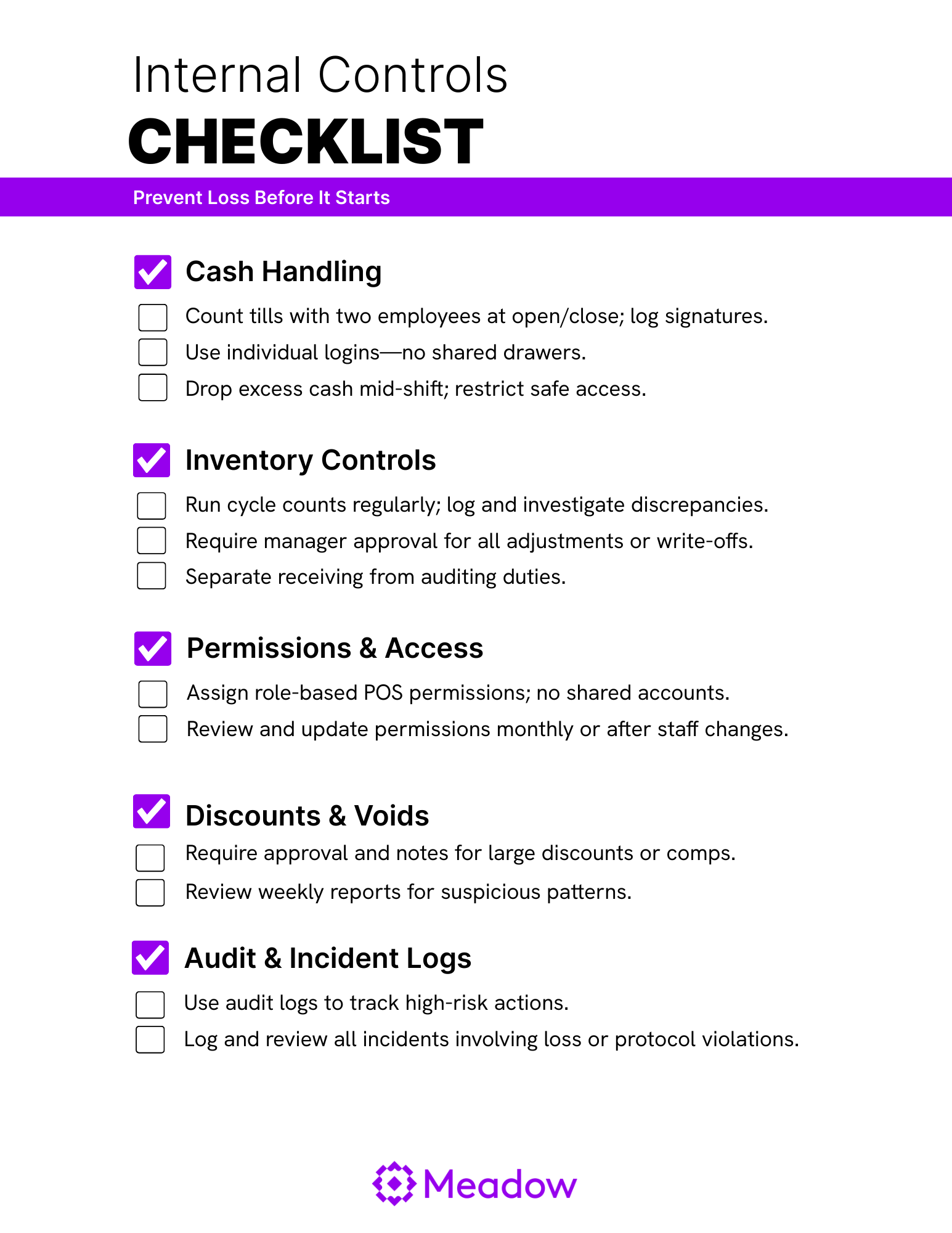
This guide breaks down how each of the three tools prevents loss on its own, how they work together as one internal control system, and what a real loss prevention workflow looks like day to day. Plus, download our Dispensary Internal Controls Checklist below.
In This Post
- Accountability Drives Profitability
- The Overlooked Side of Dispensary Security: Internal Controls
- How Meadow's Audit Log Increases Accountability and Prevents Shrinkage
- Tighten Controls with Meadow's Precise Team Permissions
- Track Every Gram with Cycle Counts
- Combining Audit Log, Cycle Counts and Team Permissions
- Dispensary Loss Prevention FAQs

Accountability Drives Profitability
Every dollar of shrinkage comes off the bottom line twice: once as lost product, once as the time spent tracking down where it went. The dispensaries that stay profitable in a compressed-margin market are the ones that can answer "who did that, and when" without launching an investigation.
That answer comes from three things working together: a record of every action taken, controls over who can take which actions, and a routine that verifies physical inventory against the system.
The Overlooked Side of Dispensary Security: Internal Controls
Cannabis retail is heavily regulated, with strict security requirements for dispensaries to protect against external theft: security personnel, surveillance, limited-access areas, and alarms. Many dispensaries exceed those requirements.
But internal risks, like misplaced inventory, unauthorized price changes, mismanaged discounts and employee theft, are not just a concern. They account for the vast majority of dispensary losses, far exceeding external theft.
- Who changed product pricing without approval?
- Who applied a 50% discount on a high-ticket item?
- Why are key compliance settings altered without documentation?
- Are blind cycle counts being properly conducted to prevent theft and shrinkage?
- Who made adjustments to inventory? Without clear tracking and accountability, shrinkage, errors, and theft spiral. Preventing loss takes more than reactive measures. It takes proactive controls that work together. That is why Meadow's Audit Log, Team Permissions, and Cycle Counts are built into the system at no extra cost, giving dispensary owners full transparency, controlled access, and real-time oversight.
Here is how each tool strengthens security on its own, and how they combine into a loss prevention strategy that actually works.
How Meadow's Audit Log Increases Accountability and Prevents Shrinkage

Think of the Audit Log as your digital security system, recording every significant action within your dispensary's POS.
What Can You Track?
Meadow's Audit Log provides full transparency on who did what, when, and where, including:
✅ Product price changes ✅ Discount creation and edits ✅ Inventory adjustments ✅ Admin access changes ✅ Compliance setting updates ✅ Customer profile modifications ✅ Shifts and cash drawer changes ✅ Employee login activity and session details ✅ Bulk inventory modifications ✅ Audit trails of financial transactions
Each log entry captures:
- What action was performed
- Who performed the action
- Exact timestamp, to the second
- IP address of where the action was taken
- A direct link to the affected page This level of cannabis dispensary security means unauthorized changes get identified and corrected quickly, stopping loss before it compounds.
Real-Life Scenario: Catching Unauthorized Price Changes
A dispensary manager notices a high-demand cannabis product was sold at a deep discount. Instead of playing detective, they check the Audit Log:
🔍 They instantly see that an admin applied a manual 50% discount. 🔍 The discount was unauthorized and not part of any scheduled promotion. 🔍 They take corrective action, preventing future revenue loss.
This is how cannabis businesses increase accountability, improve security measures, and build a team they trust.
This is not theoretical. SWED tracks every price change, inventory adjustment, and login through Meadow's audit log, so accountability is not guesswork when the numbers do not match.
Tighten Controls with Meadow's Precise Team Permissions
The Audit Log tells you who did what. Team Permissions decide who can do it in the first place.
By customizing permissions for each team member, dispensary owners can:
✔ Limit access to sensitive actions, like price changes and inventory edits
✔ Ensure budtenders only have the access they need, for example processing sales but not modifying inventory
✔ Allow purchasing managers to edit inventory without giving them full admin privileges
✔ Restrict customer data access to maintain privacy and compliance
✔ Secure financial reports, ensuring only authorized personnel have access
✔ Prevent unauthorized promotions or discount applications
✔ Ensure only authorized staff can edit compliance settings and tax rates
Suggested Permission Levels for Common Roles

- Owner: Full permissions.
- General Manager: Full permissions, or permissions tailored to manager duties, including access to products, inventory, shifts, orders, and customer settings.
- Floor/Shift Manager: Order access, edit order access, customer access, and manager privileges. May also require shift permissions for POS access.
- Purchasing Manager: Can view and edit inventory, create purchase orders, and adjust inventory levels. Requires edit price permissions if modifying product details.
- Inventory Manager: Similar to purchasing managers but focused on inventory control and reconciliation.
- Marketing Manager: Requires marketing permission to access promotions and campaign tools.
- Front Desk (Customer Intake): Needs customer access to create and edit customer profiles.
- Budtenders: Order access, edit order access, and customer access to process transactions and manage profiles.
- Order Fulfillment (Packing): Order access and edit order permissions to mark orders as packed.
- Delivery Dispatch: Order access, edit order access, and customer access to manage deliveries and driver assignments.
- Delivery Driver: Order access only, to view assigned deliveries.
- Other Roles: Custom permissions can be set for specific needs, such as limited reporting access for accountants or auditors. By setting strict access areas, dispensary owners ensure only authorized personnel can make key changes, significantly reducing operational risk.
💡 Read more: Team Permissions: Streamlining Dispensary Operations with Meadow
Track Every Gram with Cycle Counts
A Cycle Count is a routine check confirming that physical inventory matches what is recorded in Meadow. It prevents loss, catches errors early, and maintains compliance.
Why Cycle Counts Matter
- Regulatory Compliance. Many states, including California, require dispensaries to complete a full inventory count every 30 days.
- Loss Prevention. Regular cycle counts reduce shrinkage and make it easier to spot discrepancies before they become costly.
- Better Inventory Accuracy. Accurate counts reduce operational issues, keeping sales and reporting clean.
- Fraud Prevention. Blind, independent counts stop employees from covering up discrepancies or theft. ### Best Practices for Cycle Counts
There are different ways to run a cycle count, and they are not equally effective:
🚫 Printing a list of expected inventory. Discrepancies go unnoticed when staff can adjust numbers to match expectations.
🚫 Hiding expected quantities from counters. Better, but still has blind spots, especially when inventory is spread across multiple locations.
✅ Blind counts, the best practice. Assign employees specific sections to count independently without knowing expected quantities. This is what produces accuracy and accountability.
💡 Pro Tip: Run smaller, more frequent cycle counts to reduce labor costs and prevent large discrepancies. Meadow lets you count while the store stays open, so the process does not interrupt sales.
This is how high-volume operators stay ahead of loss. Off the Charts and Coast to Coast run blind cycle counts while their stores stay open, catching discrepancies before they compound.
Reconciling and doing cycle counts with Meadow is really easy. It's quick to spot discrepancies and categorize your inventory.
Raheem Santos, Inventory Manager, Coast to Coast
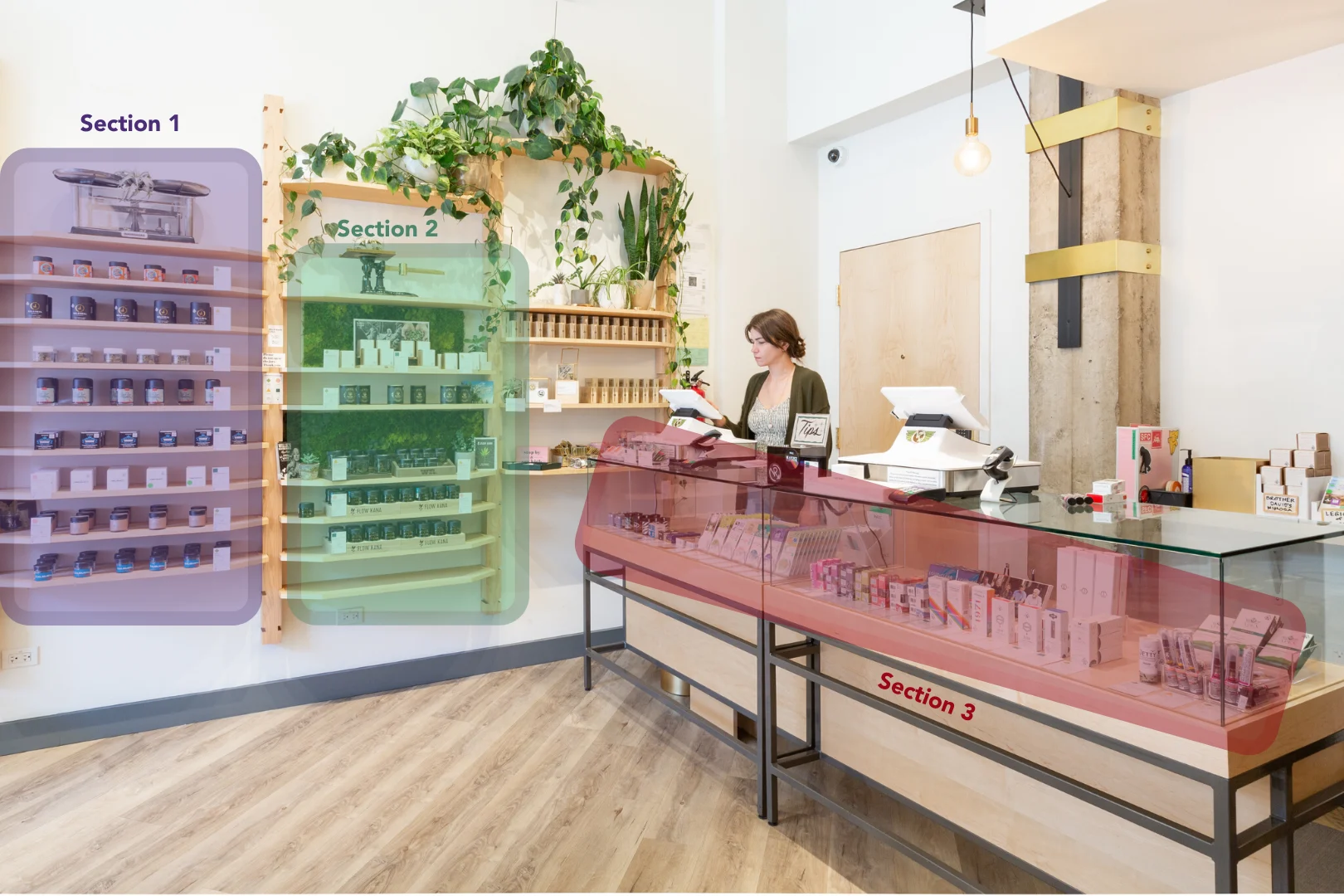
Cycle counts help dispensaries track every gram without disrupting sales. Here the inventory location is set to "Retail Floor," and employees are assigned specific sections to count independently. Blind counts ensure accuracy, accountability, and prevent shrinkage in real time.
How Cycle Counts Work in Meadow

- Select a location to count. Retail floor, back stock, or specific inventory areas.
- Conduct a blind count. Employees count without seeing expected quantities, reducing errors and manipulation.
- Use barcode scanning. Scan products to enter quantities accurately.
- Submit for review. Managers compare counted totals with Meadow's recorded inventory and investigate discrepancies.
- Resolve conflicts. Inventory managers investigate missing products, misplaced stock, or possible shrinkage.
- Finalize the count. Once verified, Meadow updates inventory to reflect accurate quantities. Regular, structured cycle counts reduce shrinkage, improve compliance, and protect the bottom line.
Combining Audit Log, Cycle Counts and Team Permissions: The Ultimate Loss Prevention Strategy
- Step 1: Set permissions so employees only have access to what they need.
- Step 2: Monitor all actions with the Audit Log to catch and correct unauthorized changes.
- Step 3: Conduct regular Cycle Counts to track every gram and prevent discrepancies.
- Step 4: Optimize by fine-tuning permissions and maintaining controls. Together these create an internal security system that minimizes financial losses, protects sensitive data, and keeps you compliant.

Dispensary Loss Prevention FAQs
What is dispensary loss prevention?
The processes and controls that reduce shrinkage and theft: audit logs, role-based permissions, cycle counts, Metrc reconciliation, and cash controls, so inventory and cash match the records.
What causes inventory shrinkage in a dispensary?
Internal theft, miscounts, mis-scans, unrecorded voids and discounts, and receiving errors. Most are caught early with regular cycle counts and a clear audit trail.
How does a POS help prevent loss?
A POS with a full audit log, role-based permissions, and built-in cycle counts makes every adjustment traceable and surfaces discrepancies before they compound.
What is a blind cycle count and why does it matter?
A blind count assigns employees specific sections to count without showing them the expected quantities. It matters because any method that reveals expected numbers lets a discrepancy be papered over, whether through carelessness or intent.
How often should a dispensary run cycle counts?
More often than the regulatory minimum. Many states, California included, require a full count every 30 days, but smaller, more frequent counts cost less labor and catch problems while they are still small enough to trace.
Ready to Close the Blind Spots in Your Dispensary?
The days of blind spots in dispensary operations are over. Meadow's Audit Log, Team Permissions, and Cycle Counts put you in control of your dispensary's security, delivering:
- Full transparency over every action in your POS
- Protection against unauthorized changes and shrinkage
- Controlled access to sensitive business data
- Stronger compliance and operational efficiency
- Higher staff accountability and improved operational trust
- Peace of mind knowing your business is protected from internal risks It is why operators trust Meadow: the #1 rated cannabis POS on G2 at 4.9 stars, with 99.99% uptime since 2014 and 20+ exportable reports for audit and variance reporting. Whether you run a single storefront or multiple locations, these tools safeguard the business and protect long-term profitability.