
The "best" dispensary POS system is the one that automates your state's track-and-trace reporting, stays online on your highest-volume days, and charges a price you can predict a year out. Not the one with the longest feature list.
That's the whole test. A cannabis POS that fails an audit, goes down at peak, or can't keep inventory accurate doesn't just frustrate your team, it costs real money. And the costs that hurt most are usually the quiet ones: per-transaction fees that scale with your growth, per-ticket support charges, a data-export policy nobody explained until you tried to leave.
This guide breaks down what actually separates the top cannabis POS platforms in 2026, compares the major options side by side, and gives you a simple framework to choose with confidence.
In This Post
- How We Evaluated, and Our Bias
- The Top Dispensary POS Systems in 2026, at a Glance
- Platform by Platform
- When Meadow Is the Right Choice
- Where Meadow Isn't the Right Fit
- How to Choose: A Four-Step Framework
- Why Dispensaries Choose Meadow
- Common Questions

How We Evaluated, and Our Bias
Let's be upfront: Meadow makes a cannabis POS, so we have a horse in this race. We've tried to keep this comparison fair, because every platform below has a real sweet spot. We name where Meadow isn't the right fit further down. Where we cite a vendor's own numbers, we label them (company-reported), and where a fact is time-sensitive we date it. The goal isn't to declare a single winner for everyone; it's to give you the criteria and the honest landscape so you can pick what fits your operation.
Everything here reflects publicly available information as of August 2026. Cannabis software moves fast, so confirm current specifics with any vendor before you sign.
We weigh every platform on six things, and treat the first three as deal-breakers, not trade-offs:
1. Compliance automation. Does it sync with your state's track-and-trace system in real time and catch errors before the state sees them? Manual CSV uploads and nightly reconciliation are a tax on your time and an audit risk.
2. Reliability and uptime. What's the documented uptime, and what's the track record on 4/20 and other peak days? An outage during your highest-volume hours is the single most expensive failure a POS can have.
3. All-in-one scope. Do POS, eCommerce, delivery, loyalty, and payments live in one system, or are you stitching vendors together? Every integration is a seam that can break.
4. Pricing model. One flat monthly fee, or per-transaction fees that grow as you do? A low headline rate with a percentage cut often costs more at scale. (See our cannabis POS pricing guide for what dispensaries actually pay in 2026.)
5. Support model. Free and fast, or charged per ticket? You will need help on a busy night.
6. Data ownership. Can you export your data freely and take it with you if you leave? If the answer is fuzzy, that's the answer.
The Top Dispensary POS Systems in 2026, at a Glance
Every platform has a sweet spot. Here's the honest landscape as of August 2026 (confirm current competitor specifics before you sign):

Platform by Platform
Meadow
Best for: single and multi-location operators who want reliability, compliance, and one system.
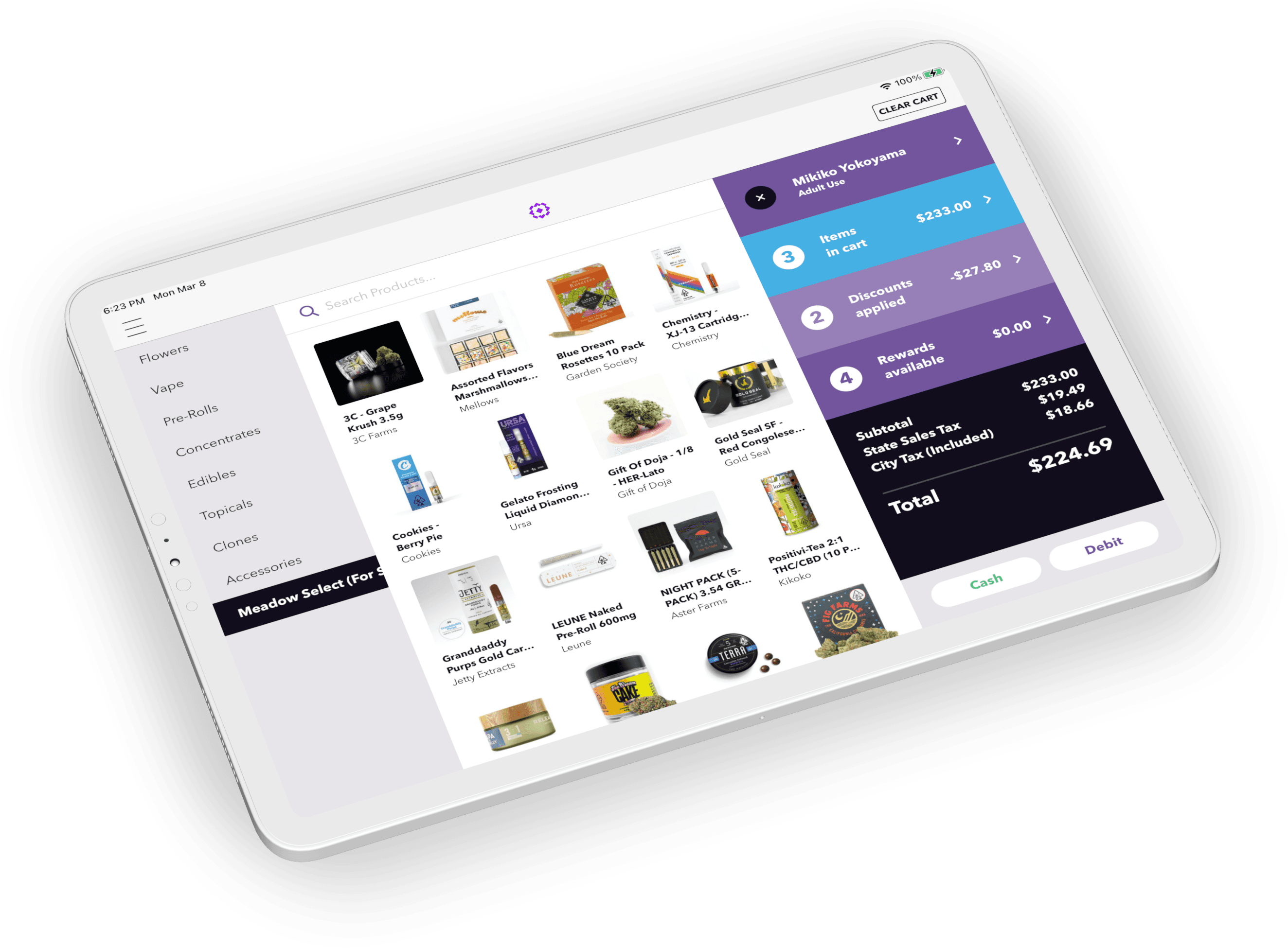
What sets it apart: all-in-one, with in-store, delivery, pickup, kiosk, lounge, and eCommerce in one platform, plus real-time Metrc syncing and audit-ready logs. Meadow holds a 4.9 rating on G2 across 90 operator reviews as of August 2026, with 99.99% uptime since 2014 and 100% uptime every 4/20 (company-reported), one flat monthly fee, and free support with a five-minute average response time (company-reported).
Watch-outs: Metrc-only and currently live in six states, so it's not an option everywhere (more on that below).
Dutchie
Best for: eCommerce and online-menu reach.
What sets it apart: the largest footprint in cannabis retail. Dutchie reports more than 6,500 dispensary partners and over $100 billion in transactions processed (company-reported), along with a deep online-ordering presence. The company launched Dutchie E-Commerce Pro on August 26, 2025, which replaces the legacy Dutchie Plus headless product; Dutchie Plus is reported to sunset at the end of 2026.
Watch-outs: a documented outage history. Dutchie went down on 4/20 in both 2023 and 2024, and admitted the failures publicly. In fairness, we found no reports of a repeat in 2025 or 2026, so ask them directly about their last three peak days. Delivery also typically needs a third-party tool like Onfleet.
Flowhub
Best for: high-volume and multi-state retailers.
What sets it apart: a reputation for speed and fast setup, plus support for both Metrc and BioTrack across many states, which matters if you operate in mixed-traceability markets. Flowhub launched a POS-native eCommerce product in July 2025 and reports processing over $3 billion in cannabis sales annually across more than 1,000 dispensaries (company-reported, July 2025).
Watch-outs: some operators cite added complexity stitching multiple tools together. (See our Flowhub alternatives guide or, for BioTrack-specific markets, our BioTrack alternatives guide.)
Treez
Best for: enterprise operators and MSOs.
What sets it apart: depth suited to larger, multi-state operations, with an enterprise eCommerce product.
Watch-outs: longer onboarding and heavier configuration than a single-location store usually needs, and enterprise pricing to match. (See our Best Treez Alternatives roundup or our direct Treez vs. BLAZE comparison.)
BLAZE
Best for: independents and smaller chains.
What sets it apart: a long-standing all-in-one platform with a broad feature set, plus BLAZE ECOM for online ordering.
Watch-outs: evaluate reliability and the support model against your peak-day needs; operator reviews are worth reading closely here. (See our Meadow vs. BLAZE comparison.)
Cova
Best for: reliability-minded retailers.
What sets it apart: a strong uptime reputation and straightforward retail workflows.
Watch-outs: delivery relies on integration partners such as Breadstack and Carrot rather than being native, and Cova eCommerce is a separate product from the POS. (See our Cova vs. Flowhub comparison.)
Jane (I Heart Jane)
Best for: menu- and eCommerce-first operators.
What sets it apart: broad marketplace reach plus Jane Roots, a native-menu product that hosts on your own domain instead of a third-party subdomain.
Watch-outs: it's primarily a menu and eCommerce layer rather than a full POS, so you're pairing it with a separate point-of-sale. (See our Jane vs. Dutchie comparison.)
When Meadow Is the Right Choice
Meadow wins when reliability, compliance, and support matter more than a long feature checklist. For most operators, that consistency is exactly what keeps the doors open and the line moving. The proof shows up in switching stories, not marketing copy:
Our experience with Meadow has been absolutely amazing. The support team is the best!
Victoria F., verified operator review on G2
West Coast Collective ran Meadow and Treez side by side across their stores. The team that used both every day chose Meadow, and the switch was a zero-downtime overnight cutover. Off the Charts runs over 40 stores on Meadow after their previous POS took up to three minutes to process a single order. When the bottleneck is your register, growth gets expensive fast.
Where Meadow Isn't the Right Fit
In the spirit of a fair comparison, here's where you should pick someone else:
- You're outside Meadow's footprint. Meadow is currently live in California, Michigan, Massachusetts, New York, New Jersey, and Minnesota. If you operate elsewhere, it's not an option yet.
- You're in a BioTrack-only state. Meadow integrates with Metrc only. In states that run on BioTrack traceability, a platform like Flowhub that supports BioTrack is the better fit. (See our BioTrack alternatives guide.)
- You need offline mode. Meadow requires an internet connection; if your store loses connectivity, sales stop. Operators with unreliable internet should weigh that carefully.
- You want a published price before talking to anyone. Meadow's pricing isn't on the website. Book a demo for a quote. Saying this out loud is the point: if those are dealbreakers, another platform will serve you better. If they're not, the strengths above are why operators switch.
How to Choose: A Four-Step Framework
- Rule out on the deal-breakers first. Compliance automation, uptime, and total cost. A low score on any one knocks a platform out, no matter how nice the rest looks.
- Match the platform to your model. Heavy delivery, a consumption lounge, multi-location, or a single store all push you toward different strengths.
- Demo with your real scenarios. A 4/20 rush, a delivery run, a Metrc discrepancy, a return. See how the system behaves under your actual workflows, not a canned demo.
- Check references and test support before you sign. Message their support with a real question and time the reply. Ask operators your size what breaks. 💡 How Meadow handles this: we'd rather you score us against everyone else on paper than take our word for it. The Complete Guide to Choosing a Cannabis Dispensary POS System →
Ready to make the move? See our zero-downtime migration playbook and the case for why switching is worth it.
Why Dispensaries Choose Meadow
- 4.9 rating on G2 across 90 operator reviews, trusted for over a decade
- 99.99% uptime since 2014, including 100% uptime every 4/20
- All-in-one: in-store, delivery, pickup, kiosk, lounge, and eCommerce in one platform
- Real-time Metrc syncing and audit-ready logs
- Free support from cannabis retail experts, five-minute average response time, no per-ticket fees
- One flat monthly fee, no processor lock-in, and your data comes with you ---
Common Questions
What's the best dispensary POS system in 2026?
The best dispensary POS system is the one that automates compliance, stays up on peak days, and fits your sales model. Meadow holds a 4.9 rating on G2 with 99.99% uptime since 2014 and an all-in-one platform spanning in-store, delivery, and eCommerce. It's Metrc-only and live in six states (CA, MI, MA, NY, NJ, MN), so confirm it serves your market.
How do I compare cannabis POS systems?
Score each platform on six criteria: compliance automation, uptime, all-in-one scope, pricing model, support, and data ownership. Treat compliance, uptime, and total cost as deal-breakers rather than trade-offs, and rule out any platform that fails one of them before you compare features.
Which dispensary POS is best for multiple locations?
For multi-location dispensaries, look for real-time multi-store inventory, fast staff training, and consistent reporting across stores. Off the Charts runs over 40 stores on Meadow using its cycle counts and Meadow Mastery training program.
What's the most important feature in a cannabis POS?
Automatic, real-time compliance syncing paired with reliable uptime. Everything else is secondary if the system fails an audit or goes down at peak, because both failures cost money the same day they happen.
How much does a dispensary POS cost?
Dispensary POS pricing depends on the model. Flat-fee platforms charge one predictable monthly rate per location; others add per-transaction fees or revenue share that grow with your sales. Compare total annual cost, not the headline rate. (See our cannabis POS pricing guide.)
Does a cannabis POS have to work offline?
Not necessarily, but it depends on your internet. Cloud platforms like Meadow require a connection, which is a non-issue in most stores and a real risk in a few. If your location has spotty service, make offline mode a deal-breaker and ask each vendor exactly what still works when the connection drops.
See How Meadow Compares for Your Shop
Run us through the four-step framework above. Ask for our 4/20 record, our pricing model, and our data-export policy, and time our support reply while you're at it. Meadow has been building cannabis retail software since 2014 as Y Combinator's first cannabis startup, and we're happy to be scored the same way we're asking you to score everyone else.