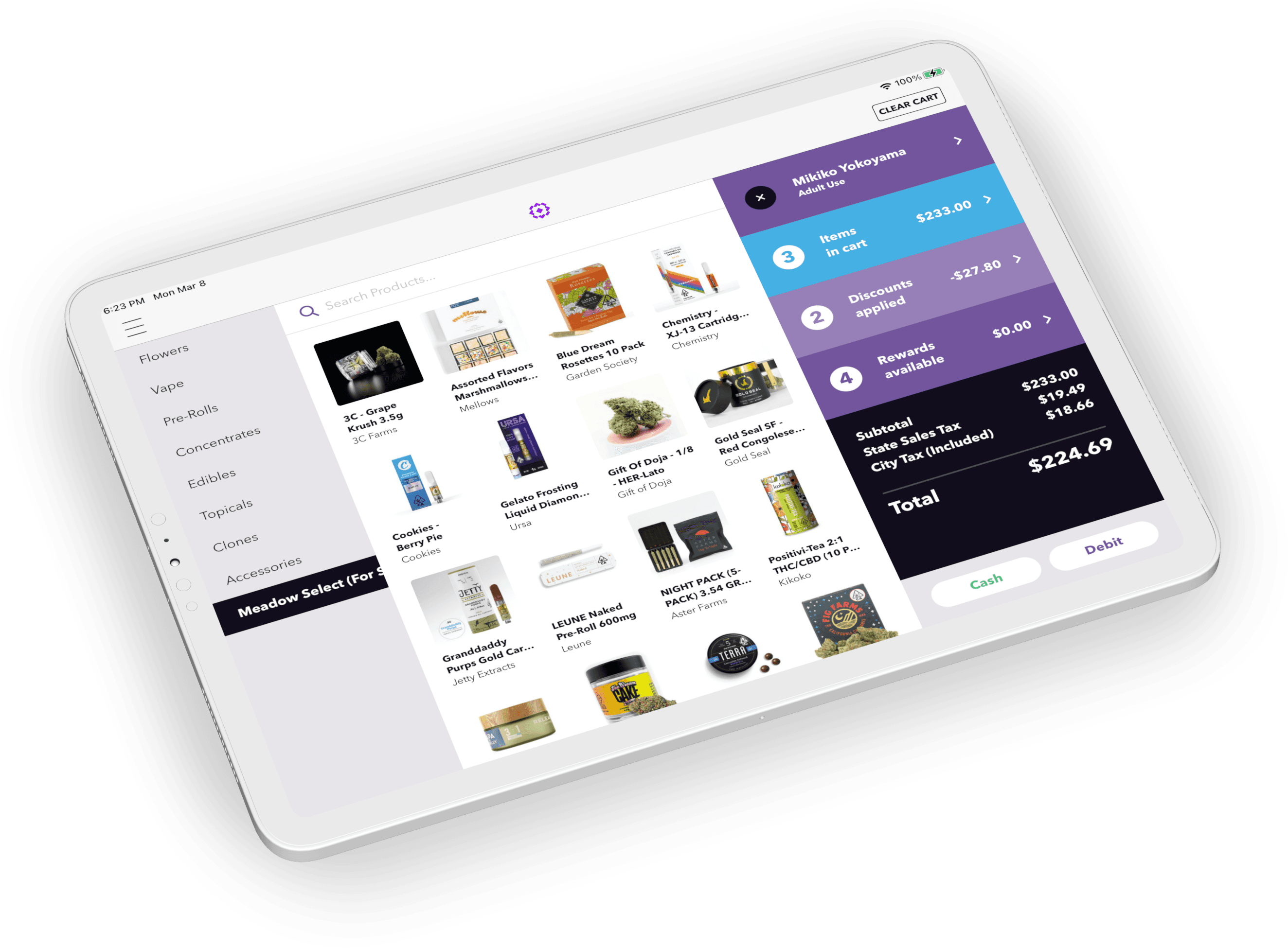

Cannabis POS pricing is rarely the number on the website. Most platforms charge one of five ways: a flat monthly fee, a per-transaction cut, a percentage of revenue, a per-seat or per-terminal rate, or a low base rate with eCommerce, delivery, loyalty, and integrations stacked on top. Two systems advertising the same headline rate can produce bills that differ by five figures a year once processing, support, and add-ons are counted.
The model matters more than the number, because the model decides how your bill behaves as you grow. A rate that looks generous at 2,000 transactions a month can become your third-largest software expense at 8,000.
This guide covers the five pricing models, the hidden costs that don't appear on a quote, typical market ranges for 2026, how to calculate your real 12-month total, and the questions that get a straight answer out of any vendor.
In This Post
- The Main Pricing Models
- The Hidden Costs That Add Up
- What Dispensaries Actually Pay in 2026
- How to Calculate Your Real Total Cost
- Questions to Ask Every Vendor
- How Meadow Prices
- How to Get an Accurate Quote
- Cannabis POS Pricing FAQs

The Main Pricing Models
Almost every cannabis POS uses one of these five structures, or a blend of two. Identify which one you are being quoted before you compare anything else.
Flat monthly fee. One predictable price per location. Your cost is identical in a slow February and on a record 4/20. Easiest to budget against, and it stops scaling once your volume passes the crossover point.
Per-transaction fees. A small cut of every sale. Nearly invisible at signup and directly proportional to your success. The busier you get, the more you pay for software that has not changed.
Percentage of revenue. The platform takes a slice of sales. Same mechanic as per-transaction, but tied to ticket size as well as count, so it compounds faster in markets with higher average orders.
Per-seat or per-terminal. Priced by registers or user accounts. This one quietly penalizes exactly the things you want: more checkout stations on a busy floor, more seasonal staff during peak weeks.
Add-on stacking. A low base rate, then eCommerce, delivery, loyalty, reporting, and integrations each priced separately. The advertised number is almost never the number on the invoice.
The honest version of this comparison is that no model is universally cheapest. Per-transaction can genuinely be the better deal for a low-volume store. What matters is where the models cross, and whether you expect to be above or below that line a year from now.
The Hidden Costs That Add Up
The subscription line is the part of the bill you can see. Ask about every one of these before you sign.
- Per-ticket support fees. Some platforms charge each time you need help. Problems you did not cause become line items, and they arrive precisely when you are busiest and least able to troubleshoot on your own.
- Processor lock-in. Being required to use one payment processor at rates you cannot shop. Over a year this can exceed the cost of the POS itself, and it is the single most commonly overlooked item on this list.
- Integration fees. Charges to connect Weedmaps, Leafly, accounting, or marketing tools you already pay for separately.
- Hardware. Required versus optional, and whether you can use equipment you already own or have to buy the vendor's.
- Onboarding and migration. One-time setup or data-migration charges. Ask whether a Metrc audit and inventory cleanup are included or billed, because on a switch those are the steps that determine whether you start clean. A good provider runs a zero-downtime migration as part of onboarding.
- Renewal increases. A rate that looks fine in year one and climbs in year two, once switching has become expensive. Ask for the renewal terms in writing before you sign, not after. ---
What Dispensaries Actually Pay in 2026
These are industry benchmarks, not Meadow's pricing, and they vary widely by state, market, and store size. Treat them as planning brackets to build a budget around, then run your own total-cost math. All figures below are as of the writing of this article.
POS software. Starter tiers commonly run roughly $99 to $150 per month per location. Mid-tier lands around $350 to $600 per month. Enterprise typically starts at $700 and up. A full mid-tier stack combining compliance, eCommerce, payments, and support often totals around $500 to $1,500 per month per location.
Payment processing. ACH runs roughly 1% to 1.5% per transaction and is often the cheapest compliant option. PIN debit runs roughly 2.5% to 4% plus about $0.50 per transaction. Cashless ATM costs the customer roughly $3 to $5 per transaction, an effective 2% to 5% depending on ticket size.
A note on cashless ATM. As of the writing of this article, cashless ATM arrangements are under active regulatory and network scrutiny, and enforcement has been increasing. Credit card networks prohibit cannabis transactions outright, which is why compliant dispensaries rely on ACH and PIN debit rather than card workarounds. If you are evaluating a payments setup, weigh the regulatory exposure alongside the rate
Hardware. Roughly $1,000 to $3,000 per register station.
The sticker is not the point. The 12-month total at your real volume is the point, and that is what the next section calculates.
💡 How Meadow handles this: Meadow supports integrated ACH and PIN debit without processor lock-in, so you can shop your own rates instead of inheriting someone else's. See how compliant cashless payments work at a dispensary →
How to Calculate Your Real Total Cost
Do not compare headline rates. Compare a full year, at the volume you expect to be doing, not the volume you are doing today.
The formula: Base subscription + transaction or revenue fees + support charges + payment processing + integration fees + amortized hardware and onboarding = your annual total cost of ownership
Then run it twice: once at your current volume, once at your target volume twelve months out. The gap between those two numbers is what the pricing model is actually charging you for growth.
A Worked Example
Here is why the crossover point matters more than the rate. These are illustrative placeholder figures, not market data. Substitute your own.
Compare a flat fee of $900 per month against a per-transaction model at 0.5% of sales, for two stores:
- Store A: $165,000/mo in sales | Store B: $480,000/mo in sales
- Flat fee at $900/mo | Store A: $10,800/year vs Store B: $10,800/year
- Per-transaction at 0.5% | Store A: $9,900/year vs Store B: $28,800/year
- Difference | Per-transaction saves $900 vs Flat fee saves $17,100
At Store A's volume, the per-transaction model is genuinely the better deal. At Store B's volume, the same model costs nearly three times as much for identical software. The crossover in this example sits at $180,000 per month in sales, which is simply the flat fee divided by the percentage rate.
Find your own crossover before you sign: divide the flat monthly fee by the percentage rate. If you expect to pass that revenue number within the contract term, the flat fee is the cheaper structure over the life of the deal, even though it looks more expensive on the quote.
This is also the calculation that a per-transaction vendor is least likely to run for you.
Questions to Ask Every Vendor
Six questions. Get the answers in writing, not on a call.
1. How do you make money beyond the subscription?
The most revealing question on the list. Payments revenue, data, integration referral fees, and hardware margin all shape how a vendor treats you later.
2. Are there per-transaction or percentage-of-revenue fees?
If yes, ask for the exact rate and run the crossover math above before the call ends.
3. Is support free or charged per ticket, and what is the real response time?
Ask for the target, then ask a current customer at your volume whether it holds on a Saturday.
4. Am I locked into a specific payment processor?
If yes, ask what happens to your rates in year two, when you have no leverage.
5. What costs extra?
Get eCommerce, delivery, loyalty, integrations, and reporting itemized. "Included" and "integrated" are different words for a reason.
6. Will my rate change at renewal, and is there a contract?
Ask for the renewal terms and the exit terms in the same breath. A vendor confident in the product will answer both.
For a side-by-side look at how the major platforms compare on more than price, see our guide to choosing a cannabis dispensary POS system, or our Flowhub alternatives and BioTrack alternatives comparisons.
How Meadow Prices
Meadow uses one flat monthly fee per location. No per-transaction fees, no percentage of revenue, and no payment processor lock-in.
Pricing is tailored to your business size and needs rather than published as a one-size-fits-all sticker, so the team builds a quote around your store count, sales channels, and volume. The practical result is a bill that stays flat as you grow, and a number you can budget against a year out.
We are not going to claim that is cheapest for everyone. If you are a low-volume single location, the crossover math above may point elsewhere, and we would rather you run it. What a flat fee buys you is predictability, and the guarantee that a record 4/20 does not come with a bigger software invoice.
How to Get an Accurate Quote
A vendor can only quote well if you arrive with the right numbers. Before any pricing conversation, pull together:
- Store count and locations, including anything opening in the next twelve months.
- Monthly transaction count and average ticket, for each location. These two numbers drive every model except flat fee.
- Sales channels you run or plan to run: in-store, pickup, delivery, kiosk, eCommerce, events.
- Your current stack and what it costs, including every tool the POS might replace. This is where add-on stacking gets exposed.
- Your current payment processing rates, so you can tell whether a bundled offer is actually competitive.
- Your peak-day volume, usually 4/20. Any per-transaction model should be priced against your best day, not your average one. Bring those six items and you will get a real number instead of a range, from any vendor.
Common Questions
How much does a cannabis POS cost?
It depends on the pricing model and your volume. As of the writing of this article, starter tiers commonly run roughly $99 to $150 per month per location, mid-tier around $350 to $600, and enterprise $700 and up, with a full stack often totaling $500 to $1,500 per month per location. Compare total annual cost at your expected volume rather than the headline rate.
What hidden fees should I watch for in a dispensary POS?
The six most common are per-ticket support charges, payment processor lock-in, integration fees, required hardware, setup or migration charges, and rate increases at renewal. Processor lock-in is the one most often missed, and over a year it can cost more than the POS subscription itself.
Are flat-fee or per-transaction POS systems cheaper?
It depends on your volume. Per-transaction can be cheaper for a low-volume store, and flat fee is cheaper above the crossover point. Find the crossover by dividing the flat monthly fee by the percentage rate: if you expect to pass that monthly revenue number during the contract term, flat fee is the cheaper structure over the life of the deal.
What does dispensary payment processing cost?
As of the writing of this article, ACH runs roughly 1% to 1.5% per transaction, PIN debit roughly 2.5% to 4% plus about $0.50 per transaction, and cashless ATM roughly $3 to $5 to the customer. Credit card networks prohibit cannabis transactions, so ACH and PIN debit are the standard compliant options.
Does Meadow charge per-transaction fees?
No. Meadow uses one flat monthly fee per location with no per-transaction fees and no processor lock-in. Talk to our team for a quote built around your store count and volume.
Why don't cannabis POS vendors publish their pricing?
Most price by store count, sales channels, and volume, which means a published sticker would be wrong for most buyers. The practical downside is that comparison shopping takes real conversations. Bring the six items listed above and you will get a firm number quickly.
Sell More Cannabis with Less Work.
You should not need a spreadsheet archaeology project to find out what your POS costs. Tell us your store count, your monthly volume, and what you are running today, and we will give you a flat number you can budget against, plus an honest read on whether the math favors us.