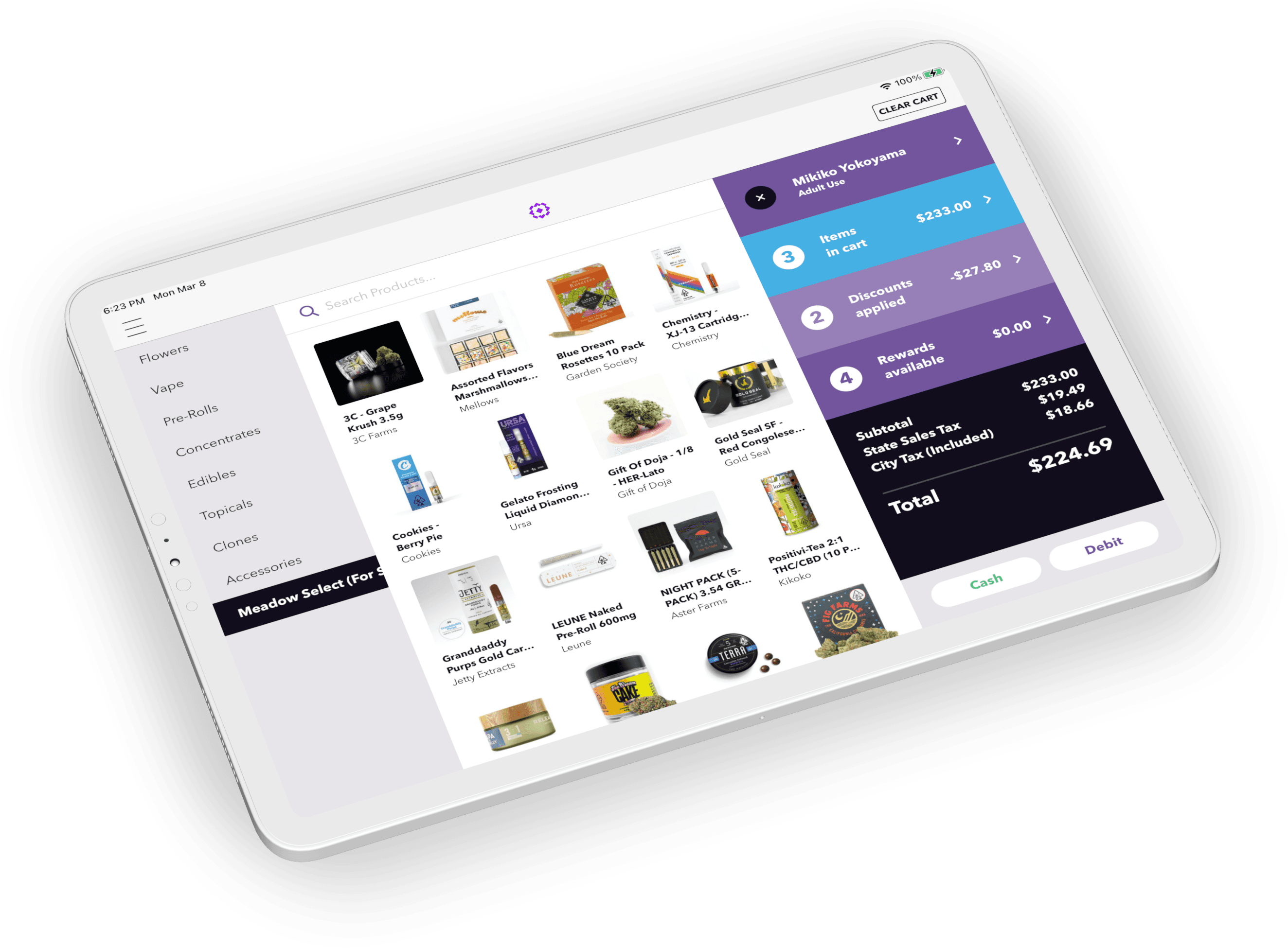

The best BioTrack alternatives for dispensaries in 2026 are Meadow, Cova, Dutchie, and Flowhub. Which one is right for you depends on a question most comparison articles skip: which BioTrack are you actually replacing?
BioTrack is two different things. It is a commercial POS and ERP sold to dispensaries, and it has also been the vendor behind several states' government seed-to-sale track-and-trace systems. Almost every competitor is one or the other. That dual role is what makes a BioTrack switch different from any other POS migration, because in a state that mandates BioTrack traceability, you report into BioTrack no matter which POS you run. What you are replacing is the commercial layer: checkout, inventory, eCommerce, delivery, and support.
This guide covers what makes BioTrack different, why operators move off it, what to evaluate in a replacement, how the top alternatives compare, and what a legacy migration actually involves. We will also be direct about the states where Meadow cannot serve you at all.
In This Post
- What Makes BioTrack Different
- Why Operators Look for a BioTrack Alternative
- What to Look for in a BioTrack Alternative
- Questions to Ask Before You Sign
- The Top BioTrack Alternatives in 2026
- What Operators Say About BioTrack
- Why Dispensaries Switch to Meadow
- Where Meadow Is Not the Right Fit
- How to Switch Off a Legacy POS Without Downtime
- What to Look for in a Long-Term Partner
- BioTrack Alternatives FAQs

What Makes BioTrack Different
BioTrack occupies a position no other vendor in this market holds: it sells a commercial POS and ERP to dispensaries, and it has historically built and operated government track-and-trace systems for states.
As of 2025, BioTrack held government track-and-trace contracts in roughly eight states, including Florida, which launched statewide in November 2024, along with Hawaii, New Mexico, Connecticut, Delaware, Arkansas, and North Dakota. It also ran Washington's system until 2017. In August 2025, BioTrack and Metrc announced a partnership that moved BioTrack's government contracts to an independent entity, BT Government, Inc., with BioTrack refocusing on its commercial POS and ERP business.
These contracts are in flux, and at least one has already changed hands. New York moved from BioTrack to Metrc, with all licensees required to be live in Metrc by December 17, 2025. If you operate in a state that used BioTrack traceability a year ago, confirm what your state runs today before you shop for anything.
Here is why the distinction decides your options:
- If your state mandates BioTrack traceability, you report into BioTrack regardless of which POS you buy. Switching POS changes your commercial layer only, and your replacement has to support BioTrack reporting.
- If your state runs on Metrc and you happen to use BioTrack's commercial POS, you have the full market open to you. You are replacing a product, not a mandate. Sort out which of those you are before you take a single demo. It eliminates half the shortlist immediately.
On the commercial side, BioTrack's strengths are real and worth naming. Deep inventory, genealogy, and seed-to-sale tracking. An extensive, customizable reporting suite reported at 100+ reports. And a genuine compliance pedigree earned from years inside the traceability business, which is not something a newer vendor can claim.
Why Operators Look for a BioTrack Alternative
Operators who leave BioTrack's commercial platform tend to describe the same four motivations.
- A modern, intuitive interface that a new budtender can learn in a shift instead of a week. In a role with high turnover, training time is a recurring operating cost, not a one-time setup cost.
- A single all-in-one platform instead of separate tools for eCommerce, delivery, and loyalty, each with its own contract, its own support queue, and its own version of your inventory.
- Faster support and a smoother day-to-day experience, particularly during peak periods when a slow ticket queue costs real sales.
- Confidence the platform keeps pace with regulatory change automatically, rather than depending on you to notice a rule changed.
The underlying question is not whether BioTrack is capable. It is whether you want your commercial retail layer to come from a vendor whose center of gravity has been traceability, or from a platform purpose-built for the dispensary floor.
What to Look for in a BioTrack Alternative
Skip the feature checklist. Compare the six dimensions that decide compliance, speed, and whether you are shopping again in eighteen months.
- Compliance automation. Real-time track-and-trace sync that catches errors before the state sees them, not a nightly batch that reports a discrepancy after the fact.
- Reliability. Documented uptime and a specific 4/20 record. Ask for the number, not the adjective.
- All-in-one scope. POS, eCommerce, delivery, loyalty, and payments in one system, running off one inventory count.
- Modern, intuitive UX. Time how long a full checkout takes in the demo, then multiply by your daily transaction count.
- Support model. Free and fast, or ticketed with a queue and a tier structure.
- Data ownership. Free export and no lock-in. Ask specifically about customer lists, sales history, and inventory.
Rate every option 1 to 5 on each with our 12-point POS scorecard, and weigh true cost of ownership with our cannabis POS pricing guide.
💡 How Meadow handles this: Meadow syncs sales, inventory, and customer data to Metrc in real time and runs daily audits with automated guardrails, so compliance issues surface the same day instead of weeks later. See why integrated POS software beats bolt-on compliance →
Questions to Ask Before You Sign
Bring these to every demo. On a legacy migration, questions four and seven matter more than anything on a feature grid.
1. Which track-and-trace system does my state require today?
Ask the regulator, not the vendor. Contracts have moved recently, and the answer determines your entire shortlist.
2. How does the provider make money?
Subscription only, or subscription plus a cut of every transaction? Ask whether payments revenue is part of their model, because it determines whether you can shop your own processor later.
3. What is the documented uptime, including 4/20?
Outage history on peak days is a matter of public record. Ask for the specific number and check it independently.
4. What happens to years of legacy inventory and package data?
This is the question that separates a clean migration from a painful one. A long tenure on an older system usually leaves package and inventory discrepancies. Ask who reconciles them, and when.
5. What is included versus what is an add-on?
Get eCommerce, delivery, loyalty, and reporting itemized in writing. "Integrated" often means "integrates with a product you will pay someone else for."
6. Who answers when something breaks on a Saturday?
Ask for the response time target, whether support is free or ticketed, and then ask a current customer whether it holds.
7. Can I export my data and leave?
If the answer requires a conversation with an account manager, that is your answer.
The Top BioTrack Alternatives in 2026
A fair shortlist. Confirm current competitor specifics independently before you sign, since platforms ship and change fast.
Meadow. A modern all-in-one platform built around compliance and reliability. The #1 rated cannabis POS on G2 at 4.9 out of 5, with 99.99% uptime since 2014 and 100% uptime every 4/20 (company-reported). Real-time Metrc syncing, with in-store, pickup, delivery, kiosk, and eCommerce running off one inventory count. One flat monthly fee per location, no per-transaction fees. Metrc-only, currently live in California, Michigan, Massachusetts, New York, New Jersey, and Minnesota.
Cova. A strong reputation for reliability and a clean 4/20 record. A common pick for operators who prioritize uptime and straightforward retail workflows. Cova does not include built-in eCommerce or delivery, so online menus and delivery run through third-party tools.
Dutchie. The highest-penetration POS in the market, reported at roughly 6,500 of about 11,000 licensed North American dispensaries, with deep eCommerce and online-menu reach. It also went down on 4/20 in 2023 and 2024, which is worth weighing if peak-day reliability is your priority.
Flowhub. Known for fast setup and speed at high-volume stores, and it supports compliance across many states via both Metrc and BioTrack. That dual support is the reason Flowhub belongs on this list specifically: if you are in a BioTrack-mandated state, it is a viable path where Meadow is not. See our Flowhub alternatives guide for a closer look.
What Operators Say About BioTrack
Peer feedback on BioTrack is harder to find than for most platforms on this list, and that is itself worth knowing before you evaluate.
BioTrack has a very small public review base compared to higher-volume platforms. Reviewers who do post tend to credit the depth of inventory tracking and the breadth of the reporting suite, and to flag that tax configuration and item setup can be cumbersome.
The practical consequence is that you cannot reference-check BioTrack the way you can check a platform with hundreds of verified reviews. So do it directly. Ask the vendor for two or three current customers who run your license type at your volume in your state, and call them. A vendor that will not put you in touch with a comparable operator has told you something.
That advice cuts both ways, and it applies to us too.
Why Dispensaries Switch to Meadow
Operators moving off a legacy system usually feel the difference on day one: faster checkouts, cleaner inventory, and support that answers. Meadow holds a 4.9 out of 5 rating on G2, the highest in cannabis retail software.
Within a couple of days of using Meadow, I knew we had a better system. Meadow is incredibly user-friendly and easy to learn with the help of the chat bubble and training videos they provide.
Marissa Molloy, Regional Manager, Off the Charts Northern California
Meadow's integration with Metrc has helped solve many problems that our last POS was unable to.
Sami D., G2 review
Meadow's support team is amazing, helpful and you'll never be left hanging.
Victoria F., G2 review
Off the Charts scaled past 35 locations on Meadow after leaving a POS that took up to three minutes to process a single order. At that store count, a slow checkout is not an inconvenience, it is a staffing decision.
Xzibit's West Coast Collective ran a genuine head-to-head before committing: one location on Meadow, two on a different system, with the same team floating between them. The people using both every day picked Meadow. The cutover was an overnight migration ahead of 4/20 with zero customer-facing downtime, and only two team members were needed on the night because Meadow's onboarding team handled the rest.
💡 How Meadow handles this: In-store, pickup, delivery, kiosk, and online menus all run off one inventory count, so there is no reconciliation step between systems. There is only one system. Read how West Coast Collective switched without missing a beat →
Where Meadow Is Not the Right Fit
We would rather tell you now than after you have spent an hour on a demo. Meadow is not your BioTrack alternative if any of these apply:
- Your state mandates BioTrack track-and-trace. Meadow integrates with Metrc only. If your state requires reporting into BioTrack traceability, Meadow cannot serve you, and a platform like Flowhub that supports BioTrack is the better path. Because contracts shifted in 2025, confirm your state's current system before deciding either way.
- You operate outside Meadow's footprint. Meadow is currently live in California, Michigan, Massachusetts, New York, New Jersey, and Minnesota. If you are elsewhere, it is not an option yet.
- You need offline mode. Meadow requires an internet connection. If your store loses connectivity, sales stop. Operators with unreliable internet should weigh that seriously.
- You want a published price before talking to anyone. Meadow's pricing is not on the website. You book a demo for a quote.
If those are dealbreakers, a BioTrack-compatible or offline-capable platform will suit you better. If you are in a Metrc state and they are not, keep reading.
How to Switch Off a Legacy POS Without Downtime
A modern migration is a planned overnight cutover, not a shutdown. Data is moved, traceability records are cleaned, and staff are trained before go-live. Most operators are live within days.
On a legacy switch specifically, one step protects you more than any other: the traceability audit and inventory reconciliation. Years on an older platform tend to accumulate package discrepancies, orphaned items, and inventory that does not match what is on the shelf. Those problems do not disappear at migration. They either get resolved before cutover, or they get imported into your new system and become your new system's problem.
The sequence that works:
- Choose a partner who has done migrations in your state, not a generic retail vendor with a cannabis module.
- Run the audit and cleanup first. Reconcile packages and inventory against the state system before any data moves.
- Migrate overnight. Hardware installed, data transferred, system live outside business hours.
- Train before go-live, not after. Staff should have completed training before their first shift on the new platform.
💡 How Meadow handles this: Meadow's onboarding team assesses your existing Metrc data, resolves discrepancies, imports inventory, and trains your staff before go-live, so your compliance records start clean rather than inheriting years of drift. See the zero-downtime migration playbook →
What to Look for in a Long-Term Partner
The software will change. What is worth evaluating is whether the company behind it will still be a good partner in three years.
- Longevity in cannabis specifically. A vendor that has lived through several rule changes in your state will handle the next one without you having to explain it.
- Who they answer to. Ownership and funding structure determine whether pricing and priorities stay stable.
- How they treat your data. Do they own it, sell it, or hold it? Free export is the clearest signal.
- Whether support is a product or a cost center. Included, ticketed, or tiered by plan.
- Track record with operators like you. A platform tuned for 200-store MSOs behaves differently than one built for a single shop with a delivery fleet.
Meadow has been building cannabis retail software since 2014 as Y Combinator's first cannabis startup, with 99.99% uptime since 2014 and more than $4 billion in cannabis retail orders processed. Check that record on any vendor you are considering, including us.
BioTrack Alternatives FAQs
What is the best BioTrack alternative?
It depends on your state and your model. Evaluate on compliance automation, uptime, all-in-one scope, modern UX, support, and data ownership. Meadow is a modern all-in-one platform with the #1 G2 rating at 4.9 out of 5 and 99.99% uptime since 2014, but it is Metrc-only, so confirm your state's traceability system first.
Is BioTrack a POS or a state track-and-trace system?
Both, historically. BioTrack sells a commercial POS and ERP to dispensaries, and it has also been the vendor behind several states' government track-and-trace systems. In August 2025, a partnership with Metrc moved those government contracts to a separate entity, BT Government, Inc., while BioTrack refocused on its commercial product. Verify your own state's current setup with your regulator.
Does Meadow work in BioTrack states?
No. Meadow integrates with Metrc only. If your state uses BioTrack for track-and-trace, you will need a POS that supports BioTrack reporting, such as Flowhub.
Is it hard to switch from BioTrack?
No, but the preparation matters more than on a typical switch. A provider-led migration includes a full traceability audit and inventory cleanup so your records start clean, usually as a zero-downtime overnight cutover. Remember you are switching the commercial POS layer. In a BioTrack-mandated state you would still report into BioTrack traceability.
Will my data carry over from BioTrack?
A proper migration reconciles your packages and inventory and keeps your traceability records continuous. Confirm the reconciliation plan with your new provider before cutover, because on a legacy switch that is the step that determines whether you start clean or import years of discrepancies.
Does Meadow charge per-transaction fees?
No. One flat monthly fee per location, no per-transaction fees, and no payment processor lock-in. Talk to our team for a quote for your store count.
Ready to Leave a Legacy POS Behind? See What the Switch Looks Like.
If you are in a Metrc state, we will show you exactly what moving off BioTrack's commercial platform involves for your store: what happens to your inventory data, how long the cutover takes, and what your team needs to do before go-live. If you are in a BioTrack traceability state, we will tell you that on the call rather than waste your time.