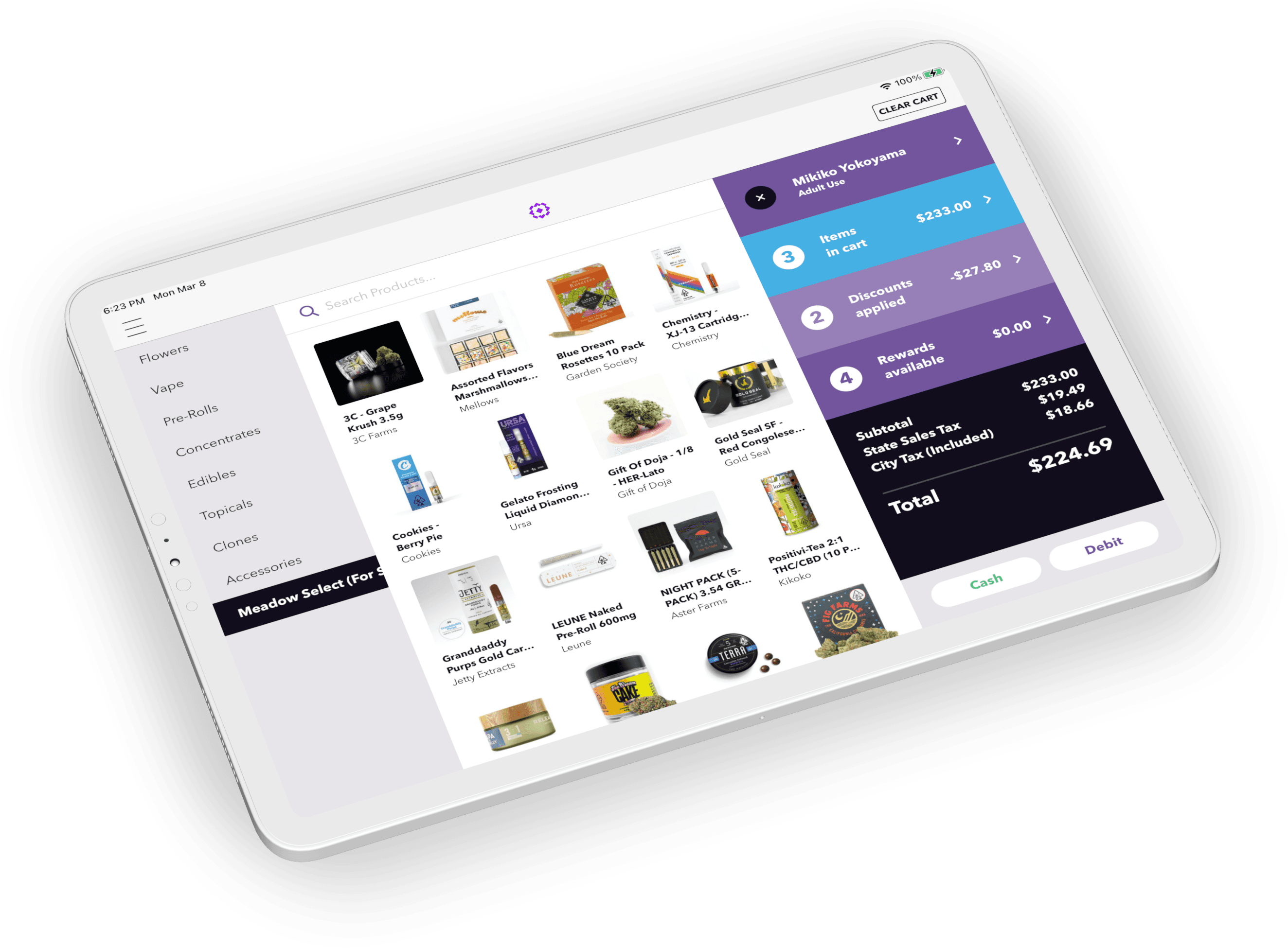

Cova and Flowhub are two established dispensary POS systems, and operators comparing them are really comparing three things: how each handles compliance, how each runs day to day, and what's still missing from each stack. Both have now shipped native e-commerce (Cova in late 2022, Flowhub in July 2025), which retires the oldest knock on both. What's left to weigh is delivery, which neither fully offers, and what the newer e-commerce products actually add to the monthly bill. This guide compares Cova vs Flowhub feature by feature for 2026, then shows where an all-in-one platform like Meadow closes the gap.
In This Post
- Why Your Dispensary Software Matters
- Key Features to Evaluate in Dispensary Software
- Cova Overview
- Flowhub Overview
- Comparing Cova and Flowhub
- The High Cost of Fragmented Systems
- Final Thoughts: Cova vs Flowhub
- Why Meadow Stands Out as a Better Alternative
- Common Questions

Why Your Dispensary Software Matters

A dispensary POS system is more than just a tool for sales. It ensures seamless inventory management, simplifies compliance, and enhances the customer experience by supporting features like online menus, loyalty programs, and delivery services. Choosing the wrong platform can lead to inefficiencies, compliance risks, and frustrated staff. In contrast, the right system empowers cannabis business owners and their teams to streamline operations, improve profitability, and scale effectively.
For the full evaluation framework, see How to Choose a Cannabis Dispensary POS System.
Key Features to Evaluate in Dispensary Software
When comparing Cova and Flowhub, it's worth evaluating them on the areas where they actually differ:
- Compliance: How well does it ensure adherence to state regulations?
- Inventory: Are counts accurate? Does it sync in real time across all menus?
- E-Commerce: Is the online store native, what does it include, and what does it cost on top of the POS?
- Delivery Tools: Does it offer integrated delivery tools?
- User Experience: Is the software easy to use, navigate, and train staff?
Cova POS Overview
Cova, headquartered in Denver, CO, and Vancouver, BC, is a dispensary software provider serving cannabis businesses across Canada and the U.S. It offers tools for compliance, sales, inventory tracking, and API integrations. Since late 2022, Cova has also offered Cova eCommerce, a plug-and-play online store that syncs with the POS in real time. Delivery remains the gap: Cova has no native delivery tools, so delivery operators rely on external solutions.
Cova's Key Features
- Compliance Tools: Automated track and trace compliance reporting.
- Inventory Management: Real-time tracking and inventory count importing.
- E-Commerce: Cova eCommerce, a native plug-and-play online store, priced at $149/month as of the writing of this article (included on enterprise plans, per Cova's site).
- Payment Processing: Supports cashless transactions through Cova Pay.
- Point-of-Sale: Supports in-store and order-ahead transactions, but no support for delivery.
Cova Strengths
- Regulatory Compliance: Tools to simplify adherence to state regulations.
- Inventory Management: Real-time inventory updates.
- Third-Party Integrations: Integrates with systems like Weedmaps, Leafly, and Alpine IQ.
Cova Weaknesses
- No Delivery Tools: Delivery services rely entirely on external solutions.
- E-Commerce Costs Extra and Keeps It Simple: Cova eCommerce is a separate monthly subscription (unless you're on an enterprise plan) and uses standardized layouts; Cova points retailers who need design freedom to third-party e-commerce partners instead.
- Issues with Speed & Reliability: Some users report long lag times and system crashes.
Flowhub POS Overview
Flowhub, founded in 2015, is another dispensary software platform focused on sales, compliance, and operations. Its mobile handheld scanner can be used for inventory management and customer check-in and verification. It also offers mobile analytics insights for quick anywhere access. In July 2025, Flowhub launched a POS-native e-commerce product with live inventory sync, a pricing and discount engine that matches the POS, and ACH pre-payment for online orders. Delivery tools remain limited, and several back-of-house workflows still lean on manual processes.
Flowhub's Key Features
- Nug: Handheld scanning for check-in and inventory management.
- E-Commerce: POS-native online ordering (launched July 2025) with live inventory sync and ACH pre-payment.
- Dispensary Analytics: Basic analytics dashboards available on mobile.
- Payment Processing: Cashless transactions with Flowhub Pay.
- Point-of-Sale: Supports in-store and order ahead transactions, with limited support for delivery.
Flowhub Strengths
- Mobile Scanning: Handheld mobile scanning for inventory and customer intake.
- User Interface: Clean UI that's easy to learn.
- Mobile Analytics: View analytics dashboards on mobile devices.
Flowhub Weaknesses
- E-Commerce Is Young: The native online store launched in July 2025, so it has a short track record; feature depth and integrations are still building out.
- Limited Delivery Tools: Delivery features are basic and don't include geofencing or automation.
- Manual Processes: Reporting, inventory reconciliation, and other tasks can be time-intensive and prone to errors.
Comparing Cova and Flowhub
Here is how the two platforms handle the five jobs above, with Meadow as the all-in-one reference point in each. Each section leads with the practical difference, then the detail.
E-Commerce
Both platforms now offer native e-commerce; the difference is what it costs and how proven it is.
- Cova: Cova eCommerce is native and syncs with the POS in real time, but it's a separate $149/month subscription (included on enterprise plans) with standardized layouts; Cova directs retailers who need advanced customization to third-party platforms, and many operators still run marketplace menus like Weedmaps or Leafly alongside it.
- Flowhub: Launched POS-native e-commerce in July 2025 with live inventory sync and ACH pre-payment. It's the newest piece of Flowhub's stack, so expect a shorter track record and a maturing feature set.
- Meadow: Built-in e-commerce with customizable online menus, included in the flat platform fee rather than sold as an add-on.
Delivery Management
Delivery is where the two platforms fall furthest behind, and where Meadow's advantage is most concrete.
- Cova: Does not support delivery. Operators must rely entirely on third-party software, which can be costly and inefficient.
- Flowhub: Provides limited delivery tools, with no support for dynamic delivery (e.g., Ice Cream Truck delivery model) or advanced features like route optimization and geofencing.
- Meadow: Native hub-and-spoke and ice cream truck (dynamic) delivery with geofencing, automated dispatch, and real-time ledger compliance, no separate delivery vendor required.
Compliance
All three sync with Metrc; the difference is how much manual work is left over.
- Cova: Known for strong compliance features, including automated reporting and Metrc syncing. However, users report occasional lag times that can disrupt workflows.
- Flowhub: Offers basic Metrc integration but requires more manual processes, such as inventory reconciliation, which increases the risk of errors and labor costs.
- Meadow: Every sale syncs to Metrc automatically in real time, including delivery via real-time ledger compliance, so reconciliation isn't a standing manual task.
Inventory Management
Real-time tracking is table stakes; reliability under load and reconciliation effort are what separate the three.
- Cova: Real-time inventory tracking is a highlight, but slow system speeds and reliability issues can cause delays during busy periods.
- Flowhub: Offers inventory management tools but relies on manual processes for reconciliation, leading to inefficiencies and inaccuracies.
- Meadow: Real-time, Metrc-synced inventory across every menu and channel, with cycle counts, forecasting, and order reminders built in.
User Experience
Front-of-house ease is a strength for both; the friction shows up in the back office.
- Cova: The platform's interface is generally user-friendly, but reports of lagging and occasional system crashes frustrate staff during peak hours.
- Flowhub: Features a clean and intuitive interface that is easy for staff to learn, but backend tasks, such as reporting, require more manual effort, which slows down operations.
- Meadow: One interface for front and back of house, designed to speed up transactions and cut training time, backed by 99.99% uptime since 2014.
The High Cost of Fragmented Systems
When dispensary software doesn't cover a job end to end, operators fill the gaps with add-on subscriptions and third-party tools: a delivery platform here, an upgraded e-commerce storefront there. This fragmented approach can result in:
- Increased Costs: Add-on products and third-party platforms come with subscription fees, transaction charges, and hidden costs.
- Operational Inefficiencies: Systems that don't integrate well lead to delays, errors, and redundant work.
- Staff Training Challenges: Employees must learn multiple platforms, creating a steep learning curve.
- Compromised Customer Experience: Poorly integrated systems can result in slower service and customer frustration.

The Long-Term Benefits of Choosing All-in-One
An all-in-one dispensary POS system simplifies operations and sets cannabis retailers up for long-term success. With everything under one roof, you can reduce costs, improve efficiency, and focus on delivering exceptional customer experiences. In an industry where convenience, reliability, and compliance are paramount, an all-in-one system is the smart choice for dispensary operators looking to thrive in a competitive market.
By prioritizing a solution that integrates essential features into a single platform, dispensaries can avoid the pitfalls of fragmented systems and fully leverage the potential and built-in efficiencies of their dispensary software.

Final Thoughts: Cova vs Flowhub
Cova and Flowhub both offer tools for sales, compliance, inventory management, and basic dispensary operations, and both have closed their oldest gap by shipping native e-commerce. The differences now sit in the details. On G2, operators report that they like Cova's real-time inventory updates, inventory counts, user interface, and support team, but don't like that it can be slow and experience lags, or even crash. Cova prioritizes compliance, and its e-commerce arrives as a separate subscription with standardized layouts rather than as part of the platform fee.
Flowhub also has some helpful tools like mobile scanning and analytics, and its POS-native e-commerce (launched July 2025) is a genuine step forward, though still early in its track record. On G2, operators like the interface's ease of use for budtenders, but report frustration with the manual effort required to access data and reports, along with dissatisfaction with support and having to work across separate front-end and back-end interfaces.
Where both systems still fall short is delivery. Cova doesn't offer it, Flowhub's tools are basic, and delivery is increasingly how dispensaries compete. Operators who deliver end up bolting on outside platforms, which brings back the extra costs, inefficiencies, and complicated staff workflows that all-in-one software is supposed to eliminate.
Why Meadow Stands Out as a Better Alternative
While Cova and Flowhub address basic dispensary needs, delivery gaps and add-on pricing expose the limitations of assembling a stack piece by piece. Meadow offers a complete, all-in-one dispensary software solution that combines point-of-sale, e-commerce, delivery, inventory management, CRM, marketing, loyalty, compliance, analytics, and payments, all within a single platform. By eliminating the need for multiple disconnected tools, Meadow simplifies operations, reduces inefficiencies, and helps dispensaries save time and money while delivering a seamless experience for both staff and customers.

Meadow's Standout Features:
- Omni-Channel Sales: Seamlessly manage sales across all channels, including in-store, pickup, delivery, floating sales, self-serve kiosks, consumption lounges, and events.
- E-Commerce & Menu Pro: Customizable online menus, online experiences and seamless checkout, included in the platform fee rather than sold as an add-on.
- Integrated Delivery: Best-in-class Hub and Spoke and ice cream truck (dynamic) delivery with geofencing, automated dispatch, and real-time ledger compliance.
- Inventory Management: Cycle counts for accurate inventory, real-time updates across all your menus, forecasting, and order reminders.
- Flexible Payment Processing: Supports multiple cashless payment providers.
- Proven Reliability: 99.99% uptime since 2014, including 100% uptime every 4/20.
- Transparent Pricing: No hidden fees or extra costs for critical features or integrations.
- Intuitive Design: Simple to use, speeding up transactions and reducing training time and operational errors.
- Exceptional Support: Fast, knowledgeable assistance from cannabis industry experts ensures easy onboarding and operations.
See What Dispensary Operators Are Saying
Meadow's G2 profile tells the same story its features do: nearly 100 reviews and consistently high marks for ease of use and reliability, categories where operators specifically flag Cova and Flowhub for lag times and manual workarounds. Real dispensary teams are behind those ratings, not marketing copy, and they're worth reading before you commit to a platform. See the reviews for yourself and judge whether Meadow's track record matches what you need from day one.
If you're ready for a trusted all-in-one system, Meadow might be the partner you need.
Common Questions
Is Cova or Flowhub better for dispensaries?
Both handle sales, compliance, inventory, and now native e-commerce. Cova is strong on compliance and inventory (with some speed complaints) and its e-commerce is an add-on subscription; Flowhub is strong on mobile scanning and a clean UI (with manual back-end work) and its e-commerce is new as of July 2025. Neither offers full delivery. For e-commerce and delivery in one system, consider an all-in-one like Meadow.
Do Cova and Flowhub have built-in e-commerce or delivery?
As of the writing of this article, both offer native e-commerce: Cova eCommerce (launched 2022, a separate monthly subscription with standardized layouts) and Flowhub's POS-native store (launched July 2025). Delivery is the remaining gap: Cova doesn't support it and Flowhub's tools are limited, so delivery operators still rely on third-party platforms.
Do Cova and Flowhub work with Metrc?
Yes, both report to Metrc in regulated states. The difference operators notice is how much manual reconciliation is left over, mismatches and adjustments still consume staff hours on fragmented stacks. Meadow syncs every sale to Metrc automatically, with real-time ledger compliance for delivery.
What's an all-in-one alternative to Cova and Flowhub?
Meadow combines POS, e-commerce, delivery, loyalty, compliance, and payments in one platform, with 99.99% uptime since 2014. See our roundup of Flowhub alternatives.
Ready for All-in-One? See Why Operators Choose Meadow.
If the comparison keeps coming back to what you'd still have to bolt on, that's the answer. Meadow has been building cannabis retail software since 2014 as Y Combinator's first cannabis startup, with delivery and e-commerce in the platform fee, not on a price list of add-ons.