
Switching your dispensary POS is worth it as soon as your current system costs you more in lost sales, support fees, and manual compliance work than a new one would cost to run. For most operators, that line got crossed a while ago. And the switch itself, handled by a provider who does migrations for a living, is usually an overnight cutover your customers never notice.
Most dispensary owners already know their POS is holding them back. They stay anyway, because switching feels risky and the current system "works well enough." That instinct is understandable. It is also the single most expensive assumption in cannabis retail.
This guide breaks down what staying on a mediocre POS actually costs you, what you gain by moving, and why a well-run migration is far less painful than the horror stories suggest.

In This Post
- The Real Cost of "Good Enough"
- What You Actually Gain by Switching
- "But Switching Is a Nightmare"
- When It's Time to Switch
- How to Switch in Five Steps
- Why Dispensaries Choose Meadow
- Switching Dispensary POS FAQs
The Real Cost of "Good Enough"
A POS that mostly works is quietly expensive. The costs just don't land on one invoice, so they're easy to ignore until they add up.
Slow checkouts are the clearest example. Before Off the Charts switched to Meadow, their previous system took up to three minutes to process a single order. That is an eternity when the line is out the door on 4/20.
With our previous POS, it took up to three minutes just to process a single order. When you're focused on delivering a great customer experience, that just doesn't cut it.
Marissa Molloy, Regional Manager, Off the Charts Northern California Stores
Multiply that across every register, every busy Saturday, and every peak day, and "good enough" quietly becomes lost revenue and lost regulars.
The rest of the bill adds up fast:
- Downtime when it matters most. An outage on 4/20 or a Friday night isn't an inconvenience. It's thousands in lost sales and a room full of frustrated customers who may not come back. This isn't hypothetical. Dutchie's POS went down nationwide on 4/20 in 2023 and again on 4/20 in 2024. In the 2024 outage, Curio Wellness in Maryland estimated roughly $80,000 in lost sales and nearly 1,000 canceled preorders (source: mjbizdaily.com), and Bloom Brothers CEO Nathan Girard put his store's losses at about $25,000 across the roughly four and a half hours the system was down (source: highlyobjective.com).
- Per-ticket support fees. Some platforms charge every time you need help, so problems you didn't cause become line items at the worst possible moment.
- Price creep. A rate that looked fine at signup climbs at renewal, and per-transaction fees scale against you as you grow. You pay more for the same software simply because you're succeeding. (Worth knowing what the market actually charges: Cannabis POS Pricing: What Dispensaries Actually Pay.)
- Compliance friction. Manual Metrc fixes and reconciliation eat hours your team doesn't have, and every manual step is a chance for an audit-triggering error.
- Lock-in. Long-term contracts keep you paying for a system you've already outgrown.
Add it up and "good enough" usually costs more than switching ever would. The question isn't whether you can afford to switch. It's whether you can afford not to.
💡 How Meadow handles this: Meadow charges one flat monthly fee with no per-transaction fees and no processor lock-in, so your software bill doesn't scale against your best months. See what dispensaries actually pay for cannabis POS →
What You Actually Gain by Switching
The right platform isn't a lateral move. It changes how the store runs.
- Reliability you can plan around. Meadow has maintained 99.99% uptime since 2014, including 100% uptime every 4/20, so the register never becomes the bottleneck on your biggest days.
- Pricing you can predict. One flat monthly fee, no per-transaction fees, no processor lock-in. The same rate whether you have a record month or a slow one.
- Compliance that runs itself. Metrc syncs automatically in the background instead of becoming a nightly chore.
- Support that doesn't nickel-and-dime. Free, fast help from a team of cannabis retail veterans, not a generic ticket queue and not a per-incident charge.
- Your data, your call. Easy export and no contract handcuffs, so you're never trapped again.
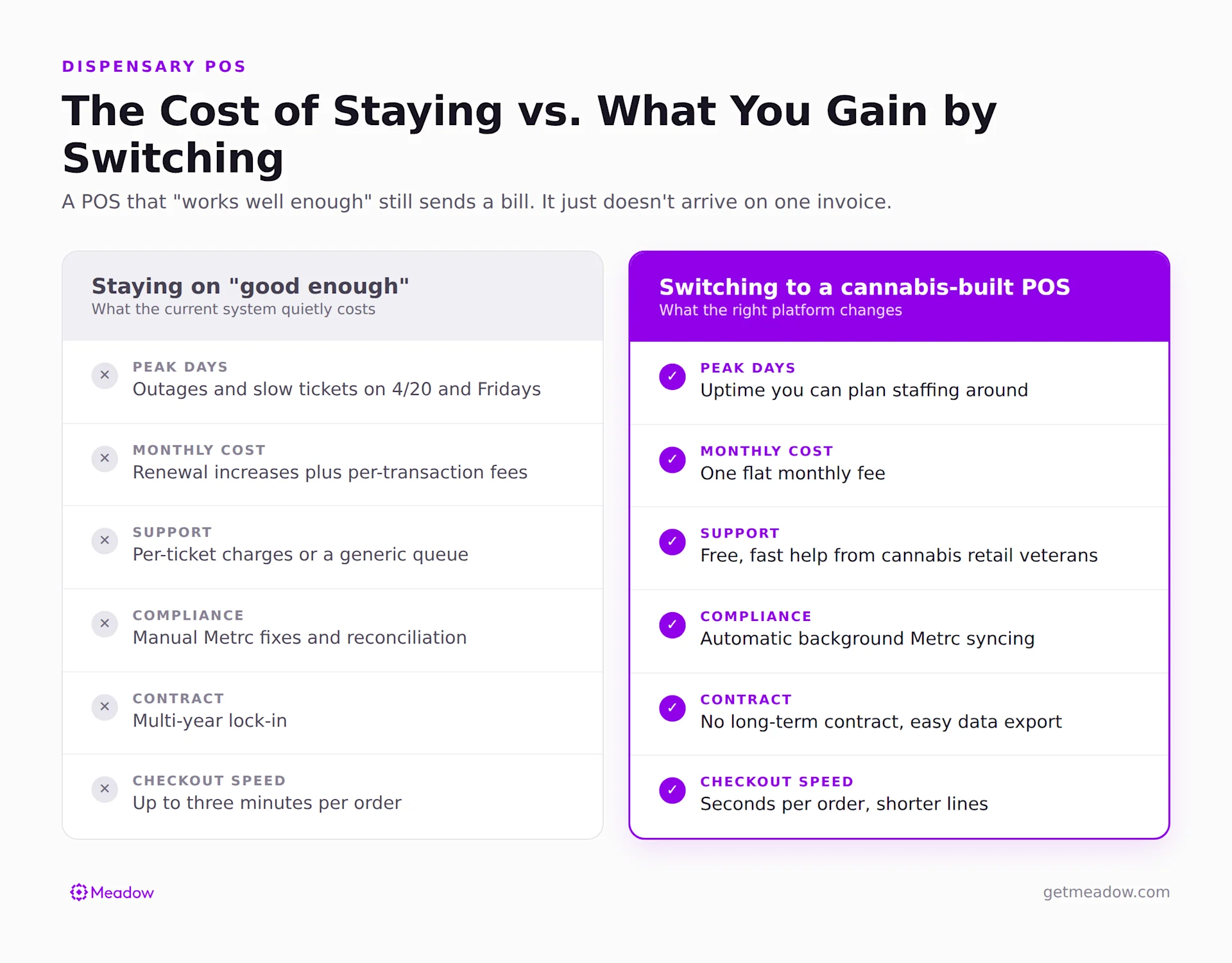
Here is the same trade laid out plainly.
Operators put it more bluntly than we would.
There isn't anything a competitor could come up with that would convince me to use any other system.
Verified Meadow customer review on G2
"But Switching Is a Nightmare"
This is the real blocker, so let's be direct. The fear is reasonable. The reality, done right, is a quiet overnight cutover that customers never notice.
When Xzibit's West Coast Collective unified on Meadow, they were running Meadow in one store and Treez in two others. Because the same team floated between locations, they got a true head-to-head test. The budtenders and managers who used both every day chose Meadow. Ahead of 4/20, Meadow's onboarding team ran a full Metrc audit and inventory cleanup, installed hardware the night before go-live, and transferred settings, inventory, and customer data before doors opened. Every budtender completed Meadow Mastery training in advance. Only two team members were needed for the migration itself. Customers experienced zero downtime. After the first launch, the second location migrated in just a few days.
That's what a good switch looks like:
- You're live in days, not months. A focused migration, not a drawn-out project that drags through your busy season.
- Your history comes with you. Products and customer data move over, so you don't start from zero.
- Metrc stays clean. A proper migration includes a full audit and cleanup, so your compliance records are accurate from day one.
- Someone does it with you. Hands-on migration support means you're not figuring it out alone at midnight.
Meadow has been a game-changer for our shop. It's streamlined our daily operations, made inventory a breeze, and the support team has been incredible. It's clear the system was built with dispensaries in mind, and it shows.
Jamie Wilson, Inventory Manager, West Coast Collective
The teams who dread switching most are usually the ones who've never seen a clean one.
💡 How Meadow handles this: Meadow's onboarding team plans the rollout, runs the Metrc and inventory cleanup, installs hardware overnight, and trains your staff before go-live. Read the full step-by-step migration playbook →
When It's Time to Switch
You don't need every box checked. One or two is usually enough:
- You lost sales to downtime or slow checkouts in the last year.
- Your bill went up without your service getting better.
- You're paying per support ticket.
- Compliance still eats hours every week.
- You're locked into a contract you regret.
- Your vendor is sunsetting a product you rely on. Dutchie has said it will support legacy Dutchie Plus, its headless ecommerce API, only through the end of 2026, which pushes dispensaries running custom storefronts onto a different architecture (source: useheady.com). As of the writing of this article, that timeline still stands. Confirm current status with your vendor before you plan around it.
If two or more of those are true, the cheapest thing you can do is start comparing. Operator-reviewed roundups are a fast way in: Best Dutchie Alternatives, Best Treez Alternatives, Best Flowhub Alternatives, and Best BioTrack Alternatives.
How to Switch in Five Steps
Here is the short version. For the full playbook, including how to time the cutover and what to ask every vendor, see How to Switch Dispensary POS Without Losing a Day of Sales.
- Choose the right partner. Pick a provider who knows cannabis retail and supports your growth and compliance needs. Our complete guide to choosing a cannabis dispensary POS system walks through the features that matter and the questions to ask.
- Compare on what matters. Uptime, total cost of ownership, and support model, not just the feature checklist. Cannabis POS pricing is where the real differences hide.
- Plan the cutover. Line up a full Metrc audit and inventory cleanup, and pick a slow window well clear of 4/20 and major holidays.
- Migrate overnight. Hardware, data, and settings move outside business hours, so there's no downtime.
- Launch with confidence. Train staff ahead of time and keep support on standby for day one.
Why Dispensaries Choose Meadow
- 99.99% uptime since 2014, including 100% uptime every 4/20
- Real-time Metrc syncing and audit-ready logs
- In-store, delivery, pickup, kiosk, and lounge sales in one system
- Free, fast support from cannabis retail experts
- Hands-on, zero-downtime migration. Your data comes with you, and there's no long-term contract.
You don't have to live with a POS that fights you. Pick your date and make the move. More on why operators choose Meadow.
Switching Dispensary POS FAQs
How long does it take to switch dispensary POS?
With a focused, provider-led migration it's typically days, not months. Hardware and data move overnight, so there's no downtime during business hours. Timelines stretch mainly when product data is messy or staff training hasn't started.
Will I lose my product catalog and customer data?
No. A proper migration moves your products and customer data so you don't start over. Confirm before you sign that your new provider handles the data transfer and that your current provider allows a clean export.
What happens to Metrc during the switch?
A good migration includes a full Metrc audit and inventory cleanup, so your compliance records are accurate from day one. That cleanup is often the most valuable part of switching, because it resolves discrepancies that have been quietly accumulating.
Is there downtime when I switch dispensary POS?
Done right, no. Meadow installs hardware and transfers data the night before go-live, so customers never notice.
Isn't switching too risky during my busy season?
Plan the cutover for a slow window and avoid 4/20 and major holidays. With overnight migration and advance staff training, the disruption is minimal, and the cost of pushing a failing system through peak season is usually higher.
How much does it cost to switch dispensary POS?
The switch itself is usually the smaller number. Compare total cost of ownership over 12 months, including per-transaction fees, support charges, hardware, and renewal increases, against what you're losing now to downtime, slow tickets, and manual compliance work. Cannabis POS Pricing: What Dispensaries Actually Pay breaks down the models.
Ready to Switch? See What a Clean Move Actually Looks Like
Meadow has been building cannabis retail software since 2014, when we became Y Combinator's first cannabis startup, and we now support operators across six states. Tell us what your current system is costing you, and we'll walk you through exactly how the move would work for your shop.