
Cannabis delivery is the licensed retail sale of cannabis goods fulfilled at a customer's address rather than inside a store. For a licensed retailer, delivery is a separate operating model with its own compliance requirements, vehicle rules, staffing needs, and margin math.
That distinction is where most delivery programs go wrong. Operators launch delivery as a feature, then discover it behaves like a second business.
This guide covers the three delivery models operators actually run, how to choose between them, the math that determines whether delivery makes money, the compliance variables that change from state to state, how to staff a delivery team, and what your software has to do to hold it together.
In This Post
- The Three Cannabis Delivery Models
- How to Choose Your Delivery Model
- The Unit Economics of Cannabis Delivery
- Cannabis Delivery Compliance: The Variables That Change by State
- Delivery Rules by State
- Building Your Delivery Team
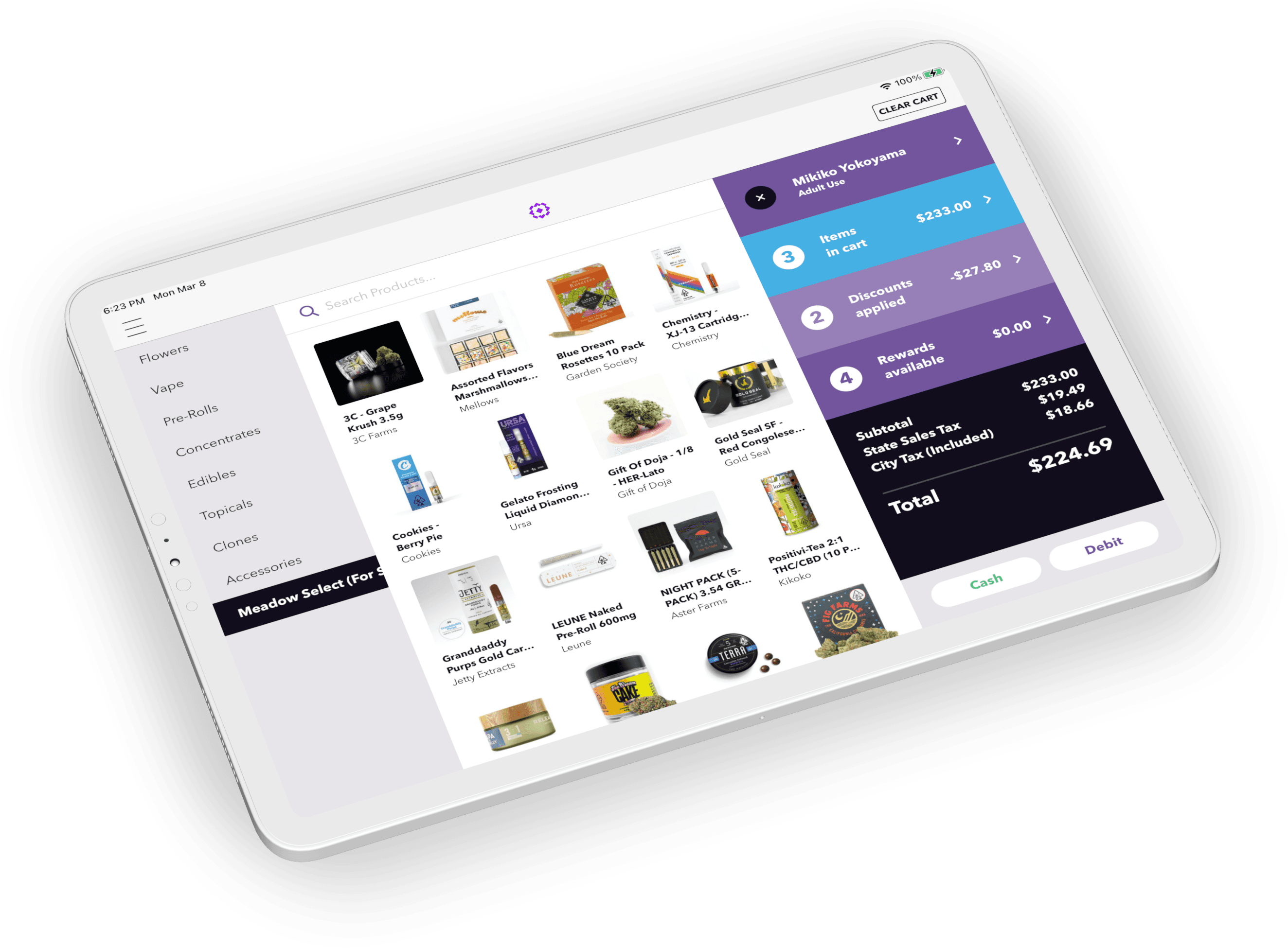
- The Cannabis Delivery Tech Stack
- Common Cannabis Delivery Mistakes
- How to Get Started
- Common Questions

The Three Cannabis Delivery Models
Licensed cannabis delivery runs on three models. They differ in where inventory physically sits at the moment a customer places an order, and that single difference drives everything else: speed, catalog size, staffing, and compliance workload.
Hub and Spoke
Inventory stays at a licensed premises. Orders arrive, staff pick and pack them, and a driver runs a route out and back.
- Customers shop the full catalog, because the full catalog is on the shelf.
- Delivery windows are longer, since every order starts at the hub.
- Compliance is more straightforward: product leaves the building already sold and assigned to a specific customer.
- Route efficiency depends on batching. One order per trip is a margin problem.
This is the default model, sometimes called standard or pizza-style delivery, and it is where most retailers should start.

Dynamic Delivery (Ice Cream Truck)
The vehicle itself operates as an inventory location. It leaves the premises pre-packed with unsold product and serves a geofenced zone, fulfilling orders from what is already on board.
- Delivery times drop sharply, because the product is already near the customer.
- The catalog is limited to what fits in the vehicle, so product mix selection becomes a real merchandising decision.
- Each vehicle needs its own live menu that reflects what is physically on board right now.
- Compliance is heavier. Unsold inventory in a vehicle triggers additional reporting obligations in some states, including California's delivery ledger requirement.
Meadow was the first cannabis software company to launch this model in California, and TechCrunch covered it in November 2021. In that reporting, Cannable's Director of Strategy and Technology, David Tuel, described the shift plainly: "Now we're able to put inventory in a car trunk." TechCrunch reported that Dynamic Delivery cut Cannable's delivery times from hours to roughly 20 minutes. Read the TechCrunch story
For the full operational walkthrough, see How to Launch a Mobile Dispensary: Step-by-Step Guide to Ice Cream Truck Delivery. Mobile Cannabis Dispensaries: The Ice Cream Truck Delivery Model then covers the three places the model earns its keep: dispatch labor, zone expansion, and onsite event sales.
Hybrid
Both models running at once. The customer chooses at checkout: fast delivery from a nearby vehicle's limited menu, or a scheduled window with the full catalog.
- Captures both the impulse purchase and the considered basket.
- Highest operational complexity. You are running two fulfillment paths against one inventory system.
- Requires software that can present two experiences on one menu without confusing the customer or double-committing a unit of inventory.
Hybrid is where mature delivery operations tend to end up, once one model is running cleanly.
How to Choose Your Delivery Model
Four inputs decide this:
Customer density. Dynamic Delivery earns its keep when a vehicle can complete several drops without leaving its zone. In a sparse territory, a pre-packed vehicle is just expensive inventory sitting in a parking lot. Map your last 90 days of delivery orders by zip code before you commit.

Catalog depth. If your differentiation is selection, and customers routinely buy across categories, hub and spoke protects the basket. If your top 40 SKUs drive most of your delivery revenue, a vehicle can carry them.
Zone footprint. Delivery zones are a design decision, not a map of everywhere you are allowed to go. A zone drawn too wide destroys route density and delivery time promises.
Staffing reality. Dynamic Delivery moves labor from the pack station to the road. Hub and spoke concentrates it in the building. Whichever model you pick, staff the constraint.
The model you can run is also constrained by your state. Vehicle inventory caps decide whether Dynamic Delivery is viable at all, which is covered in Delivery Rules by State below.
The Unit Economics of Cannabis Delivery
Delivery profitability comes down to one question: what does a completed delivery cost you, and what does it contribute?
We are not publishing industry benchmark numbers here, because delivery costs swing too widely by market, wage structure, and zone geography for a national average to be useful. Run your own numbers. Here is the math.
The Cost Per Delivery Formula
Cost per delivery = (driver labor + vehicle costs + insurance + dispatch labor) divided by completed deliveries in the same period.
Include vehicle costs honestly: fuel, maintenance, depreciation or lease, and the alarm and security requirements your state imposes. Include dispatch labor even when it is a manager doing it between other tasks, because that time is real and it scales with volume.
Contribution Per Delivery
Contribution = (average order value × gross margin) + delivery fee, minus cost per delivery.
If that number is negative, delivery is subsidized by your storefront. Some operators choose that deliberately as a customer acquisition cost. Most do it by accident.
The Levers That Actually Move Margin
- Drops per hour. The single biggest lever. Tighter zones and better batching beat almost every other optimization.
- Average order value. Order minimums, curated bundles, and cart-level merchandising raise it. Discounting lowers it, which is why delivery discounting needs its own discipline. See Smarter Ways to Discount: Building a Profitable Dispensary Discount Strategy.
- Fee structure versus minimum. A delivery fee and an order minimum solve the same problem differently. Test which one your customers accept.
- Failed and returned deliveries. Every failed drop costs a full delivery and creates a compliance event when unsold product returns to the premises.
- Vehicle utilization. A vehicle idle half its shift carries the same fixed cost as one running full.
Most operators cannot answer "what did a delivery cost us last month?" because the data lives in three systems that do not reconcile: the POS, the dispatch tool, and a payroll export.
If you are running delivery without a per-delivery cost you trust, that is the first thing worth fixing. Meadow reports delivery sales, driver activity, and inventory movement from one system, so cost per drop is a report instead of a reconstruction. Book a Call to Learn More
Cannabis Delivery Compliance: The Variables That Change by State
Delivery rules are set state by state, and they change more often than storefront rules do. Rather than a comparison chart that will be wrong within a quarter, here are the six variables to confirm with your regulator before you launch, and again whenever you enter a new market. Delivery Rules by State points you to the guide for your market.
Vehicle Inventory Limits
Most delivery states cap the retail value of cannabis goods a vehicle may carry, and may distinguish between pre-sold orders and unsold inventory. This cap determines whether Dynamic Delivery is even viable in your market.
Manifests, Ledgers, and Track and Trace Timing
Confirm what document must exist before the vehicle leaves the premises, and how quickly sales and inventory changes must be reported to your state's track and trace system. In California, delivery operators must create a Metrc inventory delivery ledger before a vehicle can legally leave the licensed premises carrying unsold or pre-sold inventory, a requirement that took effect April 1, 2023. See Important Regulatory Update: New California Cannabis Delivery Ledger.

Driver and Vehicle Requirements
Expect requirements covering driver licensing and background checks, employee badging, vehicle alarm systems, GPS tracking, product storage and concealment, and restrictions on vehicle markings. California collects much of this at the application stage through the Department of Cannabis Control's Delivery Procedures form.
Where You Can Actually Deliver
Statewide legality does not mean statewide access. Municipalities frequently restrict or ban delivery independently of the state, and some states have licensing set-asides that affect who may deliver in a given area. Verify jurisdiction by jurisdiction, not state by state.
Order Limits and Customer Verification
Confirm daily purchase limits, how they are enforced at the door rather than at the cart, and the ID verification standard for a delivery handoff. Verification at the doorstep is where delivery compliance most often fails in practice.

Cash Handling and Payment
Delivery concentrates cash risk in a vehicle. Confirm your state's requirements for secure cash handling in transit, then decide whether cashless options reduce your exposure. See How to Accept Cashless Payments at Your Dispensary.
Delivery Rules by State
The fastest way to work through the six variables above is to start with your own market. We have published in-depth delivery guides for four states:
- California. How to Start a Cannabis Delivery Service in California is worth reading regardless of where you operate. California is the most mature delivery market in the country and its rules have been revised repeatedly as the program matured, which makes it the most instructive one to study. Covers the DCC licensing path, the inspection process, and zone setup.
- New York. How to Start a Cannabis Delivery Service in New York covers OCM licensing and works through the dynamic delivery model in detail, including how express menus and vehicle-level inventory operate under New York's rules.
- New Jersey. How to Start a Cannabis Delivery Service in New Jersey covers CRC licensing, the final inspection, and how New Jersey's municipal rules interact with delivery access, which is the sharpest version of the jurisdiction question above.
- Michigan. How to Start a Cannabis Delivery Service in Michigan covers CRA licensing, Metrc reporting, and where Michigan's administrative rules stand for delivery operators.
Operating in Massachusetts or Minnesota? Start with the six variables above and confirm each one directly with your state regulator. Newer markets tend to revise delivery rules fastest, so a guide is worth less there than a current conversation with the agency.
Confirm every rule in this section against your primary state regulator before relying on it. Delivery regulations are among the fastest-moving rules in cannabis retail.
Building Your Delivery Team
Your drivers are the only employees who meet customers alone, off-premises, holding both product and cash. Staff accordingly.
Hiring Drivers
Look for clean driving records, valid licensing, and comfort with process. Background checks are required in most delivery states and are worth doing thoroughly regardless. The trait that matters most is consistency under mild chaos: a wrong address, a customer whose ID does not match the order, a zone that closes early.

Training
Every delivery employee should be trained on ID verification and duplicate-order detection, secure in-vehicle product handling, the handoff script, what to do when a delivery fails, and how to document the return of unsold product. Delivery training is not a shortened version of budtender training. The failure modes are different.
The Dispatcher
Someone owns the board. In a small operation that is a manager between other duties, which works until volume arrives. Auto-dispatching removes the routine assignment decisions, which is what lets one person cover more volume without a second hire.
The Cannabis Delivery Tech Stack
Delivery software has to do six jobs. Operators usually discover the gaps in job four or five, after launch.
Nice Guys Delivery has run on Meadow since 2015:
Meadow is the best delivery system out there with a team that's incredibly dialed into how a delivery service really operates. We've been with Meadow since 2015 and have grown our customer base exponentially. Meadow has been with us every step of the way with a system that takes care of all the regulations, taxes, logistics, and compliance, so I can focus on my customers and growth.
Monica Gray, COO, Nice Guys Delivery
Online Menu and Ordering
Delivery is an e-commerce business with a car attached. The menu must be mobile-first, reflect real availability, handle delivery zone logic and fees at checkout, and let the customer choose a fulfillment experience when you run hybrid. See How to Build a Seamless Cannabis Ecommerce Experience.
Real-Time Inventory Sync
Inventory has to be accurate across the storefront, the online menu, every vehicle, and your track and trace system simultaneously. Overselling a unit that is physically in a vehicle across town is worse than overselling on the floor.

Dispatch and Routing
Assignment, routing, live tracking, and reassignment when a route breaks. Automatic dispatch to the nearest available driver is what makes zone-based delivery scale past a handful of vehicles.
The Driver App
Drivers need order details, ID verification, navigation, status updates, and proof of delivery in one place. If drivers are switching between three apps and a text thread, your data will not reconcile at the end of the shift.
Compliance Reporting
Sales and inventory movement should report to your state system automatically. Manual CSV uploads are the largest single source of audit risk in delivery, because the reporting volume is higher and the timing windows are tighter than storefront retail.
Customer Communication
Order confirmations, driver-en-route notifications, and delivery confirmations reduce failed drops. Location-based messaging turns an underused vehicle into demand.
If you are evaluating platforms, Meadow vs. BLAZE: Choosing the Best Cannabis Delivery Software walks through the questions worth asking, and Meadow's cannabis delivery software covers how the pieces fit together.
Common Cannabis Delivery Mistakes
- Drawing zones too wide. Coverage feels like growth. It destroys route density and blows delivery time promises.
- Launching Dynamic Delivery before hub and spoke is clean. The mobile model amplifies whatever inventory discipline you already have, in both directions.
- Treating delivery as a storefront extension in reporting. If delivery revenue is not separated from in-store, you cannot see its margin, and you will keep funding it blindly.
- Under-training on the doorstep handoff. ID verification at the door is the compliance moment with the least supervision and the highest exposure.
- Ignoring failed deliveries. They cost a full delivery, create a return-to-premises compliance event, and usually signal a fixable data problem.
- Running dispatch in a separate tool. Every system boundary is a place where the numbers stop matching.
How to Get Started
- Confirm your license permits delivery at both the state and local level, and identify what you still need to file. Your state's delivery guide is the fastest way to see what that involves.
- Pull 90 days of order data and map demand by zip code. Let that pick your model and draw your zones.
- Build your compliance checklist from the six variables above, verified against your primary regulator.
- Choose your software before you buy vehicles. The platform determines which models you can actually run.
- Launch one zone. Measure cost per delivery and drops per hour for a full month before expanding.
- Then scale. Add vehicles or zones against the numbers, not against enthusiasm.
Common Questions
Do you need a separate license for cannabis delivery?
It depends on your state and your existing license type. Some states include delivery privileges within a retail license, others require a separate delivery license or endorsement, and local jurisdictions often require their own permit on top of the state's. Confirm both levels before you plan a launch date. The state guides in Delivery Rules by State walk through the licensing path for California, New York, New Jersey, and Michigan.
What is the difference between hub and spoke and dynamic delivery?
In hub and spoke delivery, inventory stays at a licensed premises and drivers deliver pre-packed orders out and back. In dynamic delivery, the vehicle carries unsold inventory and operates as its own inventory location, fulfilling orders placed within its zone. Hub and spoke offers the full catalog; dynamic delivery offers speed.
How much inventory can a cannabis delivery vehicle carry?
Most delivery states cap the retail value of cannabis goods in a vehicle, and the cap often differs for pre-sold versus unsold product. Confirm the current figure with your state regulator, because these limits have been revised in several markets. Your state's delivery guide covers the current rules for that market.
Is cannabis delivery profitable for dispensaries?
It can be, but profitability depends almost entirely on route density and average order value rather than on delivery volume alone. Calculate cost per completed delivery and compare it to contribution per delivery. Delivery costs sit in payroll and vehicle expenses rather than in their own line item, which is how a loss goes unnoticed. For the Dynamic Delivery case specifically, see Mobile Cannabis Dispensaries: The Ice Cream Truck Delivery Model.
Can you deliver cannabis into a city that has banned dispensaries?
Sometimes, depending on the state. Delivery access and storefront licensing are governed separately in some states, which is why delivery can reach customers in jurisdictions with no retail location. This is one of the most jurisdiction-specific questions in cannabis delivery, so verify locally. New Jersey is a useful example: our New Jersey guide covers how a municipality can prohibit a delivery business from siting there without preventing deliveries to consumers inside its borders.
What software do you need to run cannabis delivery?
At minimum: an integrated online menu, real-time inventory sync across all sales channels, dispatch and routing, a driver-facing mobile app, automated track and trace reporting, and customer notifications. Running these as separate tools is workable at low volume and becomes the main source of reporting and compliance problems as you scale.
Launching or Rebuilding Delivery? Talk to the Team That Has Been Doing This Since 2014.
Meadow has powered licensed cannabis delivery since Y Combinator backed us as its first cannabis startup in 2014, and we built the first Dynamic Delivery platform in California. Whether you are filing for your first delivery permit or trying to figure out why your delivery margin is thinner than your storefront's, we can walk through your operation with you.
More Resources for Dispensaries
- How to Start a Cannabis Delivery Service in California
- How to Start a Cannabis Delivery Service in New York
- How to Start a Cannabis Delivery Service in New Jersey
- How to Start a Cannabis Delivery Service in Michigan
- How to Launch a Mobile Dispensary: Step by Step Guide to Ice Cream Truck Delivery
- Mobile Cannabis Dispensaries: The Ice Cream Truck Delivery Model
- California Cannabis Delivery Ledger Requirements: A Compliance Guide
- Meadow vs. BLAZE: Choosing the Best Cannabis Delivery Software