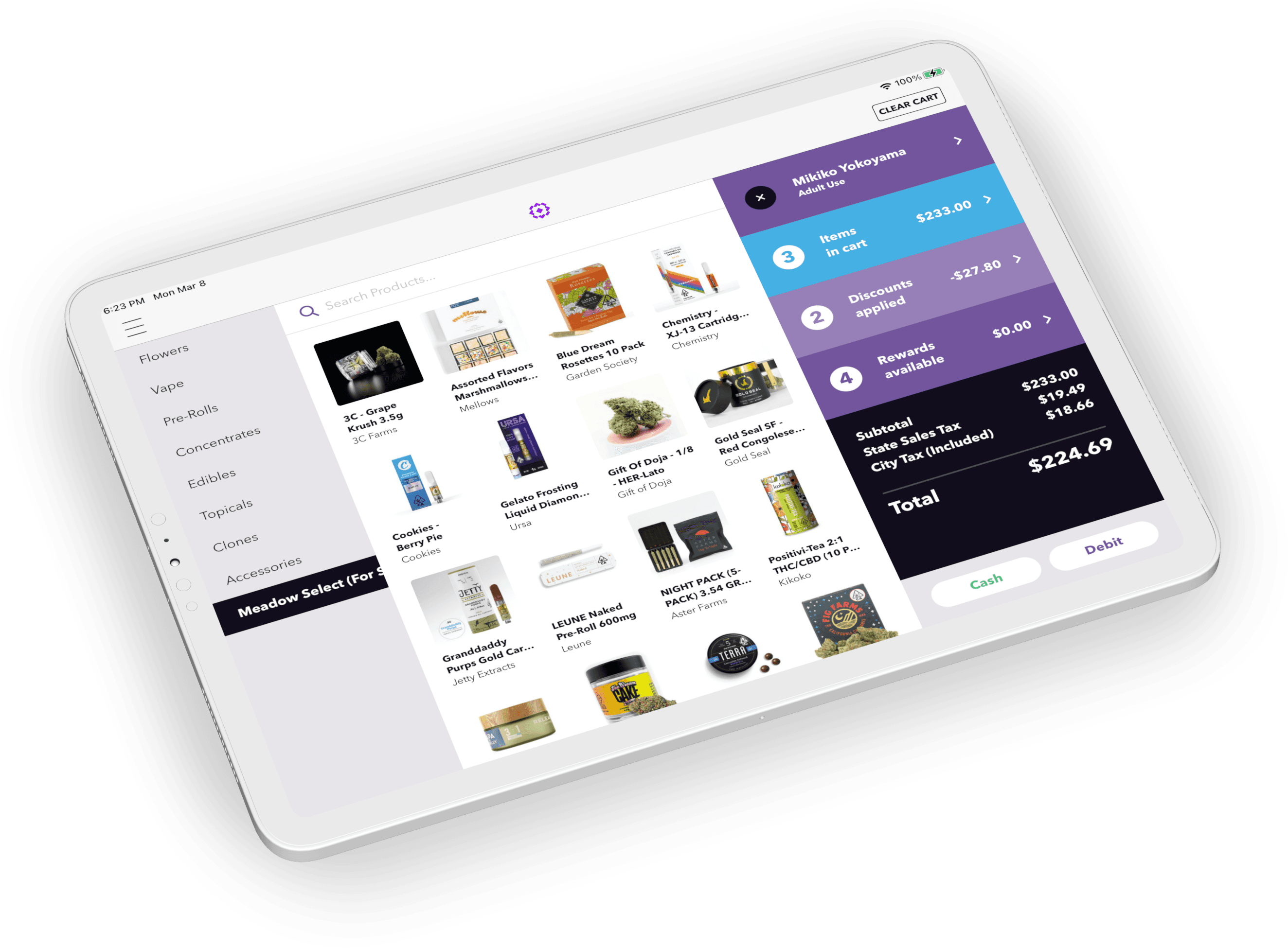

Dispensaries accept cashless payments on two compliant rails: PIN debit at the counter and ACH bank transfers for online, pickup, and delivery orders. Credit cards are not an option, because the major card networks prohibit cannabis transactions regardless of state law or federal scheduling.
That constraint pushes operators toward a patchwork of debit, ACH, and cash workarounds. Some are compliant. Some can get your merchant account or bank relationship shut down overnight. Choosing the wrong setup can mean frozen funds, surprise fees, or a compliance problem you didn't see coming.
This guide breaks down how cannabis payment processing actually works, the options on the table, what each one costs, and the traps to avoid, so you can accept digital payments compliantly while increasing total spend and sales.
In This Post
- Why Can't Dispensaries Accept Credit Cards?
- Why Cashless Payments Matter for Cannabis Retail
- Cashless Payment Options for Dispensaries, Compared
- ACH: Secure Online and Pay-by-Phone Payments
- Debit: Fast, Familiar, Compliant Transactions
- What About Cashless ATMs?
- Do Dispensaries Take Apple Pay?
- Can Dispensaries Use Tap to Pay?
- What Is Dual Pricing?
- Compliance Traps to Avoid
- Why Integrated Payments Matter
- Getting Started with Cashless Payments
- Common Questions
Key Takeaways
- Dispensaries cannot accept Visa, Mastercard, or American Express for cannabis purchases, because those networks prohibit cannabis transactions at the network level, separate from any state law.
- The two compliant cashless rails are PIN debit for in-store sales and ACH bank transfers for online, pickup, and delivery orders. Both operate outside the credit card networks.
- The April 2026 federal order moved state-licensed medical cannabis to Schedule III, but recreational cannabis remains Schedule I and the card networks have not changed their cannabis policies in response.
- Cashless ATM arrangements carry the most regulatory exposure of the common options, because card network rules prohibit processing point-of-sale purchases as ATM withdrawals.
- Payments that sync back to the POS reconcile automatically, which is what keeps compliance reporting accurate and your records bank-friendly at close.

Why Can't Dispensaries Accept Credit Cards?
No specific law outright bans credit card transactions for cannabis. Instead, major card networks like Visa, Mastercard, and American Express have policies prohibiting them because cannabis remains a controlled substance at the federal level. That single fact drives every complication downstream: limited accepted methods, heavy compliance scrutiny, higher fees, and a market full of gray-area "solutions."

Dispensaries attempting to process credit card payments must often misrepresent the nature of their business, a violation of payment processor agreements that can result in fines, account termination, and serious legal consequences.
And no, rescheduling didn't fix this. The federal order that took effect in April 2026 moved FDA-approved cannabis products and state-licensed medical cannabis to Schedule III. It did not make cannabis federally legal, and it did not change card network rules. Recreational cannabis remains Schedule I.
The industry now has a federal read on this question rather than just an assumption. In a report publicly released on September 8, 2026, the U.S. Government Accountability Office found that accepting customer payments remains difficult for cannabis businesses largely because two major credit card companies prohibit cannabis purchases, and that an organization representing the networks said those policies would not change short of federal legalization (GAO-26-107498, "Banking Services: Cannabis Businesses Face Access Challenges"). The same report documented account closures, high account fees, and high loan interest rates as ongoing realities for licensed operators.
A broader proceeding is still open. As of the writing of this article, the DEA held an expedited administrative hearing from June 29 through July 15, 2026, on whether cannabis as a whole should move from Schedule I to Schedule III, and the presiding judge's written recommendation has not yet been issued. Nothing about that proceeding changes what you can accept at the counter today. Confirm current federal status before making a payments decision that depends on it.
The safe path is a compliant payment method that integrates cleanly with your POS and your banking setup, so every transaction reconciles and nothing raises a flag. See our full breakdown of what dispensaries actually pay for POS and payment processing before you commit to a setup.
Why Cashless Payments Matter for Cannabis Retail
Cashless payments raise average ticket size, cut cash-handling risk, and speed up the line, and all three matter more at a dispensary than at a general retailer because cash here carries extra compliance and security weight. Cash-only checkout is still common across the cannabis industry, and it brings handling, transport, and shrink costs that cashless options reduce.
- Bigger sales: Customers are more likely to spend more when they're not limited by the cash in their wallet.
- Tipping for employees: Cashless transactions make it easier for budtenders and drivers to receive tips, increasing job satisfaction and earnings.
- Higher order completion: Customers who pay online in advance with ACH are more likely to complete pickup and delivery orders, reducing no-shows.
- Faster, more secure transactions: Cash handling slows down service and creates theft risks. Cashless options provide a smoother experience for both dispensaries and customers.
- Easier accounting and reconciliation: Digital payments reduce errors, improve record-keeping, and make compliance reporting more straightforward.

Cashless Payment Options for Dispensaries, Compared
With credit card networks off-limits, dispensaries have three cashless options in common use, and they differ most in where they clear and how much regulatory exposure they carry.
| Method | How it clears | Typical cost | Best channel | Compliance exposure |
|---|---|---|---|---|
| ACH / Pay-by-Phone | Bank to bank, outside the card networks | Roughly 1% to 1.5% per transaction | Online, pickup, delivery, in-store via QR code | Lowest |
| PIN debit | Debit networks, PIN authorized | Roughly 2.5% to 4% plus about $0.50 per transaction | In-store counter | Low |
| Cashless ATM | Processed as an ATM withdrawal | Roughly $3 to $5 per transaction, paid by the customer | In-store counter | Highest |
| Cash | Not applicable | Handling, transport, and shrink costs | All | Low, but highest security burden |
Cost ranges are industry benchmarks as of the writing of this article, not Meadow's pricing. See our cannabis POS pricing guide for the full breakdown and how to calculate your real total.
Each method has unique benefits. Let's break them down.
ACH: Secure Online and Pay-by-Phone Payments
ACH payments, also called Pay-by-Phone for in-store purchases, let customers transfer funds directly from their bank account for online orders, in-store transactions, and delivery, without cash, a debit card swipe, or additional hardware.
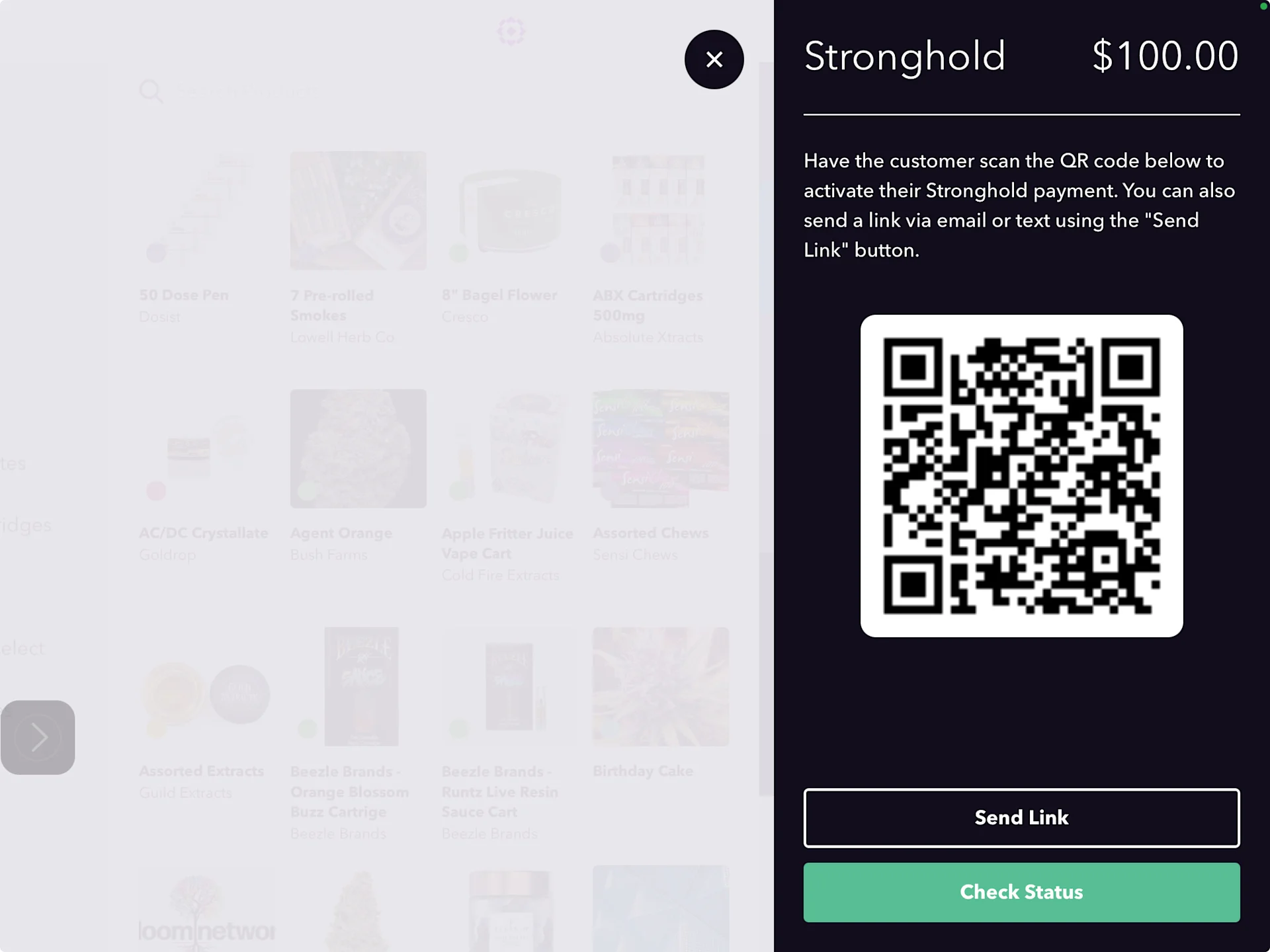
Meadow's Stronghold integration supports secure payments for dispensaries: customers pay by phone with a QR code or secure text-to-pay link, no app required, for in-store, online, pickup, and delivery orders. Learn more about Meadow's ecommerce platform, delivery software, and other integrations.
How ACH Works for Online and In-Store Payments
- The customer links their bank account via a secure online portal.
- They authorize a payment from their checking account when purchasing online, in-store, or via delivery.
- Funds transfer electronically from the customer's account to the dispensary's account.
- Once approved, the transaction is finalized.
Why ACH Is a Reliable and Easy Cashless Payment Option
Accept Payments Anywhere: Customers can pay online, in-store, or for delivery using ACH, making transactions seamless across all sales channels.
Safe and Secure: Direct bank transfers reduce fraud risk and cash handling.
Compliant: ACH transactions do not rely on credit card networks and are fully legal for cannabis sales.
Fast and Simple Setup: No new terminals or hardware. Customers scan a QR code, link their bank, and complete checkout.
Encourages Tipping: Customers can add gratuity during the payment process, which can be automatically assigned to the budtender or driver serving them.
No Chargebacks: Unlike credit cards, ACH payments aren't subject to chargebacks, since chargebacks are a card-network mechanism. ACH transactions can still be reversed under standard bank return rules, but that's a narrower, less common risk than the chargeback disputes credit card processors deal with regularly.
Debit: Fast, Familiar, Compliant Transactions
PIN debit is the fastest compliant way to take a cashless payment at the counter, and the one customers need no explanation for.
What Is PIN Debit?
Unlike credit card transactions, PIN debit lets customers pay directly from their debit card, entering their Personal Identification Number to authorize the payment, the same way they would at a grocery store or gas station.
How Debit Works in Dispensaries
- The customer swipes or inserts their debit card at checkout.
- They enter their PIN to approve the transaction.
- The payment is processed directly from their bank account.
- Funds are transferred to the dispensary's bank account, with no middleman.
Why Debit Is Ideal for Cannabis Retail
- Reliable: Uses the same banking infrastructure as standard debit purchases.
- Familiar and Easy for Customers: Customers are already used to paying with debit, making this a seamless and intuitive payment option.
- Fast Fund Transfers: Money goes to your account without workarounds or holding periods.
- Bigger Transactions: Customers spend more with debit than cash.
Debit provides a simple, fast, and trusted way for dispensaries to process cashless transactions while eliminating the risks of handling cash.
What About Cashless ATMs?
A cashless ATM, sometimes called a reverse ATM, rounds a purchase up to the nearest dollar and processes it like an ATM withdrawal, with the difference returned as change. It became common in cannabis retail because it works with the cards customers already carry.
The tradeoff is regulatory exposure. Card network policies prohibit processing point-of-sale purchases as ATM withdrawals, and enforcement has increased in recent years, with some providers exiting the space as a result. That makes cashless ATM less ideal than ACH and PIN debit, which do not route a cannabis purchase through the card networks at all.
If your dispensary uses a cashless ATM, know how your provider processes and codes transactions, and have a backup payment method in place so a sudden provider change doesn't interrupt sales.
Do Dispensaries Take Apple Pay?
Generally, no. Apple Pay and other card-based mobile wallets run on the major card networks, and those networks prohibit cannabis transactions, the same reason dispensaries can't accept credit cards. For a cashless checkout that works, use PIN debit at the counter, or ACH for online, pickup, and delivery orders.
Can Dispensaries Use Tap to Pay?
Yes, with a debit card. On Meadow's Dejavoo debit terminals, customers can insert or tap their debit card to pay. Tap to pay through a mobile wallet like Apple Pay or Google Pay is different: wallets typically run on the major card networks, which prohibit cannabis transactions, so they generally aren't an option. Learn more about Meadow's point of sale and compliant PIN debit.
What Is Dual Pricing?
Dual pricing offers one price for cash and another for electronic payment, reflecting the cost of processing. Done correctly and disclosed clearly to the customer, it's a common way operators manage payment costs. The rules and network policies around it vary by method and state and change over time, so confirm current requirements before you roll it out.
Compliance Traps to Avoid
Three failure modes account for most payment problems at licensed dispensaries, and all three are avoidable at the vendor-selection stage.
- Processor lock-in. Some POS systems force you onto a single processor at rates you can't shop or negotiate. Keep that choice yours.
- Gray-area methods. A "solution" that violates card-network rules can freeze your funds and your account with little warning. If a vendor's pitch sounds too clever, dig in before signing.
- Disconnected payments. If payments don't sync back to your POS, reconciliation and compliance reporting become manual, slow, and error-prone. Errors here are expensive.
If you can't name your processor, your rate, and what happens to your funds if the network changes policy, you're carrying risk you haven't priced. Meadow's team walks operators through their current setup and where the exposure sits. Book a Call to Learn More
Why Integrated Payments Matter
When payments live inside your POS, every transaction reconciles automatically, your reports stay accurate, and compliance is one system instead of three. That saves hours at close and keeps your records audit-ready and bank-friendly.
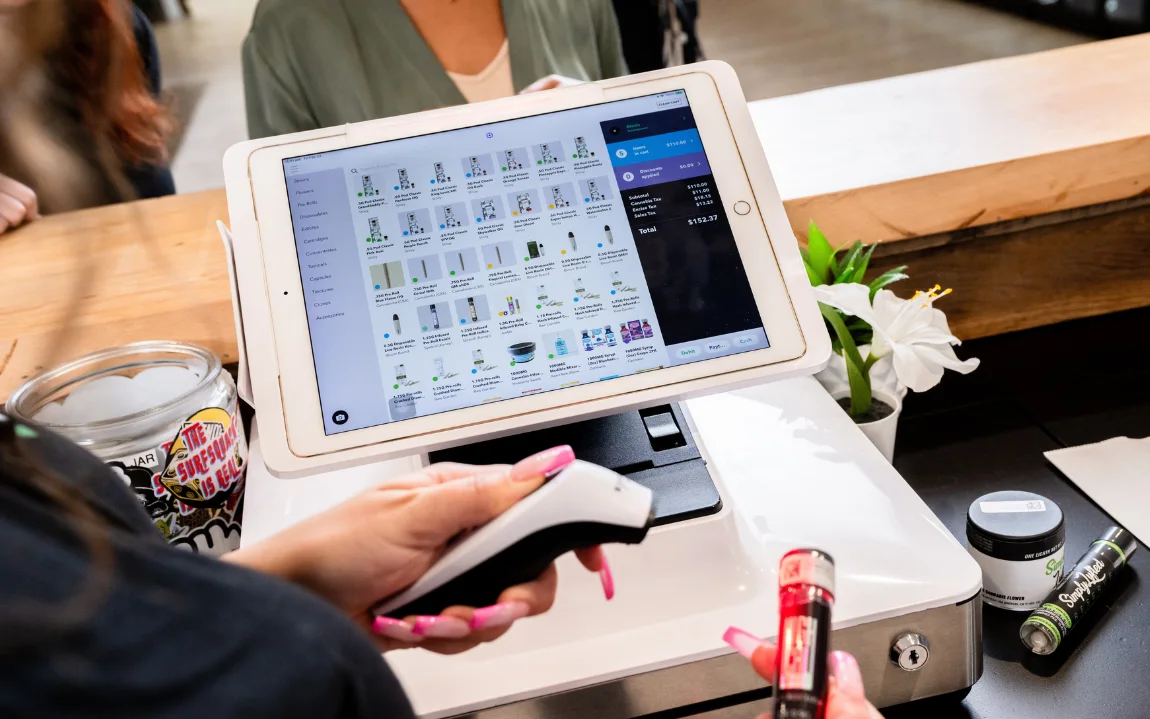
Meadow supports compliant in-store PIN debit, wireless terminals, and eCommerce ACH, all integrated with the POS, inventory, and Metrc, with no processor lock-in. Customers can pay when they order online for pickup or delivery, split payments across methods, and tip digitally, with everything flowing into one set of books and fewer abandoned orders. For a side-by-side look at how platforms compare on payments, compliance, and support, see our guide to choosing a cannabis dispensary POS system. New to the category? Start with What Is Cannabis POS Software? or browse the best dispensary POS systems.

Getting Started with Cashless Payments
Switching payment methods takes five steps, and the order matters: banking first, processor second, channels third.
- Confirm your banking relationship. Your bank should know you're a cannabis business and support the payment methods you plan to use.
- Vet the processor. Ask directly: Is this method compliant with card-network rules? What happens to my funds if the network changes policy? Can I see the fee schedule in writing?
- Choose methods that match your channels. PIN debit for in-store, ACH for online prepay, pickup, and delivery.
- Integrate with your POS. Payments that sync automatically with your point of sale eliminate manual reconciliation and keep compliance reporting accurate.
- Train your team. Budtenders who can process cashless payments confidently keep lines moving and tips flowing.
Common Questions
How do dispensaries accept payment?
Most use compliant PIN debit in-store and ACH for online orders, alongside cash. Standard credit card rails remain unavailable while cannabis remains a federally controlled substance.
Do dispensaries take Apple Pay or credit cards?
Generally no. Apple Pay and credit cards run on the major card networks, which prohibit cannabis transactions. Compliant alternatives are PIN debit and ACH bank transfers.
Do dispensaries accept tap to pay?
Yes, for debit cards. On Meadow's Dejavoo debit terminals, customers can insert or tap their card. Tap to pay through mobile wallets like Apple Pay or Google Pay generally isn't available, because wallets run on the major card networks, which prohibit cannabis transactions.
Did rescheduling change dispensary payment processing?
No. The April 2026 federal order moved FDA-approved cannabis products and state-licensed medical cannabis to Schedule III, and recreational cannabis remains Schedule I. In its September 2026 report on cannabis banking, the GAO noted that the card networks indicated their policies would not change without federal legalization. Confirm current status before relying on it.
What is dual pricing at a dispensary?
Dual pricing sets one price for cash and another for electronic payment, reflecting processing costs. It must be disclosed clearly and follow current network and state rules.
Are cashless ATMs compliant for dispensaries?
Cashless ATMs process purchases as ATM withdrawals. Card network policies prohibit disguising point-of-sale transactions this way, and enforcement has increased in recent years, so compliance depends on your provider and how transactions are processed. If you use one, confirm those details with your provider.
Why should payments be integrated with my POS?
Integrated payments reconcile automatically, keep reporting accurate, and make compliance one system instead of several, which saves time at close and keeps you audit-ready.
Does Meadow lock me into a payment processor?
No. Meadow supports compliant in-store debit, wireless terminals, and eCommerce ACH integrated with the POS, with no processor lock-in.
Want Payments That Reconcile Themselves and Keep You Compliant?
If you're running payments through one vendor, compliance through another, and reconciling both by hand at close, that's the part we fix first. Meadow has built payments, POS, and Metrc compliance into one system for licensed operators across six states since 2014.