
Online reviews are the single biggest factor in whether a "dispensary near me" search surfaces your store or your competitor's. They decide whether Google puts you in the top three results or on page two, and they answer the question a new customer is already asking before they walk in: can I trust this store?
Most dispensaries treat reviews as something that happens to them. The best ones treat review generation as a system, tied to the moment a sale is completed.
This guide covers why reviews drive both local ranking and customer trust, how to build a review system that runs off your transactions instead of your team's spare time, what Google's policies actually permit, and how the Meadow and Edge integration automates the loop.
In This Post
- Why Reviews Decide Whether New Customers Find You
- How to Build a Review System That Runs Itself
- What Google's Review Policies Actually Allow
- How the Meadow and Edge Integration Works
- Common Questions
Why Reviews Decide Whether New Customers Find You
Reviews are the biggest lever on local search that most dispensary operators leave entirely to chance, and the numbers behind that are not subtle. Per BrightLocal's 2026 Local Consumer Review Survey, 97% of consumers read reviews for local businesses. More usefully for setting a target: 47% will not use a business with fewer than 20 reviews, 31% will only use one rated 4.5 stars or higher, and 74% specifically look for reviews written in the last three months.
Read those three together and you get your actual goal. Not "more reviews." Enough recent reviews, at a high enough average, that you clear the bar a first-time customer has already set before they found you.
Two things make this sharper for cannabis than for most retail. First, dispensaries largely cannot buy their way to the top of Google. Advertising restrictions take paid search off the table for most operators, which makes your review profile one of the only levers you have for owning that "near me" real estate. Reviews are your ad budget, earned rather than bought. Second, customers cannot sample before they buy, so the opinions of strangers carry more weight than they would for a category where you can judge the product yourself.
There is also a newer reason to care. BrightLocal found that consumers using AI tools for local recommendations jumped from 6% to 45% in a single year. Those tools read the same review text Google does. A store with detailed, recent reviews describing actual products and staff is legible to an AI answer; a store with 12 stars and no words is not.
The compounding effect runs both ways. A dispensary with 100 recent, detailed, four-and-five-star reviews outranks the shop down the street sitting on 10 stale ones, and it wins the searcher comparing both. A handful of one-star reviews with no positive volume to outweigh them can quietly cap how many new customers ever find you.
The good part is that this is one of the few growth levers you fully control. It does not take a bigger budget. It takes a system that asks every satisfied customer, at the right moment, in a way that is effortless for them and for your team.
How to Build a Review System That Runs Itself
Ask After Every Completed Sale
The highest-leverage change most dispensaries can make is to stop asking sporadically and start asking after every completed sale. Satisfied customers rarely think to post on their own, but they will if you ask at the moment they are happiest, which is right after a good experience at your counter.
Manual asking does not scale, because it depends on a busy budtender remembering. Automation does. When the request fires off a completed transaction, timing and consistency stop being a matter of willpower. A text message sent shortly after purchase lands while the visit is fresh and the customer still has their phone out, which is why it outperforms an email that arrives the next morning.
One caution that matters legally and practically: ask every customer, not the ones you predict will say something nice. More on why in the policy section below.
Start here: Turn on automated post-sale review requests so the ask goes out on every transaction rather than the handful your team remembers.
💡 Meadow x Edge advantage: Edge tracks fulfilled orders in your Meadow POS and automatically prompts each customer to leave a review after their transaction, with no spreadsheets and no reminders for your team. See the Meadow x Edge integration →
Give Unhappy Customers a Faster Path Than a Public Review
The worst way to learn about a bad visit is to read about it publicly three days later. A good system gives every customer an easy private channel to your team alongside the public one, so a fixable problem reaches a manager while it is still fixable.
The mechanism is simple: the request asks the customer to rate their visit and makes reaching your team as easy as posting publicly. When someone flags a problem, a manager gets it in real time and can respond. Many customers, once heard, soften or update what they were going to post. Some post nothing. And the ones who do post negatively often note that the store responded, which reads considerably better to the next searcher than silence.
The distinction that keeps this compliant: the private channel is offered to everyone, not routed to unhappy customers as a way of keeping them off Google. Offering a feedback path is fine. Using it as a filter is not.
Start here: Make sure every customer gets a one-tap private feedback option alongside the public one, and assign a manager to own responses within 24 hours.
💡 Meadow x Edge advantage: Edge routes feedback from every customer to your team in real time, so a manager can reach out before a fixable issue becomes a permanent one on your listing.
Connect Reviews to the Budtender Who Earned Them
Cannabis retail runs on the counter relationship. A review that names the person who helped is more credible to the next reader and considerably more motivating to your team, which turns a marketing program into a retention one.
The model works like this: reviews that name an employee earn that employee a cash bonus, starting small and scaling over time. Edge suggests beginning around $3 per mention. That does three things at once. It gives budtenders an immediate reason to deliver a five-star experience, it builds a recognition loop in a role where turnover is expensive, and it produces the specific, name-checking reviews that read as authentic rather than solicited.
The compliance line here is important and worth stating precisely. Rewarding your own employee for service a customer chose to praise is not the same as paying a customer for a review, and Google's policy addresses the latter. But the request itself should not instruct the customer on what to write. See the policy section below for why that distinction matters.
Start here: Set a per-mention bonus so great service gets recognized the moment a customer calls it out, and tell your team how it works.
💡 Meadow x Edge advantage: Because every sale in Meadow is tied to the budtender who rang it up, Edge can attribute a review to the right person and reward it automatically. That same data powers staff-performance tracking, so recognition is grounded in what happened at the register. See our guides to budtender incentives and tracking staff performance in Meadow.
Treat Volume and Recency as an SEO Program
Consistent review flow is one of the strongest local ranking signals a dispensary can send, and it is cumulative. A store collecting reviews every week climbs. A store that collected 200 reviews two years ago and stopped slides as fresher competitors pass it. That is not a Google quirk; it matches how customers behave, given that 74% are specifically looking for reviews from the last three months.
Volume, quality, and recency compound. More reviews raise the odds a searcher finds one mentioning the exact product or experience they care about. Detailed reviews carry natural keywords, a strain, a category, a neighborhood, that help you surface for those searches. Recency tells both Google and the reader that the opinions still describe your store.
Reviews are only half of local visibility, though. Pair them with accurate Google Business Profile information, consistent listings across directories, and real SEO on your own site.
Start here: Commit to a weekly cadence rather than a periodic review drive, and audit your Google Business Profile and directory listings for accuracy while you are at it. Dispensary SEO: The Truth About E-Commerce, Google Rankings, and Online Sales covers the site half.
Manage the Program by the Numbers
Reputation feels soft until you put a dashboard on it, at which point it becomes as manageable as sales or inventory. Review it monthly and watch the metrics that actually move the outcome:
- Google reviews generated per month, per location.
- Employee mentions per month, and which budtenders earn the most.
- Which locations lead and which lag.
- Satisfied versus dissatisfied customers, split by 4-and-5-star against 1-to-3-star, whether or not they posted publicly.
- Bonus dollars paid for mentions, so you can weigh program cost against return. As a rough planning figure, expect review requests to convert on a low single-digit percentage of transactions. The right target depends on your traffic. The habit matters more than the number.
Start here: Put a monthly reputation review on the calendar and pick two or three metrics you will hold each location accountable to.
💡 Meadow x Edge advantage: Edge's dashboards combine review data with your Meadow transactions, so managers see employee performance and customer satisfaction next to real sales data. Meadow's analytics and reporting makes that a few minutes of work rather than a spreadsheet project.
What Google's Review Policies Actually Allow
This is the part most review advice skips, and it is the part that can cost you your listing. Google's prohibited and restricted content policy is explicit, and the language matters more than the summary.
What is prohibited. Google's fake engagement policy bars businesses from offering "incentives, such as payment, discounts, free goods and/or services, in exchange for posting any review or revision or removal of a negative review." It separately bars businesses from "discourag[ing] or prohibit[ing] negative reviews, or selectively solicit[ing] positive reviews from customers." That second clause is the one that catches well-intentioned operators: asking only the customers you expect to be happy is review gating, and it is a violation even when every review you collect is genuine.
The same policy adds a line worth reading twice: merchants "should not require or pressure users to leave ratings or write reviews while on the premises, nor should they request that specific content be included."
What is permitted. Asking every customer, consistently, after a completed sale. Offering everyone an easy way to reach your team privately. Responding to reviews, positive and negative. And rewarding your own employees for service that customers chose to praise, which is a compensation decision inside your business rather than an incentive offered to the reviewer.
The line to be careful about. An employee-mention bonus is defensible precisely because the incentive flows to your staff, not to the customer. It stops being defensible if a budtender starts telling customers "mention me by name and I get paid," which converts it into pressure on the premises and a request for specific content. This is a training issue, not a software one. The rule for your team is simple: give people a reason to remember you, never a script for what to write.
If you are unsure whether your specific flow clears these lines, read the policy directly rather than relying on a vendor's summary, including this one.
How the Meadow and Edge Integration Works
Everything above is possible manually. The integration is what makes it run without anyone owning it as a chore.
About Edge. Edge, formerly EyeRate, is an employee-driven reviews and recognition platform built around the idea that the person at the counter is the one who earns the review. Per figures confirmed with Edge in a previous collaboration: more than 6,000 businesses and 228,000 employees on the platform, and over $14 million paid out in employee rewards to date. Note that Edge's public site currently shows older figures (5,000 businesses, 130,000 employees, $6 million), so please confirm which numbers to publish.
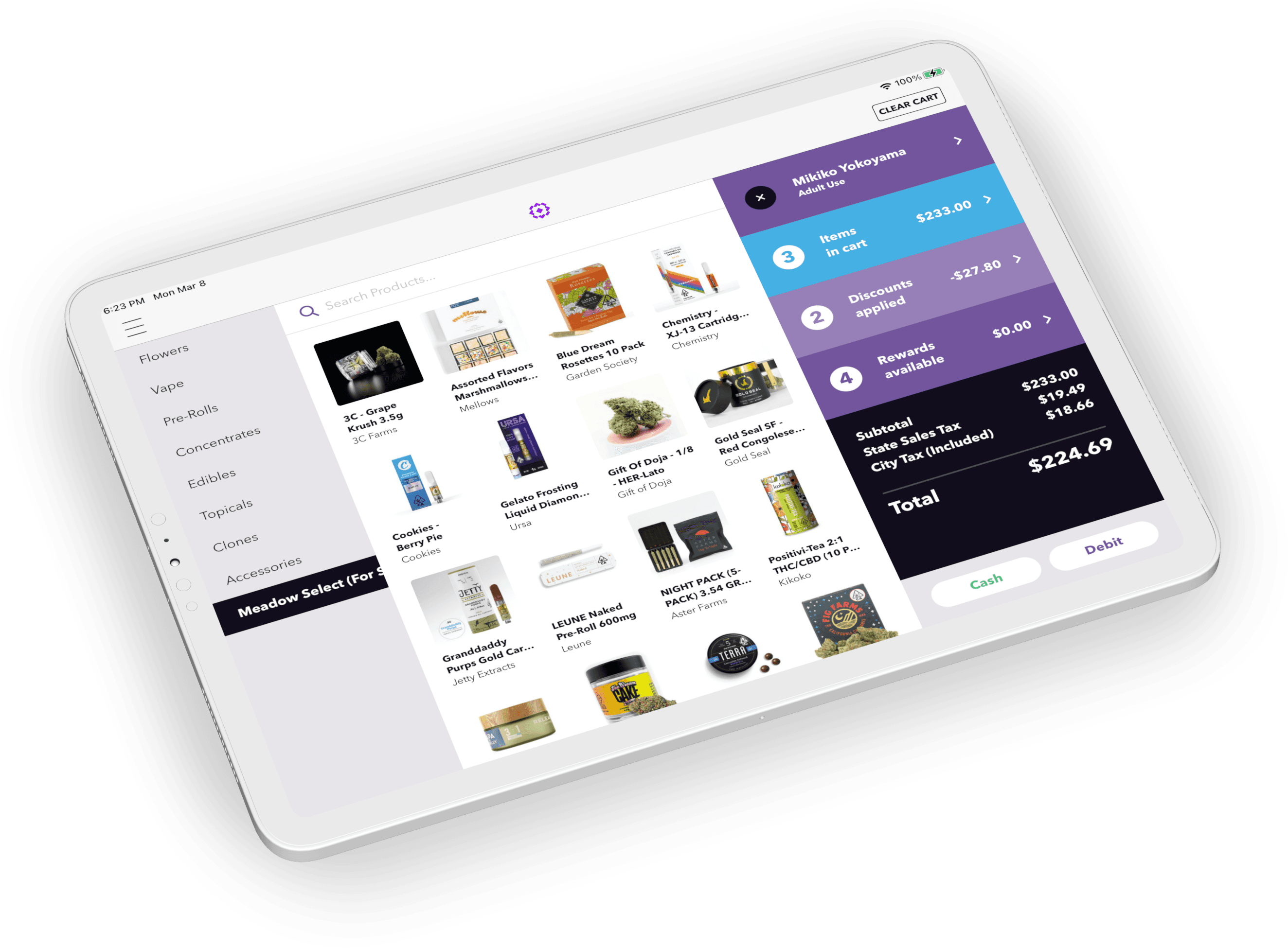
About Meadow. Meadow is the all-in-one cannabis POS built in California and running there since 2014, now powering dispensaries across California, New York, New Jersey, Michigan, Massachusetts, and Minnesota. As Y Combinator's first cannabis startup, Meadow has processed $4B+ in orders and is the #1 rated cannabis POS on G2. A review program built on POS data is only as reliable as that data, which is where the integration starts.
How it works:
- A sale is completed in Meadow, and Edge tracks the fulfilled order through your POS.
- The customer receives a review request tied to that visit and the budtender who served them.
- Every customer gets a path to post publicly or reach your team privately, so problems surface in time to fix them.
- When a positive review names a budtender, that employee earns recognition and a bonus automatically.
- Managers see review data and Meadow transactions in one dashboard, so employee performance and customer satisfaction sit next to real sales numbers. What it looks like in your store. Three people experience this differently, and it is worth knowing what each of them sees.
The customer finishes a purchase, leaves, and gets a text a short while later asking how the visit went. One tap posts publicly, one tap sends a note straight to the store. Nothing to download, no account to make, no clipboard at the counter.
The budtender does the job they were already doing, and when someone names them in a review, they get recognized and paid for it without filing anything or asking anyone. Over a few weeks that changes the texture of a shift: the counter interaction stops being invisible work.
The manager stops chasing reviews entirely. What arrives instead is a private complaint at 4pm that can be resolved by 5pm, a weekly count that moves in one direction, and a dashboard showing which locations and which people are actually driving the numbers. The program that used to be a recurring line on a to-do list becomes a report you read.
Getting started. Connect Edge from your Meadow admin settings or through your Meadow rep, configure your request timing and reward rules, and start collecting. Most of the setup decisions are about timing and bonus amounts rather than technical work, since the sales data Edge needs is already flowing through your POS.
Employees earn money when they are mentioned in reviews online, win sales competitions and receive digital tips from happy customers.
Mike Pieri, Edge
This is a win for everyone at the counter. The dispensary earns reviews and visibility, the budtender gets credit for the experience they created, and the customer gets a better visit because of it. That is a virtuous cycle, and it starts with a single sale.
David Hua, CEO and Co-Founder, Meadow
If your review count has been flat while your competitor's climbs, that gap is a system problem, not a service problem. Meadow's team can show you what the automated version looks like running off your own sales. Book a Call to Learn More
Common Questions
How do I get more Google reviews for my dispensary?
Ask every customer right after a completed sale, when the experience is freshest, rather than hoping they remember later. An automated system like the Meadow and Edge integration sends a request after each transaction, gives every customer an easy path to post publicly or share feedback privately, and does it consistently rather than only when your team remembers to ask.
Do online reviews affect a dispensary's Google ranking?
Yes. Local ranking is heavily influenced by the quantity, quality, and recency of your reviews. A dispensary with a steady flow of recent four-and-five-star reviews typically outranks one with few or stale reviews in "near me" searches. It matters more in cannabis than in most categories, because advertising restrictions keep most dispensaries out of paid search entirely.
Can I pay customers to leave reviews for my dispensary?
No. Google's policy prohibits offering "incentives, such as payment, discounts, free goods and/or services, in exchange for posting any review," and separately prohibits discouraging negative reviews or selectively soliciting positive ones. Violations can get reviews removed or your listing penalized. What you can do is reward your own employees for service good enough that customers mention them, which is the model Edge uses.
How many reviews does a dispensary need?
BrightLocal's 2026 survey found 47% of consumers will not use a business with fewer than 20 reviews, 31% will only use one rated 4.5 stars or higher, and 74% look for reviews written within the last three months. So the target is not a single number: it is enough recent reviews at a high enough average to clear all three bars at once, which is why cadence beats campaigns.
How does the Meadow and Edge integration work?
Edge tracks fulfilled orders in your Meadow POS and prompts each customer to leave a review after their transaction. Positive reviews naming a budtender trigger recognition and a bonus for that employee, and managers see review data alongside POS transactions in Edge's dashboards. You enable it from your Meadow admin settings or through your Meadow rep.
Turn Your Best Service Into Your Best Marketing
Your budtenders are already delivering experiences worth talking about. The dispensaries that win local search are the ones that capture those moments as reviews automatically, on every sale, instead of hoping someone remembers. Meadow connects point of sale, e-commerce, delivery, inventory, and compliance in one system, so your reputation runs on the same autopilot as the rest of your operation.