
Cannabis SMS marketing is the practice of sending promotional and transactional text messages to dispensary customers who have explicitly opted in to receive them. Because cannabis businesses are locked out of most paid social and search advertising, SMS is one of the few marketing channels a dispensary fully owns. It is also one of the most tightly regulated, with federal telemarketing law, mobile carrier policies, and state cannabis rules all stacked on top of each other.
This guide breaks down the compliance rules that govern cannabis SMS as of August 2026, how to earn opt-in consent the right way, what you can and cannot say, how to choose a platform, and how to measure results, so you can build a text channel that drives repeat visits without putting the list at risk.

In This Post
- Why SMS Works So Well for Dispensaries
- The Compliance Rules That Govern Cannabis SMS
- Consent and Opt-In: Building Your List the Right Way
- Content Rules: What You Can and Cannot Say
- Choosing an SMS Platform for Your Dispensary
- Measuring What Your Texts Actually Drive
- Getting Started with Cannabis SMS Marketing
- Common Questions
Why SMS Works So Well for Dispensaries
SMS is the highest-leverage owned channel most dispensaries have, because the people on the list already know you and asked to hear from you. Paid cannabis advertising is heavily restricted across most platforms, so the customers who opted in are gold. Texts reach them instantly, get read at far higher rates than email, and tie directly to a visit.
Best of all, an opted-in list is an owned audience. No algorithm change or ad-policy update can take it away from you. For a dispensary, a healthy SMS list is one of the most durable marketing assets you can build. That durability is also why compliance matters so much: one careless blast can cost you the channel, or worse.
The Compliance Rules That Govern Cannabis SMS
Cannabis SMS sits under three overlapping layers of rules: federal telemarketing law, mobile carrier policies, and state cannabis marketing regulations. As of the writing of this article in August 2026, the practical requirements look like this, but every item below needs confirmation with counsel before you rely on it:
- TCPA (federal). The Telephone Consumer Protection Act requires prior express written consent before sending marketing texts. Statutory damages run $500 per violation and up to $1,500 for willful or knowing violations, assessed per message, which is what makes a single non-compliant blast to a large list an existential number rather than a fine.
- Opt-out mechanics (federal, effective April 11, 2025). The FCC's consent revocation rules require senders to honor a revocation made through any reasonable means, treat the standard keywords (stop, quit, end, revoke, opt out, cancel, unsubscribe) as valid opt-outs, and process the request within 10 business days. One confirmatory text is permitted within five minutes, and it cannot contain promotional content. The portion of the rule that would make a single opt-out apply across every message type you send has been delayed again and is now scheduled to take effect in January 2027. Build for it now rather than retrofitting later.
- Quiet hours (federal). FCC rules restrict telephone solicitations before 8 a.m. and after 9 p.m. in the recipient's local time. Courts are currently split on whether a customer's opt-in also amounts to consent to receive messages inside those hours, and quiet-hours text claims have become an active class-action category. Until that question settles, send inside the window and consider adding time-of-day language to your opt-in terms.
- Carrier policies. The major carriers apply their own content rules on top of federal law, and cannabis sits on their restricted-content lists in most cases, alongside the categories the industry refers to as SHAFT. Enforcement happens at the brand level through A2P 10DLC campaign registration, not message by message, and it is a moving target. This is a core reason platform choice matters.
- State cannabis rules. Your state's cannabis marketing regulations govern promotions, product claims, discount language, and audience restrictions, and they differ meaningfully state to state.
Treat compliance as the foundation, not an afterthought. The operators who win at SMS are the ones who treat the opt-in list as something to protect, not exhaust. Route your consent language, message templates, and sending practices through legal review before the first campaign goes out.
Consent and Opt-In: Building Your List the Right Way
Clear, documented, explicit opt-in consent is the non-negotiable starting point for cannabis SMS marketing. No buying lists, and no "we had their number anyway."
- Get explicit consent before texting anyone. Consent must be affirmative and documented, and your records should show when and how each customer opted in. Those records are your defense, so treat retention of them as part of the program.
- Honor opt-outs immediately and automatically. A "STOP" must work the first time, every time, without a human in the loop, and the other standard keywords have to work too. Federal rules give you 10 business days at the outside; a good platform does it instantly.
- Collect consent where customers already are. Checkout, your online menu, and loyalty sign-up are the natural moments to ask.
- Make the value clear at the moment you ask. "Get first access to drops and member deals" converts better than "join our texts."
💡 How Meadow handles this: Meadow's built-in loyalty program gives customers a concrete reason to opt in at sign-up, so list growth happens as a natural part of enrollment instead of a separate ask. See how dispensaries use their own data to level up loyalty.

Content Rules: What You Can and Cannot Say
What you send is regulated just as much as who you send it to. State cannabis rules constrain promotions, pricing language, and product claims, and carriers filter content on their own terms. Within those constraints, the messages that perform are the ones built around the customer:
- Lead with value. A real reason to come in beats "we exist." A restock of a customer's favorite, a member-only perk, an event, or early access gives people a reason that is actually about them.
- Tie offers to behavior. Win-back messages for lapsed buyers, early access for loyalty members, and category restocks for the people who buy that category.
- Mind timing and frequency. A few well-timed, relevant texts beat daily noise. Over-texting is the fastest way to drive opt-outs, and quiet-hours rules restrict late and early sends.
- Avoid health claims and restricted language. Most states prohibit therapeutic claims and regulate discount phrasing; run your message templates past compliance review.
Carrier filtering applies to the words inside the message, not just who sends it. Cannabis terms in the text body can get a message filtered before it ever reaches a phone, and disguising those words with numbers or symbols in place of letters does not solve the problem. The same goes for links: dropping your store's website into the text can flag the message, because the destination identifies it as cannabis.
It is worth being clear about what does not work here. Because carriers enforce at the brand level through 10DLC registration, misrepresenting your business type or rotating through new numbers when messages stop landing tends to make things worse, not better, and can get your brand blocked outright. The durable pattern is the opposite of evasion: register honestly, work with a platform that understands cannabis routing, keep the text itself short and neutral, and let a linked page carry the rich content. Meadow's Digital Flyers are built for exactly this: a short text links to a PIN-protected, branded page where you can share full offer details, product info, images, or a direct link to your menu, visible only to the customer who received it.
If discounts are part of your SMS playbook, structure them deliberately rather than training customers to wait for blasts. Our guide to building a profitable dispensary discount strategy covers how to protect margin while still giving the list real value.

Choosing an SMS Platform for Your Dispensary
The right cannabis SMS platform handles compliance mechanics automatically and connects directly to your sales data. Evaluate on these criteria:
- Cannabis-friendly delivery. Can the platform actually deliver cannabis content reliably given carrier filtering, and can they explain how their routing and 10DLC registration work?
- Consent and opt-out automation. Opt-in records, automatic handling of every standard opt-out keyword, and quiet-hours enforcement should be built in, not manual.
- POS integration. Segmentation is only as good as the purchase data behind it. A platform that reads live sales data can target lapsed customers, VIPs, and category buyers precisely.
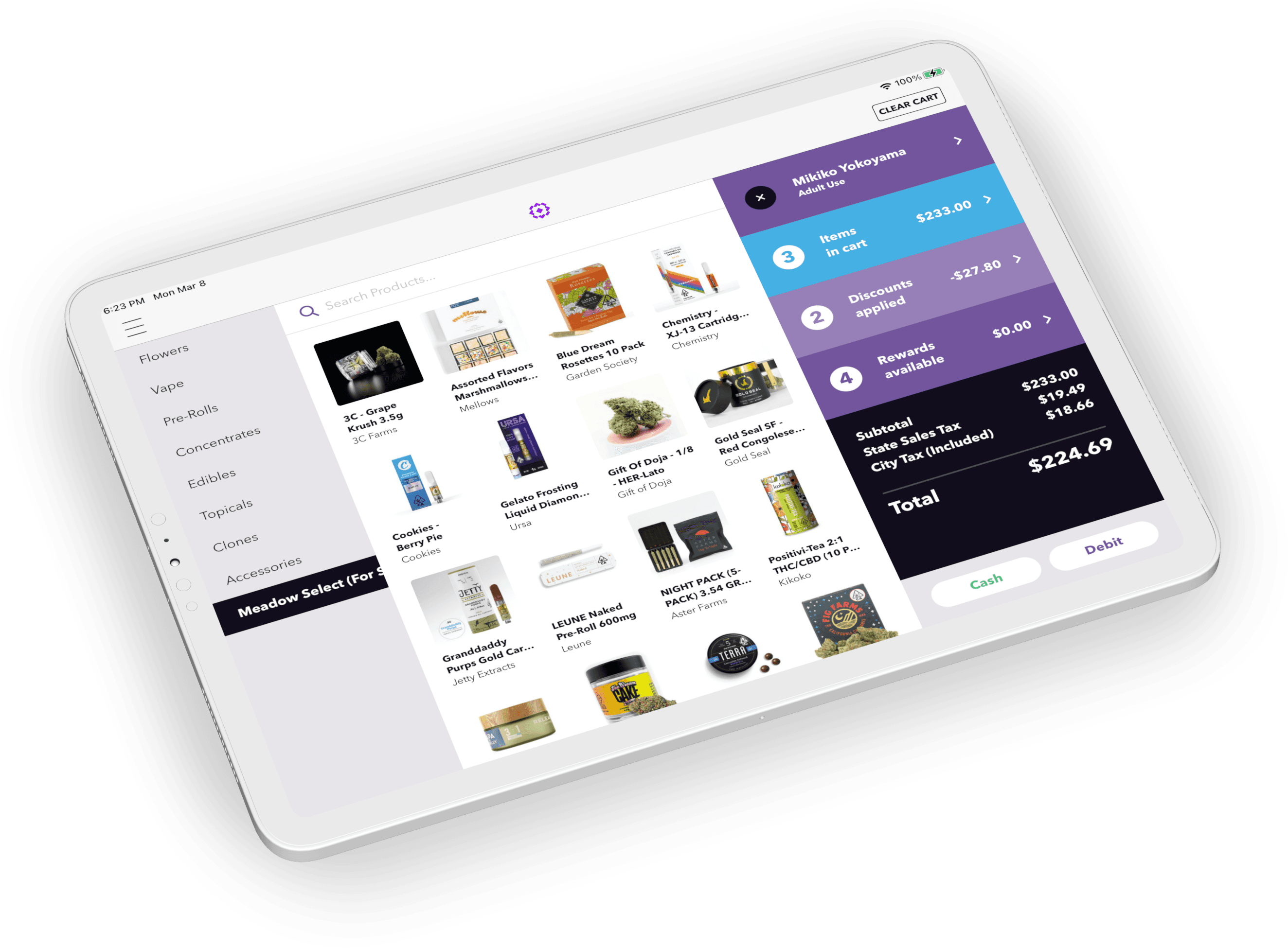
- Attribution. You should be able to trace a campaign to visits and revenue, not just delivery rates. 💡 How Meadow handles this: Text marketing is built directly into Meadow, so you can send targeted campaigns using segments from your live POS data, including purchase history, brand preference, and location, with compliant message templates included. See the power of marketing segments for how operators build them.
For advanced multi-channel campaigns across SMS, email, and push, Meadow's Alpine IQ integration reads from the same source of truth, with customer records, purchase history, and marketing opt-ins syncing automatically between the two platforms. The Higher Path consolidated three separate systems into that setup; their story is here.
Your POS is the data engine underneath all of this. If you are evaluating that layer too, start with the complete guide to choosing a cannabis dispensary POS system.

Measuring What Your Texts Actually Drive
Measure SMS campaigns by visits and revenue, not opens and deliveries. The point of a text is a customer through the door or an order placed, so the measurement loop has to connect campaigns back to sales.
- Track revenue per campaign, not just click or delivery rates.
- Watch opt-out rate as a health metric. A rising opt-out rate means you are spending the list faster than you are growing it.
- Watch delivery rate as a compliance signal. A sudden drop usually means carrier filtering, not customer disinterest, and it is worth diagnosing before you send again.
- Compare segments. If win-back messages outperform generic promos, shift the mix accordingly.

💡 How Meadow handles this: Because Meadow's customer data lives in the POS, you can see what a campaign actually drove in sales, closing the loop between a text sent and a customer through the door. Segments built from purchase history, including lapsed customers, VIPs, and category buyers, stay current automatically.
Getting Started with Cannabis SMS Marketing
A clear path from zero to a working, compliant SMS program:
- Run legal review first. Have counsel approve your consent language, opt-in flow, and message templates before anything sends.
- Set up consent capture at checkout, on your online menu, and in loyalty sign-up, with the value proposition stated at the moment of the ask.
- Choose a platform against the criteria above, with POS integration and compliance automation as requirements, not nice-to-haves.
- Start with one segmented campaign, such as a win-back message to customers who have not visited in 60 days, rather than a blast to everyone.
- Measure by revenue, iterate monthly, and keep the send frequency low enough that the opt-out rate stays flat.
Customers who come in from a text still need a fast checkout when they arrive. If cash-only friction is costing you conversions, see our guide to accepting cashless payments at your dispensary.
Ready to Text Smarter? See Why Operators Choose Meadow.
Growing an SMS list shouldn't mean juggling spreadsheets and separate marketing tools. With Meadow, opt-in capture happens at loyalty sign-up, segments build themselves from live purchase data, and every campaign traces back to real revenue. We've been building cannabis retail software since 2014, and we've helped operators across six states turn their customer data into their best marketing channel.
More Resources for Dispensaries
- The Power of Marketing Segments
- How to Build a Profitable Dispensary Discount Strategy
- 7 Proven Strategies to Bring New Customers into Your Dispensary
- How to Accept Cashless Payments at Your Dispensary
- The Complete Guide to Choosing a Cannabis Dispensary POS System
- Dispensary SEO: How to Boost Your Dispensary's Online Presence
- How The Higher Path Fixed Online Loyalty by Switching to Meadow + Alpine IQ ---
Common Questions
Is cannabis SMS marketing legal?
Yes, with consent. As of the writing of this article in August 2026, you must obtain prior express written consent before sending marketing texts, honor opt-outs made through any reasonable means, and follow TCPA, carrier, and state cannabis rules. Requirements change; confirm the current rules with counsel before launching.
What are the TCPA penalties for a non-compliant text?
Statutory damages are $500 per violation and up to $1,500 for a willful or knowing violation, assessed per message. On a list of any size, that arithmetic is the reason consent records and automatic opt-out handling are worth doing properly.
What time of day can a dispensary send marketing texts?
Federal rules restrict telephone solicitations before 8 a.m. and after 9 p.m. in the recipient's local time. As of August 2026, courts are split on whether an opt-in also covers messages inside those hours, and quiet-hours claims are an active litigation trend. Send inside the window, and confirm your approach with counsel.
How often should a dispensary text customers?
Prioritize relevance over frequency. A few well-timed, valuable messages outperform daily blasts, protect your opt-in list from churn, and keep your opt-out rate low.
How do I build an SMS list for my dispensary?
Collect opt-in consent at checkout, on your online menu, and through loyalty sign-up, and make the value clear at the moment you ask. Segment the list using your POS purchase data so each message is relevant to the person receiving it.
What should I send in a cannabis SMS campaign?
Value-led messages tied to behavior: restocks of favorites, member perks, events, early access, and win-back offers for lapsed customers. Avoid generic blasts and anything that conflicts with your state's content rules.
Why are my dispensary's texts not getting delivered?
Usually carrier filtering. Cannabis content is restricted on most carrier networks, enforcement happens at the brand level through 10DLC registration, and cannabis terms or a dispensary URL inside the message body can get it blocked. Keeping the text short and neutral, with the detail on a linked page, is the standard fix.
Can I text customers about cannabis discounts?
Usually yes with proper consent, but state rules on discount and promotional language vary and carriers filter cannabis content. Confirm your state's promotion rules with compliance counsel before sending discount campaigns.