
Cannabis market intelligence is the practice of using aggregated sales data from across the industry to decide what your dispensary stocks, how you price it, and when you reorder. It is the difference between knowing what your store did and knowing whether that was good.
Because your own numbers cannot tell you that. If flower was up 12% last month, you have no idea whether to celebrate. If the market was up 20%, you lost share while your revenue went up. Every sale you ring is a data point, and most dispensaries leave that data sitting in a report nobody opens, with no outside context to make sense of it anyway.
This guide covers why your own sales data is not enough on its own, four ways to put market data to work on buying and pricing, how market data changes vendor negotiations, and how the Meadow and Headset integration automates the whole loop.
In This Post
- Why Your Own Sales Data Is Not Enough
- How to Put Market Data to Work
- Market Data Is Negotiating Leverage
- How the Meadow and Headset Integration Works
- Common Questions

Why Your Own Sales Data Is Not Enough
Your POS answers questions about your store. It cannot answer questions about your position, and position is what determines whether you are gaining or quietly losing ground. Four questions make the difference.
Am I winning or lagging? Your category mix compared against what comparable stores in your region actually sell. A store doing 55% flower in a market averaging 40% is either serving a real niche or missing a category, and revenue alone will not tell you which.
What is about to sell? Category and brand velocity across many stores shows a trend forming weeks before it reaches your shelves. Your own sell-through only reports what already happened.
Is my price right? Where you sit against the market median for the same category, brand, and format. Not so you can always be cheapest, but so that when you are 20% above market, you know it and you chose it.
Which brands are rising, and which are quietly dying? A brand that is flat in your store but falling across the region is a brand to stop reordering. A brand that is flat in your store but climbing everywhere else is a merchandising problem you can fix this week.
Answering these well is what separates buying on instinct from buying on evidence. The four practices below start with what you can do on your own, and none of them require new software to begin.
How to Put Market Data to Work
Benchmark Your Store Against the Market
Benchmarking compares your store's shape, not just its size: category mix, average basket, units per transaction, and price position. Shape is where you actually differ from everyone else.
A rough version is possible by hand. Most state regulators publish aggregate sales data by category, competitor menus are public, and distributor reps will tell you what is moving if you ask them well. The limits are real, though. State data is monthly, lagging, statewide rather than local to your trade area, and too coarse to say anything at the brand or format level. Rep intelligence is useful and also, reasonably, self-interested.
Start here: Pull your last 90 days of sales by category and calculate each category's share of revenue, then calculate the same percentages from your state's most recent published data. Write down the three categories where you differ most, and one sentence each on whether that gap is a deliberate choice or a blind spot.
💡 Meadow x Headset advantage: Headset benchmarks your live Meadow sales against anonymized data from comparable retailers in your region, so the comparison is current and local rather than statewide and a month old.
Buy What Is About to Sell
Most dispensary buying runs on lagging indicators: last month's sell-through, plus whatever the rep is pushing, plus the buyer's instinct. That combination reliably stocks what sold and misses what is starting to sell.
The distinction that matters is between a category that is growing and one that is growing faster than it was. Acceleration is the signal. A format moving from 4% to 6% of market revenue in a quarter is telling you something a category sitting flat at 20% is not, even though the flat category is bigger. Two patterns are worth tracking in your own data meanwhile: stockouts on top sellers, which are pure lost revenue and invisible because a sale that never happened leaves no record, and any category where units are up while revenue is flat, which means price is collapsing under you.
Start here: List your top 20 SKUs by units over the last 60 days and count the days each was out of stock. Multiply those days by average daily units and margin. That number is what slow reordering cost you last quarter.
💡 Meadow x Headset advantage: Headset surfaces category and brand velocity across thousands of retailers, so your buyer sees a trend forming across the market instead of inferring it from one store's rear-view mirror.
Price With Context Instead of Guesswork
Most dispensary pricing gets set once at intake on a standard markup and revisited only when something stops selling. That works until the market moves.
Pricing with context means knowing your position by category before you set it, then choosing deliberately. Being above market is a legitimate strategy when service, selection, or location justify it. Being above market without knowing it is how a category quietly dies on your shelf while you wonder why. Three positions are worth distinguishing: on traffic-driving categories like flower and pre-rolls, price is what gets someone in the door and market position matters most. On margin categories like edibles, topicals, and accessories, customers comparison-shop less and there is room to hold. On genuinely new formats, no market price is established yet, and that is where early margin lives.
Start here: Take your three highest-volume categories, pick five representative SKUs in each, and check what three competitors in your trade area charge for the equivalent item. Note whether you sit above, at, or below, then decide out loud whether that is the position you want.
💡 Meadow x Headset advantage: Headset shows where your Meadow pricing sits against market medians by category and brand, so that check becomes a dashboard instead of an afternoon clicking through competitor menus.
Turn Reordering Into a Standing Process
Reordering is where good intentions go to die. It is nobody's favorite task, it happens weekly at best, and it is usually triggered by someone noticing an empty shelf.
The manual version works and depends entirely on consistency. You set a par level and a reorder point per SKU, someone reviews days of supply on a schedule, and orders go out before the shelf empties. Done every week, it eliminates most stockouts. The failure mode is not the method, it is the busy week when the review slips and you find out on a Saturday. What scales past memory is letting the data trigger the reorder. In other retail sectors this is standard practice under the name vendor-managed inventory: an approved supplier sees live sell-through for their own products and replenishes against agreed levels, with the retailer controlling who sees what. Headset has built its Bridge product around exactly this approach for cannabis.
Start here: Calculate days of supply on your top 20 SKUs, current units divided by average daily units sold. Anything under your supplier's lead time plus three days is already late. Set a reorder point for each and put a recurring 20-minute hold on the calendar to review them.
💡 Meadow x Headset advantage: Through Bridge, brands and vendors you approve can see live Meadow sell-through for their own products and replenish automatically, with per-vendor access you grant and revoke yourself.
Market Data Is Negotiating Leverage
Everything above is about what you stock. This is about what you pay for it, and it is where market data pays for itself fastest.
A vendor meeting where you know the regional market price for the category, the brand's trend line across your region, and your own sell-through against comparable stores is a fundamentally different meeting. You are not accepting a price sheet, you are negotiating one. Worth being clear-eyed about why: the rep already has this data. The imbalance was never that the information did not exist, only that one side of the table had it.
That changes what you can reasonably ask for. A brand declining regionally needs your shelf more than you need it, which is leverage on price, terms, or promotional support. A brand accelerating regionally that you do not carry is one you should be asking about before your competitor does. And a brand whose products sell through faster in your store than the regional average is a case for better pricing, made with evidence instead of assertion.
Start here: Before your next vendor meeting, write down three numbers: your sell-through rate on their products over the last 90 days, your current margin on their category, and what two competing brands in that category are priced at on your shelf. Ask for terms that reflect them.
3 Strategies to Secure the Best Vendor Deals for Your Dispensary goes deeper on how operators structure those conversations.
How the Meadow and Headset Integration Works
Everything above is doable by hand. The integration is what makes it a standing capability instead of a project someone owns until they get busy.
About Headset. Headset is cannabis retail's market-intelligence and benchmarking platform, founded in 2015 by Cy Scott, Brian Wansolich, and Scott Vickers, three of Leafly's co-founders. It aggregates receipt-level point-of-sale data from thousands of retailers into a single view of what is selling, at what price, in which categories, and how fast that is changing. Per its own published figures:
- 3,500+ retail partners across the US and Canada.
- 34 cents of every dollar spent on cannabis in the US and Canada flows through the platform as data.
- $47 billion in cannabis sales data aggregated at the receipt and basket level.
- 30+ cannabis POS systems integrated.
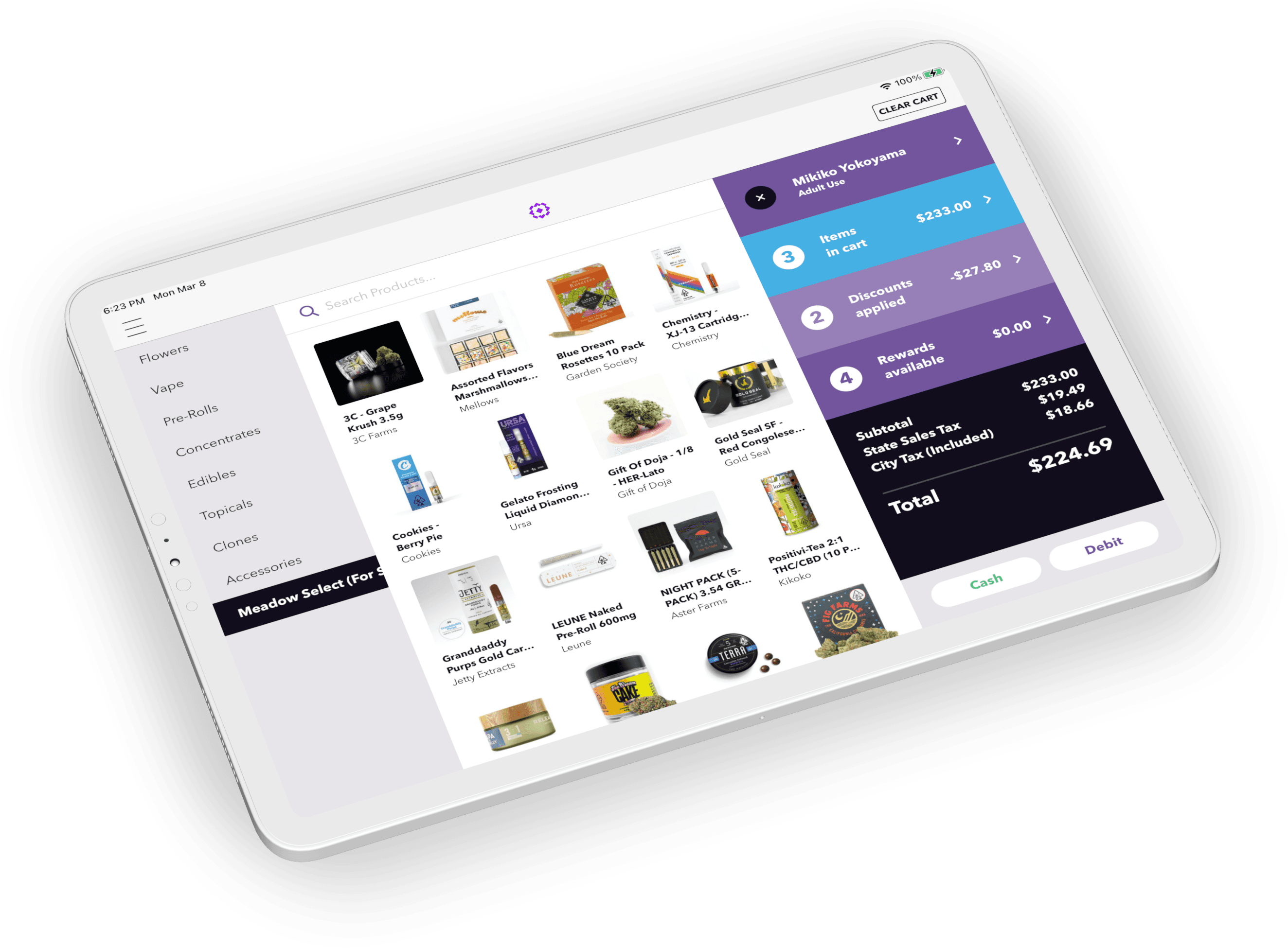
- 16 US states and 4 Canadian provinces covered. About Meadow. Meadow is the all-in-one cannabis POS built in California and running there since 2014, now powering dispensaries across California, New York, New Jersey, Michigan, Massachusetts, and Minnesota, with point of sale, inventory, online ordering, delivery, and compliance in one system. Market intelligence is only as good as the data feeding it, and clean, real-time, receipt-level data from a single source of truth is what makes a benchmark trustworthy.
How the data flows:
- Your Meadow POS captures every sale at the register, as it already does.
- That data syncs to Headset automatically and in real time. No CSV exports, no manual reporting.
- Headset anonymizes and aggregates it alongside data from thousands of other retailers.
- You see your store benchmarked against the market in Headset's retailer dashboards.
- Through Bridge, vendors you explicitly approve can see live sell-through for their own products and replenish against it. What it costs. The integration is free for retailers. Headset monetizes the vendor and brand side, so dispensaries pay nothing to connect.
Getting started. Generate your Meadow API key from your Meadow admin dashboard, send it to your Headset representative to initiate syncing, and log in to Headset to view your real-time dashboards. You can revoke any vendor's access at any time from your Bridge settings. The integration reads data your POS has already captured and does not touch your state traceability submissions, so it has no effect on your Metrc compliance.
POS integration shows us how things are happening as they are happening, whereas retailers can typically only share data on a monthly basis. This is an important component because things change daily in the cannabis industry, and monthly data wouldn't allow us to keep up with the dynamic nature of the space.
Cy Scott, Co-founder and CEO, Headset
[PLACEHOLDER QUOTE. Real, published Cy Scott quote from the Headset blog, 2020. Headset team: keep, edit, or replace with a fresh line about what Meadow retailers specifically get from the partnership. We would prefer the fresh line.]
Our customers already capture clean, real-time sales data at every register. Headset is how they put it to work: seeing exactly where they sit against the market, then buying, pricing, and stocking accordingly. It turns a dispensary's own data into its sharpest competitive edge.
David Hua, CEO and Co-Founder, Meadow
Dozens of dispensaries already run Meadow and Headset side by side.
If your buying decisions are still running on last month's numbers, that is a fixable problem, and it costs nothing to fix. Meadow's team can show you what your own data looks like once it is connected. Book a Call to Learn More
Common Questions
What is cannabis market intelligence?
Cannabis market intelligence is aggregated, anonymized sales data from across the industry, used to benchmark your store against comparable retailers, spot category and brand trends early, and make buying and pricing decisions based on what the whole market is doing rather than your store alone. Headset is the leading provider, drawing on receipt-level POS data from thousands of retailers.
How is market intelligence different from my POS reports?
Your POS reports tell you what your store did. Market intelligence tells you whether that was good. Flower up 12% means one thing in a market that grew 5% and the opposite in a market that grew 20%, and only outside data can tell you which one you are in.
Is the Headset integration free for dispensaries?
The Meadow and Headset integration is free for retailers to connect. Headset monetizes the vendor and brand side rather than the retail side.
Does connecting Headset affect my Metrc compliance?
No. Headset reads data your Meadow POS has already captured and does not alter your regulatory submissions.
Can I control which vendors see my data?
Yes. You grant access per vendor and can revoke any vendor's access at any time from your Bridge settings.
Stop Guessing What to Stock.
Your registers already capture everything you need to buy, price, and reorder with evidence instead of instinct. Meadow connects point of sale, e-commerce, delivery, inventory, and compliance in one system, so the data reaching Headset is clean, complete, and current, and the benchmark you get back is one you can act on.