
Last updated: June 2026 | By the Meadow team
TL;DR: A Metrc reconciliation is an inventory adjustment that corrects a package quantity in Metrc to match your physical count. It requires a reason code, a written note, and an immediate sync to the state. It can't be undone. This guide covers when to run one, how to do it correctly, which reason codes apply in your state, and how to prevent the discrepancies that make reconciliations necessary in the first place.
Every cannabis dispensary will run a Metrc reconciliation at some point. Your physical count doesn't match Metrc. A scale variance crept in over weeks of weighing. A package got oversold during a busy Saturday shift. Something doesn't add up.
A reconciliation is the right response to all of these. But done wrong — wrong reason code, wrong quantity, missing notes — it can create new problems while fixing the old ones. Regulators see every adjustment you make, along with the reason you gave for it.
What Metrc reconciliation actually is
A Metrc reconciliation is a formal inventory adjustment: you tell the state that a package's quantity has changed, why it changed, and by how much.
Reconciliation is one of several required Metrc reports, alongside sales, transfers, and adjustments, see our complete guide to Metrc reporting for the full picture of what's required and when.
It's not a confession. It's not a red flag on its own. Regulators expect dispensaries to run reconciliations — physical inventory doesn't always match system records perfectly, and the compliance process for correcting that is a reconciliation. What matters is that you document it accurately, choose the right reason code, and don't let discrepancies pile up.
What regulators watch for:
- Frequency — reconciling the same package repeatedly suggests a process problem, not a one-time error
- Magnitude — large adjustments without clear documentation invite scrutiny
- Reason codes — codes that don't match the notes (or no notes at all) are a red flag
- Pattern — consistent variances in a specific product category or location often signal a weighing, receiving, or shrinkage issue
These are exactly the patterns a Metrc red flags check catches early, worth running one before an inspector does.
A single well-documented reconciliation is routine. A pattern of unexplained adjustments is what triggers questions.
When to run a reconciliation
Run a reconciliation when your physical count doesn't match Metrc and you've confirmed the physical count is correct.
Common triggers:
- Cycle count results — a count turns up a discrepancy between shelf and Metrc
- Scale variance — products sold by weight show small variances over time
- Receiving error — a package was entered at the wrong quantity when first accepted
- Spoilage or damage — product that can't be sold
- Theft or shrinkage — missing product with no other explanation
- Oversold quantity — more product sold than the system reflected
- Trade or display samples — product pulled for non-sale purposes
How to run a Metrc reconciliation in Meadow
Before you start: confirm the physical count is accurate. Recount if there's any doubt. Once submitted, a reconciliation can't be undone.
- Find the package — Go to Inventory > Reconciliations, or open the package in Meadow and click into the package details
- Adjust the quantity — Enter how many units you need to add or remove to match what you physically have
- Select a reason code — Choose the most specific code that applies. Reason codes vary by state and license type — check which codes your state offers in the list below
- Write a note — Clear, factual: what the discrepancy was, when you found it, what caused it if known. This goes to Metrc and may be reviewed by an inspector.
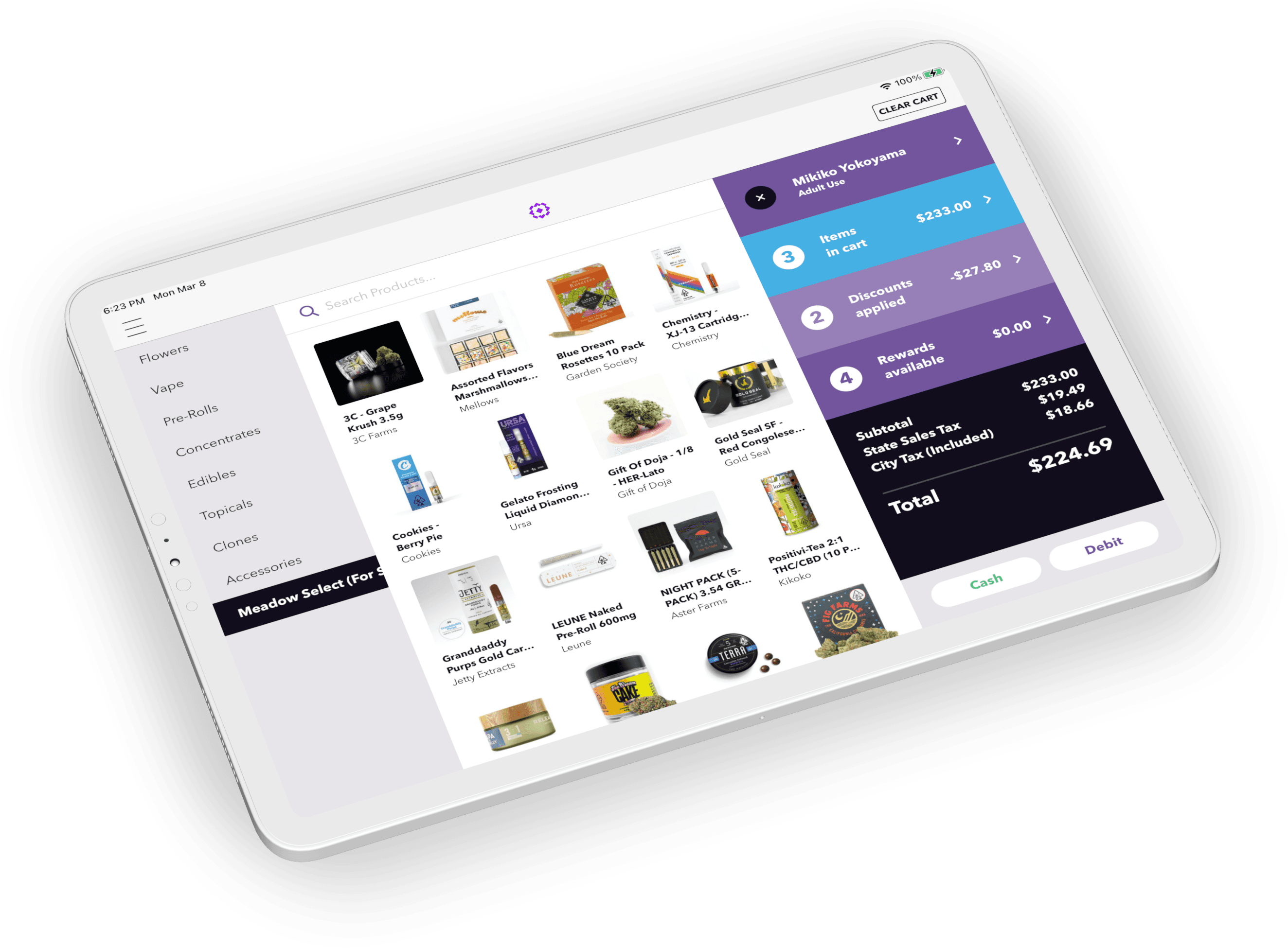
- Submit — Meadow syncs the adjustment to Metrc automatically with your reason code and notes attached
If you entered the wrong quantity: run a second reconciliation with the correct figure and a note explaining the correction.
Metrc adjustment reason codes
Adjustment reasons vary by state. There is no universal list — each state defines its own codes, and the options you see in Metrc also depend on your license type (retailers, cultivators, manufacturers, and labs each get a different menu). The list below compiles the reason codes across the states Meadow serves for retail; always confirm definitions and documentation requirements in your own state's Metrc account before using a code.
API Adjustment Error (NJ) — An adjustment made erroneously in both the API and in Metrc.
Damage (CA) — Damage to the packaged product.
Damaged During Transfer (NY) — Product damaged in transport, unfit for retail due to compromised packaging or product integrity.
Display Sample (CA) — Cannabis goods used for display purposes in a licensed designated retail area.
Enforcement Testing (CA) — Samples removed from inventory for enforcement-related analysis, under state or local order.
Entry Error (NY, NJ, MI, MN, MA) — Typographical or data entry mistakes, such as incorrect quantities when pulling packages. Not to be used for correcting sales.
Incorrect Quantity (CA) — Package received via transfer that was mis-weighed or mis-counted. Not for correcting sales; significantly off packages should be rejected at intake.
Internal Product Testing Samples (MI) — Product taken for internal QA or in-house testing.
Inventory Audit (MN, MA) — Used during physical counts when the exact cause of a discrepancy can't be determined.
Mandated Destruction (CA) — Plants or packages destroyed in a state- or locally-mandated or supervised process.
Onsite Testing (CA) — In-house quality assurance testing on a licensed premises. Not for official state testing.
Over Pulled (CA) — Too much product placed in a new package, leaving less in the source package than Metrc reflects. Requires a note identifying the corresponding under-pulled package.
Over Sold (CA) — Over-reported sales from the package.
Package Material (MN, MA) — A container or packaging material mistakenly included in the recorded product weight.
Product Re-Form (MA) — A product unit that becomes unusable but will be re-formed into a subsequent batch (processors).
Public Safety Recall (CA) — Goods removed from sale, distribution, and consumption due to a potential or imminent health and safety risk.
QA Test Sample (CA) — Sample provided to a licensed lab for quality assurance testing. Not for official state testing.
Regulatory Test Sample (CA) — Representative sample obtained by a licensed testing lab for regulatory compliance testing.
Research and Development (CA) — Product used for research and development.
Sample Tested (CA) — Portion of a representative sample used in compliance testing (lab use only).
Scale Variance (All states) — A measurable weight difference between scales, unrelated to drying or moisture loss. Michigan caps it at 0.9 grams per pound.
Spoilage (All states) — Expired, deteriorated, or otherwise unusable product that must be destroyed.
State Authorized Adjustment (CA) — Requires prior state approval; the Metrc support ticket number must be included in the notes.
State Investigation (NY) — Used at the state's direction during an investigation or compliance review.
Theft (All states) — Product lost to internal or external theft. The regulator must be notified and supporting documentation submitted.
Trade Sample (CA, MI, MN) — Definition varies: in California and Minnesota, product provided to employees (CA requires the employee's name or number and the date and time in the notes); in Michigan, product provided to another licensee evaluating a potential purchase.
Transfer Error (NY) — Corrects transfer mistakes (wrong quantity or product) not caught at the time of receipt.
Under Pulled (CA) — Too little product placed in a new package, leaving more in the source package than Metrc reflects. Requires a note identifying the corresponding over-pulled package.
Undersold (CA) — Under-reported sales from the package.
Voluntary Surrender (CA) — Goods voluntarily surrendered, in coordination with state or local jurisdiction, and no longer in the licensee's possession.
Waste (All states) — Product rendered unusable and disposed of per state regulations — including failed testing, contamination, recalls, or mandated destruction. Minnesota distinguishes hazardous vs. non-hazardous waste.
How often should you reconcile?
Reconcile when a discrepancy exists, not on a fixed schedule. But build counting into your operations so discrepancies don't compound:
- Daily: reconcile packages with negative quantities immediately — negative Metrc inventory is a compliance violation in most states
- Weekly: spot-check top 10–20 high-velocity SKUs for variance
- Monthly: full cycle count across all active inventory locations
- Before any inspection: compare your POS package list to Metrc — find and fix discrepancies before an inspector does
Why reconciliations happen — and how to reduce them
Receiving errors — A package entered at the wrong quantity compounds until caught. Fix: count every package against the manifest before accepting in Metrc. Metrc Retail ID scanning can reduce this risk further by confirming the correct package automatically.
Theft — Cannabis product can go missing due to internal or external theft.
Package splits done incorrectly — Split in POS but not Metrc (or vice versa). Fix: all package operations through an integrated workflow only.
Product pulled without a record — Samples, tastings, waste logged informally. Fix: require a Metrc adjustment for any product leaving inventory outside of a sale.
Scale variance from weighing — 0.1g variance per transaction × 100 transactions = 10g adjustment. Fix: calibrate scales on a fixed schedule, train staff on consistent weighing technique.
Reconciliation vs. cycle count: what's the difference?
A cycle count is the counting process — physically counting product and recording the result to find discrepancies.
A reconciliation is the adjustment in Metrc — the formal correction with a reason code and note that syncs to the state.
You do a cycle count to discover discrepancies, then run a reconciliation to fix them. Cycle counts can also come back clean — no adjustment needed. In Meadow, cycle counts are timestamped, creating a paper trail that shows active monitoring even when no adjustments are required.
State-specific notes
California: The DCC requires documentation of all inventory adjustments with reason codes; records must be maintained for 7 years. Large or frequent adjustments on the same product can trigger a compliance review.
New York: As of May 2026, all reconciliations must flow through your integrated POS — manual Metrc entry is no longer accepted for NY retailers.
Michigan, Massachusetts, New Jersey: All require adjustment reason codes. Each state's cannabis regulator publishes enforcement guidance — check your state's published thresholds.
FAQ
What is a Metrc reconciliation?
A Metrc reconciliation is a formal inventory adjustment that corrects the quantity of a cannabis package in Metrc to match your physical count. It requires a reason code and a note, syncs automatically, and cannot be undone.
Can I undo a Metrc reconciliation?
No. Once submitted, it's permanent. If you entered the wrong quantity or wrong reason code, create a second reconciliation to correct it and include a note explaining the correction.
How often should I run reconciliations?
Reconcile whenever a discrepancy exists. Build cycle counts into your daily, weekly, and monthly operations to catch discrepancies early.
Are Metrc adjustment reason codes the same in every state?
No. Each state defines its own list, and the codes available to you also depend on your license type. California licensees choose from 25 defined reasons, New York has 10, New Jersey 9, Michigan 8, and Minnesota and Massachusetts each see roughly ten. A few codes — Scale Variance, Spoilage, Theft, Waste — appear in nearly every state, but their definitions and documentation requirements differ.
What reason code should I use for a general count discrepancy?
It depends on your state — most don't offer a universal catch-all code. Identify the cause first: Scale Variance for weight products, Over Sold (California) if more was sold than the system showed, or Entry Error (New York, New Jersey, Michigan, Minnesota, Massachusetts) for data-entry mistakes — keeping in mind Entry Error can't be used to correct sales. Minnesota and Massachusetts do offer an Inventory Audit code for count discrepancies whose cause can't be determined. Pick the most specific code your state offers and explain the cause in the notes.
Does Meadow sync reconciliations to Metrc automatically?
Yes. When you submit a reconciliation in Meadow, the adjustment reports to Metrc automatically with your reason code and notes. No separate Metrc login required.
The bottom line
Reconciliations are a normal part of running a compliant dispensary. What matters is doing them correctly: right quantity, right reason code, honest notes. If you're reconciling the same product repeatedly, the fix isn't in Metrc — it's upstream in your receiving, weighing, or sales process.
See how Meadow's inventory and reconciliation workflow operates →
Meadow serves licensed cannabis retailers in CA, MI, MA, NY, NJ, and MN. This guide is for informational purposes only and does not constitute legal advice.