
The data-execution gap is the space between the reports a dispensary pulls and the decisions those reports actually change. Most operators have plenty of data. Very few let it change what they buy, what they shelf, or what they cut.
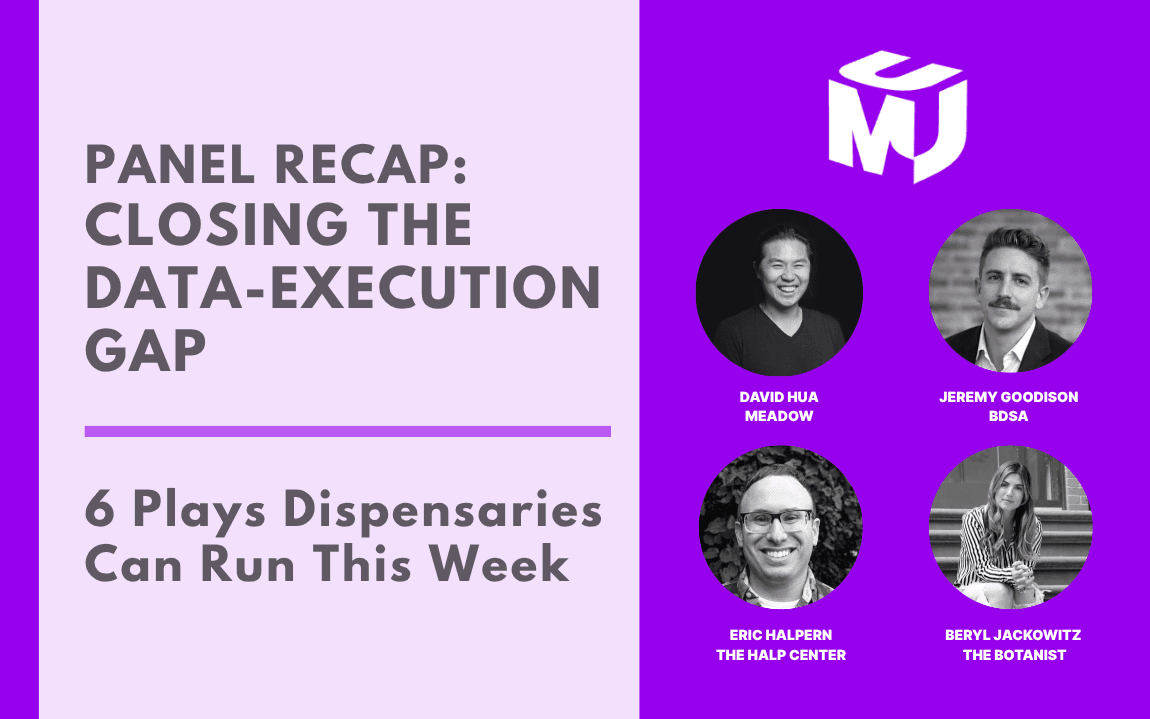
At MJ Unpacked Atlantic City, I moderated a 40-minute panel called Closing the Data-Execution Gap. The session framing said it best:
Cannabis operators are flooded with dashboards, reports, and third-party insights, yet real operational change often stalls.

The room was full of New Jersey operators running one to three stores, the segment where data is most abundant and least applied. I opened with a show of hands.
"How many of you pull a sales report at least once a week?" Most hands went up.
"Keep your hand up if that report actually changed a purchasing decision in the last 30 days." Most hands dropped.
That is the gap. The data exists. The reports get pulled. They just are not changing what happens on Monday.
For the next 40 minutes, we walked a single product from the loading dock to the reorder and showed where the gap costs real money. Below are six plays you can run this week, in the words of the panelists who run them every day.
💡 Why this matters: Every play below maps to a workflow inside your dispensary POS, e-commerce, and inventory system. The cleaner the data, the faster the decision.

In This Post
- Meet the Panel
- See the Panel Slides
- Play 1: Share the Dashboard With Your Vendors
- Play 2: Stop Trusting Your "Average" Cost
- Play 3: Buy to Your Payment Terms, Not Your Shelf
- Play 4: Educate Your Budtenders Out of the Discount Trap
- Play 5: Run a Monthly "SKUs to Kill" Report
- Play 6: Use New Jersey's Crystal Ball
- Bonus: 4 More Gaps We Didn't Have Time For
- Closing Thoughts
Meet the Panel
- Jeremy Goodison | Account Director, BDSA. The market lens.
- Eric Halpern | Consultant, The Halp Center. Former retail planning lead at Fine Fettle. Eleven stores, three states, six and a half years of operator experience.
- Beryl Jackowitz | National Buyer and Merchant, The Botanist. Decides what goes on the shelf at a multi-state retailer.
- David Hua | CEO, Meadow. Moderator. Meadow is the POS, e-commerce, and inventory platform for cannabis retail.
See the Panel Slides
Play 1: Share the Dashboard With Your Vendors
The value: End the adversarial vendor cycle. Get brands investing more in your shelf while you hit your margin targets.
Most buyer-brand relationships are adversarial because each side is looking at different data. Beryl Jackowitz of The Botanist flips that by sharing her brand health dashboard with every vendor she works with. "I share the brand health dashboard with every vendor. I love a monthly call. It's on the calendar. We plan out the promos. We just get it done." That cadence does something the typical quarterly check-in can't: it turns the vendor into a co-owner of the numbers. Once a brand sees the same sell-through and margin data Beryl sees, the conversation stops being about pitching and starts being about problem-solving.
Numbers tell lots of stories, but numbers don't buy. Very clear from the beginning of the conversations: what I am looking for here are my margin targets. I cannot sit on excess inventory. If I make my brands partners, then we'll all be successful.
Beryl Jackowitz, The Botanist
What to do this week
Pick your top three vendors. Put a recurring 30-minute monthly call on the calendar. Share your store-level sell-through, average margin, and inventory days-on-hand by SKU. State your margin target. Let them help you hit it.
👉 Read more: 3 Strategies to Secure the Best Vendor Deals for Your Dispensary
Play 2: Stop Trusting Your "Average" Cost
The value: Your margin reports are running on bad numbers. Fix one dashboard view and stop overpaying.
The cost you booked on a SKU is rarely the cost you paid over its lifetime. Free cases, end-of-month promo pricing, multiple deliveries at different rates all average together, and most POS systems hide it from you.
Beryl Jackowitz called a weighted average cost view "pretty game changing." Her example: Blue Dream doesn't need to come in at $20. $35 is fine. $42 is not. Without a dashboard showing the true cost across the life of the SKU, you can't tell which one you're paying.
Jeremy Goodison of BDSA flagged the part most operators miss: the data quality issue isn't only in your POS. It's in your menu.
We use POS panel as well as web scraping, taking online menus. Is it on discount? Is it in stock? It's a powerful tool, but it is definitely going to be a little bit dirty.
Jeremy Goodison, BDSA
POS data has been getting cleaned up for ten years. Menu data is where the inconsistencies now live, and it's the part your customers actually see. Your data needs to agree in at least three places: Metrc tags, your POS catalog, and your e-commerce menu. When it doesn't, every report you pull is wrong.
What to do this week
Audit one product across all your locations. Same name, same cost, same retail price? If not, fix that one product and put a process in place: catalog-level pricing, one naming convention, fewer hands on the data.
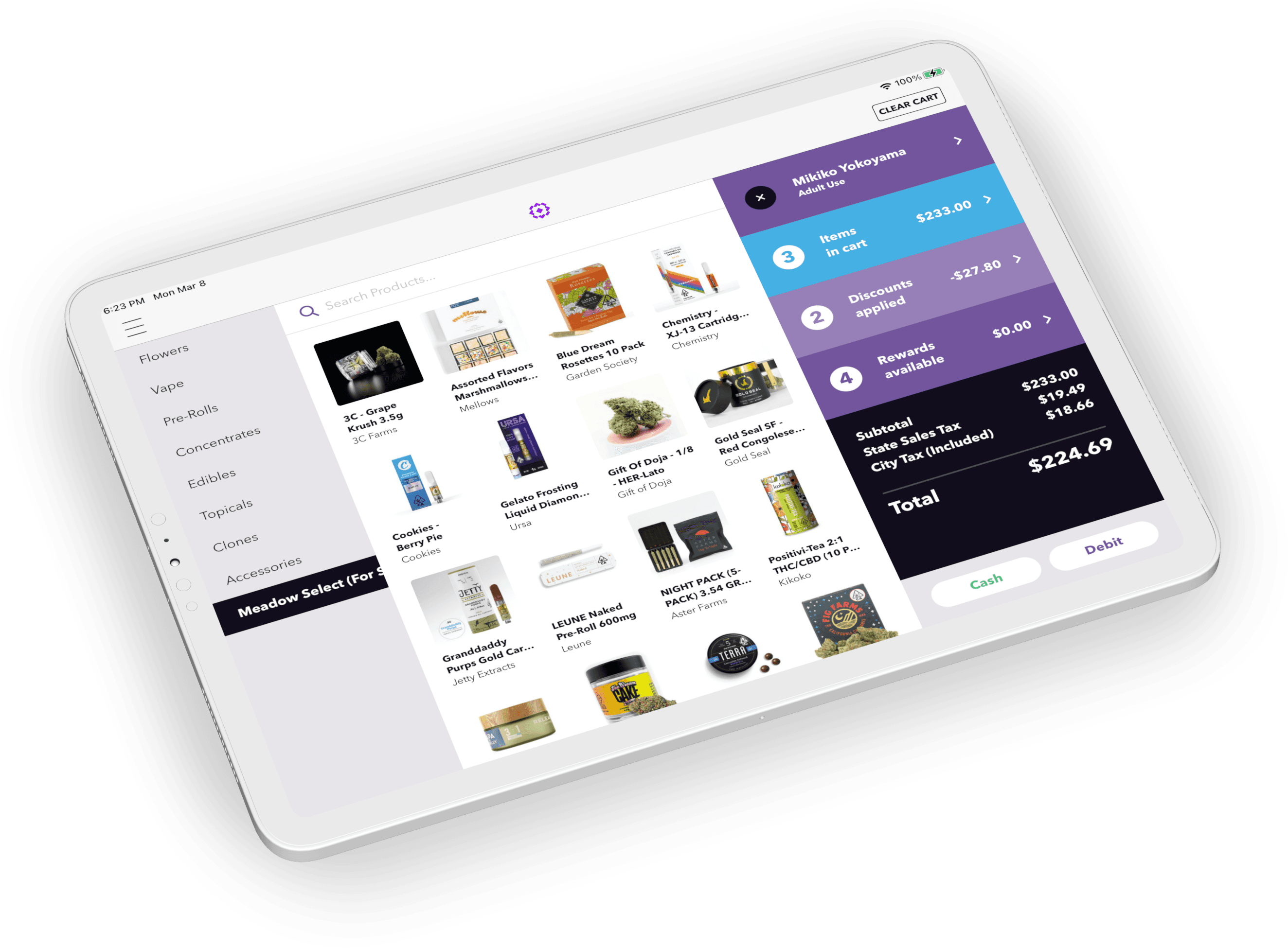
💡 How Meadow handles this: Meadow runs as a single source of truth across POS, inventory, e-commerce, and Metrc so your menu, your catalog, and your compliance data stay in agreement automatically. See how integrated POS prevents data drift →
Play 3: Buy to Your Payment Terms, Not Your Shelf
The value: A product can "sell fine" and still strain your cash flow. Buy in halves and stay cash-positive.
Eric Halpern's first question on any order isn't whether the product will sell. It's whether it will sell before the invoice is due. Split an order in two, move the first half, bring in the second. If you can turn both halves before payment is due on the first, you're running cash-positive on that SKU.
Can you move two orders before the first one was even paid for? Phenomenal. Really have cash flowing.
Eric Halpern, The Halp Center
His second filter is promotion dependence. If a product only moves on sale, it isn't earning its slot, it's renting one. Customers buying only at a discount aren't loyal to the product, they're loyal to the discount.
Eric's baseline benchmark: one unit per day. Less than that without a niche reason (topicals, tinctures, accessories) and it doesn't earn the shelf. Menu visibility matters too: 15 seconds or less is how long a customer scans before bouncing.
Beryl added the seasonality nuance dashboards alone miss. Her three New Jersey stores see lifts her other-state stores don't. Southern New Jersey is a beach town, so she pulls last-year-comparable data to plan for the seasonal uptick.
What to do this week
Pick one SKU. Compare your last buy order to your sell-through over the same period. If you bought a 60-day supply and it took 90 days to move, halve the next order and reorder twice as often.
👉 Read more: Smarter Ways to Discount: Building a Profitable Dispensary Discount Strategy
Play 4: Educate Your Budtenders Out of the Discount Trap
The value: Discounts don't build loyalty. Budtenders do. Move budget from promos to staff education and protect your margin.
The majority of products sold in a dispensary are coming from a budtender recommendation. Have the brand take the time and really treat the team as if they're sales reps of their own company. Have the team be genuinely excited to talk about it. That makes a world of a difference.
Eric Halpern, The Halp Center
Beryl's take on the patient education days (PEDs) and pop-ups most brands default to: "The idea that a pop-up is your answer is just not the case. I don't want to take time away from my budtenders to have someone who's potentially mediocre having conversations."
Her workaround is the vendor takeover, a brand spotlight that moves product without touching margin. Dedicated digital screen time, above-the-fold emails, website banners. "Those are things that we don't currently sell," she said. "So that is a free way to also move the product."
What to do this week
Pick one product you've been propping up with discounts. Pull it off promo for two weeks. Move that budget into a budtender training, takeover screen, or email feature instead. See what sells without the discount crutch.
Play 5: Run a Monthly "SKUs to Kill" Report
The value: Cannabis is over-assorted. Cutting SKUs sharpens your floor, frees vault space, and recovers cash.
Beryl's view is that cannabis is way over-assorted, and a bigger assortment doesn't equal bigger sales. So she and Jeremy built a standing monthly report to act on it.
Jeremy and I have set up standing reports that I get once a month, and one of them is called 'SKUs to Kill.' I run it for every single store.
Beryl Jackowitz, The Botanist
Jeremy's broader point: the operators winning right now let data drive the assortment instead of gut feel. Good automation pushes the insight to you (here are the SKUs missing from your assortment, here are the ones doing nothing) instead of making you log in to find it.
Usability matters more than the data itself. If the report takes 30 minutes, gut wins. If it takes 30 seconds, data wins.
What to do this week
Sort your inventory by sell-through over the last 60 days. Bottom 10% gets a decision: cut, discount to clear, or change format. Don't just reorder it.
💡 Meadow makes this 30-second easy. Meadow's Inventory Velocity report shows exactly how fast products are moving, down to units per day, so you can reorder with precision, prioritize best-sellers, and drop underperformers.
Play 6: Use New Jersey's Crystal Ball
The value: New Jersey is where mature markets were three years ago. Mature-market data is your roadmap, not a curiosity.
Jeremy closed the panel with a snapshot of the New Jersey market and three signals worth planning around.
New Jersey Cannabis Retail | Market Snapshot, April 2026
- Last 12 months: $1.17B in retail sales (+5.1% vs. prior year)
- Last 6 months: $588M (+3.0%)
- Last 3 months: $291M (+4.7%)
- 515 brands | 337 retail locations
- Top 5 brands: Rhythm | Ozone | Fernway | Garden Greens | Select
- Top 5 product types: 3.5g Flower | 2g Distillate Disposable | 1g Distillate Cartridge | 100mg THC Gummies | 7g Flower
Source: BDSA Retail Sales Tracking, April 2026
Three Signals to Plan Around
- Large-format vape is taking center stage. The 2-gram disposable is now the number two product type in New Jersey and the second fastest-growing.
- Geography matters. Border stores ran about 7 to 9% higher than inland New Jersey for the 4/20 lift, a cross-border dynamic worth planning around.
- Flower's lead is closing. Flower currently has 11% more share than vape. In mature markets like California, Arizona, and Colorado, the gap is much smaller. In some cases vape is already ahead.
New Jersey is early in its cycle. Connecticut, Massachusetts, and California have already been through price compression, promo wars, and assortment rationalization. New Jersey has a crystal ball, and most operators aren't looking at it.
What to do this week
Pull one Connecticut or Massachusetts market report from BDSA, Headset, or a comparable source. Compare category mix two years ago vs. today. That's your roadmap.
👉 For New Jersey operators: How Meadow supports New Jersey dispensaries →
Bonus: 4 More Gaps We Didn't Have Time For
The panel was 40 minutes. The prep call was four hours. These four came up over and over in prep and in conversations with operators since.
1. The Promo Fiction
Permanent BOGOs and 20%-offs around an inflated frontline price mean the "regular price" is a number nobody pays. Your margin reports read off a fake number, and you can't tell whether a promo drove incremental sales or cannibalized full-price ones.
The check: What percent of your last 30 days of unit sales happened at full menu price? Under 30%? Your menu price isn't real.
2. The Back Stock Gap
A product sells out on the floor while more sits 20 feet away in the vault. The gap isn't between data and buying. It's between the vault and the shelf. Sometimes the team can't reach a corner of the vault because overstocked product is blocking it.
The check: Walk your vault. How many SKUs are over-on-hand in back vs. sold out on the floor right now?
3. The Metrc Tag Pile-Up
Every shipment of the same product gets a new Metrc tag. If your POS treats each tag as a separate product, one fast-moving SKU can show up as 30 slow-moving ones across your reports. Your velocity data is wrong, and the products you think aren't working actually are.
The check: Pull your top 20 SKUs by unit volume. Is the same product showing up as multiple entries instead of one?
💡 How Meadow handles this: Meadow consolidates Metrc package tags under a single parent product in the POS catalog, so your velocity reports reflect real sell-through, not fragmented entries for the same SKU.
4. The E-Commerce Gap
Most dispensaries either don't have an e-commerce menu or have one with inaccurate listings. Your menu is your storefront. If it's wrong or missing, you're losing sales you'll never see.
The check: Pull up your menu on your phone. Pretend you're a customer. Can you find what you'd buy in 15 seconds? Are the prices, sizes, and strain names right?
👉 Read more: How to Build a Seamless Cannabis E-commerce Experience
Closing Thoughts
At the start of the panel, the room dropped their hands when I asked who'd let a report change a purchasing decision. By the end, every panelist was saying the same thing a different way: the data exists. The gap is between having it and using it.
Pick one play. Run it this week. Pick a different one next week. That's how you close the gap.
Big thanks to Jeremy, Eric, and Beryl for showing up with stories and specifics, and to the MJ Unpacked team for putting the right operators in the room.
Sell More Cannabis with Less Work
Meadow's all-in-one cannabis retail platform connects POS, inventory, e-commerce, delivery, and Metrc compliance, so your data agrees with itself and your team can act on it in seconds.
Resources
- Official session listing: Closing the Data-Execution Gap | MJ Unpacked 2026
- Jeremy Goodison | BDSA: bdsa.com
- Eric Halpern | The Halp Center: thehalpcenter.com
- Beryl Jackowitz | The Botanist: shopbotanist.com
- Meadow | POS, e-commerce, and inventory for cannabis retail: getmeadow.com