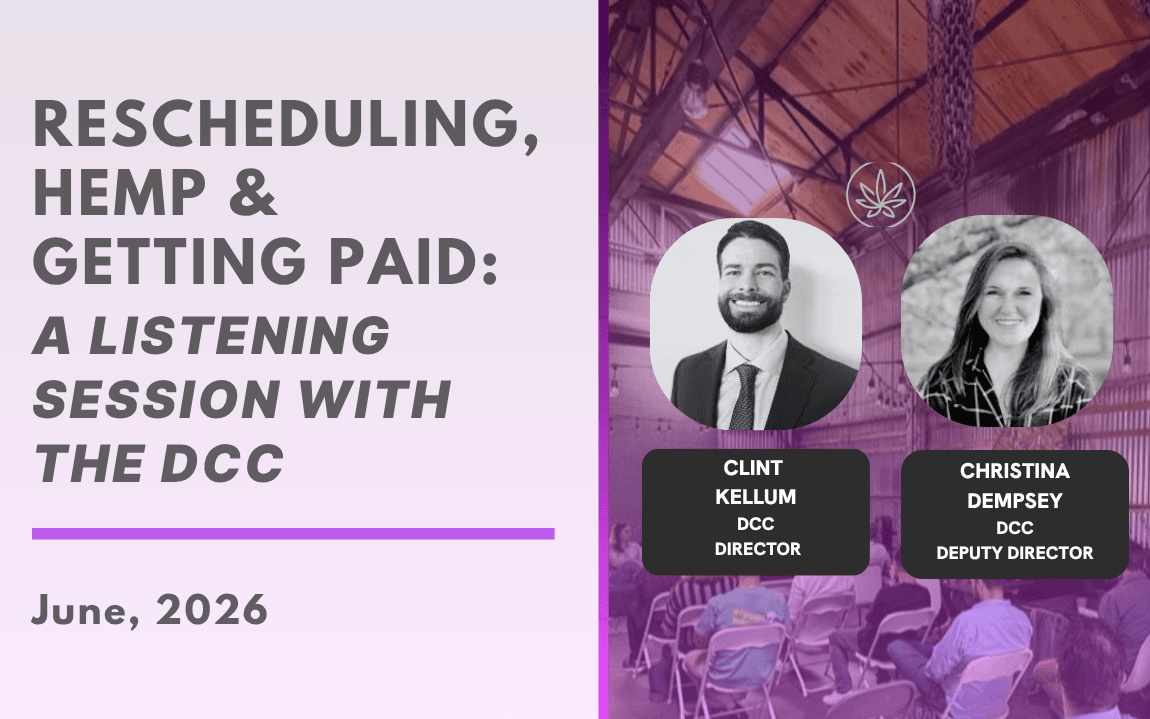

A room of California cultivators, retailers, and manufacturers sat down with DCC Director Clint Kellum and Deputy Director Christina Dempsey at Meadow HQ for two hours of questions. No scripted presentations, no talking points. Just operators asking about the things they actually lose sleep over, and getting straight answers back.
Kellum and Dempsey fielded live questions on the federal rescheduling order, a new medicinal ("M") designation for retailers, batch tagging in Metrc, hemp's 2028 entry under AB 8, license-fee penalties, and, the topic that drew a lot of discussion, late payments and collections.
California's cannabis industry is being reshaped in real time by federal moves, and the state is trying to react without overcorrecting. Here are the highlights that matter most for operators.
In This Post
- Rescheduling Is Real, but the Path Isn't Paved Yet
- The Medicinal Designation: What Changed for Retailers
- Hemp Joins the Cannabis Supply Chain in 2028
- Batch Tagging in Metrc Is Close
- License Fees
- The Topic the Room Got Loudest About: Getting Paid
- Local Bans: Still the Biggest Barrier to Access
- What You Can Do Right Now

Rescheduling Is Real, but the Path Isn't Paved Yet
The dominant topic was the federal rescheduling order and what it means for California operators. For context: on April 23, 2026, the U.S. Department of Justice and DEA moved state-licensed medical cannabis into Schedule III and opened an expedited administrative hearing on broader rescheduling.
The honest answer from the DCC was that nobody has the full picture yet, and most of what's circulating is assumption dressed up as fact. The agencies that have to implement the order, the DEA and the IRS, haven't issued the guidance that would tell operators and states which direction to actually move. As Christina Dempsey put it, the department doesn't want to run too far ahead of where the facts stand today.
A few things the DCC was clear about:
- Whether to register with the DEA is a personal decision. The DCC can't advise operators on whether to register. It doesn't have information operators don't, and the decision comes down to the risk each business is willing to take versus the benefit it's seeking.
- Timing matters. The DEA has said it will keep accepting new registration applications past its initial 60-day window, but applications filed after June 26, 2026 lose expedited processing. So late June isn't a hard cutoff to register, it's the line between a fast-tracked review and a standard one. Separately, the DEA's expedited administrative hearing on broader rescheduling (Schedule I to III) begins June 29, 2026 and must conclude by mid-July.
- There's a spectrum of risk tolerance. On one end, operators are registering with the DEA using their existing license and changing nothing about how they operate. On the other, some are standing up a separate legal entity holding a medicinal-only license for maximum coverage. The DCC noted even the most conservative path isn't foolproof. No one yet knows how the DEA will diligence these operations, including whether finding adult-use activity on the same site becomes a problem.
- Taxes are a big part of the calculus. A move to Schedule III would lift the federal 280E tax penalty that currently blocks cannabis businesses from deducting ordinary operating expenses. Operators were watching for forthcoming IRS guidance, including whether a state medical license that's also DEA-registered would let them apportion part of their business to the medical side for relief. The specifics aren't out yet.
The DEA's broader hearing is also facing mounting legal challenges that could see the order stayed or overturned. If you've been waiting for a clean signal before changing how you operate, you're not behind. The signal isn't here yet.

The Medicinal Designation: What Changed for Retailers
The most concrete change for retailers who want to register with the DEA: you can now create a separate legal entity, under identical ownership, to hold a medicinal-only (M) license while your original entity keeps its adult-use (A) license.
Why it matters: the medicinal license is the credential the DEA cares about, but you can't simply convert to M-only, because most of your customers are adult-use and you need to keep selling to them. The separate-entity structure lets you hold both at once: an adult-use storefront and a DEA-registrable medicinal entity.
The details operators need to understand:
- It's built for retailers because of who they sell to. A retailer's customer base is mostly adult-use, so they have to keep an A or A&M license. The separate entity is what gives them a DEA-registrable credential without giving up adult-use sales.
- The designation doesn't limit who you can do business with. A, A&M, and M holders can all transact with any license type. The M designation's specific value is at retail, where you're dealing directly with consumers and need the DEA-registrable credential.
- Cultivators don't need the same fix. A cultivator can change their designation to medicinal-only and still sell to A and A&M licensees down the supply chain, and they can register with the DEA as manufacturers.
Hemp Joins the Cannabis Supply Chain in 2028
If you've watched intoxicating hemp products undercut the regulated market, there's a timeline now. Hemp produced some of the session's most tangled discussion, reflecting how messy the federal picture has become since the 2018 Farm Bill.
The logic the legislature settled on, according to the DCC, was straightforward: California already has a strong regulatory framework for cannabis, so rather than build a second parallel system for hemp, fold hemp into the one that exists.
The key dates and mechanics operators should plan around:
- Beginning January 1, 2028, California's AB 8 moves hemp into the regulated cannabis supply chain. Hemp will be allowed in only as tested biomass (plant material) at or below 0.3% THC, subject to the same testing, track-and-trace, and pesticide standards as cannabis, and can then be used in products made under the cannabis framework. AB 8 phases in from January 1, 2026; until 2028, licensed manufacturers may only use concentrates and extracts derived from licensed cannabis.
- Loopholes are closing now. The legislation tightened the rules that let intoxicating hemp products sell outside any real framework, and added enforcement tools against smoke shops repeatedly selling these products illegally.
- CBD-to-THC conversion is prohibited. Operators can extract hemp for full-spectrum products, but cannot convert hemp-derived CBD into THC to undercut cannabis-sourced THC. AB 8 also bars hemp-derived THC extracts, oils, and concentrates from being used in cannabis products, and keeps a ban on hemp flower and pre-roll sales.
- Synthetic-cannabinoid testing is being built. The DCC said its lab is developing the capacity to identify products derived from CBD synthesis, targeted to be available by January 2028.
Layered on top: a federal appropriations measure passed last November bans hemp products containing THC, with a one-year delay, plus active advocacy pulling in every direction. The DCC's honest position is that it's watching the federal government before committing, and that there's a lot to stand up between now and 2028 before any of this is operational.
A recurring theme operators raised: cannabis is a strong source of THC and a mediocre source of CBD, while hemp is the reverse. Several see hemp's regulated entry as a path to a better CBD supply for balanced, one-to-one products, not a threat to flower cultivators.

Batch Tagging in Metrc Is Close
Some good news on the operational front. Operators pressed on the cost and burden of track-and-trace (Metrc), pointing to a per-tag cost (operators cited about 21¢ a tag) paid to a private vendor. What the DCC shared:
- Batch tagging regulations went out for public comment on June 12, 2026. The goal is to reduce the labor of tagging.
- Batch tagging won't necessarily cut your data costs. The DCC cautioned that the underlying contract counts individual data points, so one tag covering 100 plants can still be billed as 100 plants. Set expectations accordingly.
- Track-and-trace funding moved into the tax structure (tier one), so it's no longer funded as a license-fee activity.
- Registering may mean opening Metrc to the DEA. DEA registrants generally can only transact with other DEA registrants, so anyone who registers would likely be expected to disclose their track-and-trace activity to the federal government. The DCC said the order appears to lean on record-keeping verified through systems like track-and-trace, drawing a parallel to ARCOS, the DEA's controlled-substance order-tracking system.
When operators floated dropping Metrc entirely, the DCC pushed back gently: robust, individualized tracking may be part of why the federal order grew comfortable with state medical licenses in the first place.
License Fees
One of the sharpest exchanges came from a Bay Area retailer who described the license-fee structure as adversarial: operators have had to predict the next year's revenue, pay a fee based on the tier they guess, get no refund or credit if they overpay, and face a 50% penalty on the difference if they underpay.
The DCC's response offered real movement:
- The 50% penalty is a regulation, not a statute (inherited from the original Bureau of Cannabis Control rules). The department frames it as aimed at willful misreporting, which it says is rare. Operators pushed back that relief isn't automatic: you often have to ask or escalate, and for cultivation there's no payment-plan flexibility.
- Fee equity is on the radar. As the DCC develops the combined-activities ("Cal") license, it's revisiting what fees, penalties, and reasonable expectations should look like.
The practical advice from the room: if you're hit with a penalty you believe is unfair, don't accept the first answer. Ask.
The Topic the Room Got the Most Discussion: Getting Paid
The energy in the room peaked not on rescheduling or hemp, but on payment terms. Several operators made clear that late payment and collections is the existential issue for the supply chain right now: a cultivator or manufacturer can wait 90 to 120 days to get paid for product it already delivered, "if it gets paid at all."
How the Imbalance Took Hold
The structural problem operators laid out: California built a distribution layer that functions like a three-tier system, but without the payment and credit rules that typically come with one. Combine that with heavy retail consolidation, and smaller supply-chain businesses have almost no leverage.
- The rules are silent, so the leverage flows uphill. California's regulations say almost nothing about credit terms. By operators' estimate, as few as five to ten retail groups now control much of the state, so brands have little bargaining power.
- Terms keep stretching. What used to be standard terms have drifted to 90- and even 120-day net, and increasingly to consignment, where the retailer doesn't pay until, or unless, the product sells.
- Consignment is a trap, not a term. As one operator framed it: consign a pair of boots to a shop and, if they don't sell, you take them home. Consign cannabis to a retailer and after 90 days it can sit on the shelf indefinitely. You can't easily reclaim it and sell it elsewhere.
- It rewards the worst actors. A retailer who doesn't pay gains a cash-flow advantage over one who does. One operator said a competitor with 30-plus stores is moving to consignment, leaving suppliers little real choice but to accept it or walk away from the revenue.
The Model Operators Kept Pointing To: Alcohol's Credit Law
The clearest ask from the room was to stop reinventing the wheel and borrow a framework that already works: California's alcohol regulations, administered by the Department of Alcoholic Beverage Control (ABC). Much of the DCC's own framework was adapted from alcohol regulations in the first place.
Under California's Business and Professions Code (§25509, part of the "tied-house" trade-practice rules), alcohol suppliers cannot extend credit to a retailer beyond 30 days. If a retailer hasn't paid within 30 days of delivery, every unpaid supplier must then sell to that retailer cash-in-advance (COD) until the balance is cleared, and statutory late penalties accrue (1% of the unpaid balance at day 43, plus another 1% every 30 days after). As of January 1, 2026, those payments must run by electronic funds transfer initiated by the 30th day. The ABC administers and enforces these rules directly.
The consequences are automatic and rule-based, so the regulator never has to arbitrate a he-said/she-said dispute. A retailer that doesn't pay simply loses the privilege of buying on credit, industry-wide, until it settles up.
Operators also pointed to other states as proof credit terms can be regulated without breaking the market:
- Washington: all cash-on-delivery at the time of delivery, no credit allowed in the supply chain.
- New York: capped at no more than 30-day net terms.
Where the DCC Landed
Director Kellum was sympathetic but honest about the constraints:
- It doesn't want to arbitrate private disputes. Refereeing two businesses over payment is traditionally the courts' role and invites lawsuits from whichever side loses.
- A court-triggered path is the more likely lever. The DCC floated giving itself authority to act against a licensee after a court has already ruled that the business isn't paying.
- A prior bill already died over this exact question. A Distributors Association bill, asking the DCC to arbitrate disputes (and later to suspend or revoke the license of a business a court found wasn't paying), failed in committee. The core objection: revoking a non-paying business's license doesn't actually help its suppliers collect.
- Capacity is the real bottleneck. Rescheduling, batch tagging, the ~150-page combined-activities ("Cal") license regs, and a comparably sized AB 8 package are all moving at once.
Operators floated a lighter-touch starting point: a clear channel to report repeat non-payers, so the department can treat many suppliers naming the same business as a signal. The DCC committed to convening operators, including those who'd disagree, to find a workable path.
This is the issue we'd watch. It's quieter than rescheduling, but it's the one putting good operators out of business right now.
Local Bans: Still the Biggest Barrier to Access
On retail access, the DCC was straightforward about what it can and can't do:
- It cannot overturn local bans. Local control was written explicitly into Prop 64's intent, and because it's a voter-approved ballot measure, the legislature has been reluctant to challenge it.
- The one partial exception was delivery, and it was contested. In 2018–19, the state's then-bureau said local governments can't prohibit deliveries originating from a licensed business outside their jurisdiction. After a court challenge, the statute today frames it as the state declining to enforce local delivery bans, not a repeal. The DCC can't replicate that across retail broadly.
- There's no legislative pathway right now, so the department is working the problem at the grassroots level: fact sheets for local governments, a local-government toolkit with industry associations, and panels at venues like the League of California Cities.
- The missing ingredient is organized consumer demand. The people who show up to oppose a local dispensary are energized, while consumers who'd welcome legal access haven't organized to be heard.
Progress here is happening one jurisdiction at a time.
What You Can Do Right Now
A few practical takeaways from two hours of straight talk:
- If you're weighing DEA registration, mind the June 26 expedition cutoff. You can still apply after that date, but applications filed after June 26, 2026 won't get expedited processing. Decide which path fits your risk tolerance, and don't count on a fast-tracked review if you wait.
- Don't restructure your operation around rescheduling yet. The federal guidance that would tell you how isn't out. Plan for scenarios; act on facts.
- If you got an unfair underpayment penalty, contest it. The DCC's stated intent doesn't always match operators' experience, and the department acknowledged the gap.
- If payment terms are crushing you, document it and organize. A coordinated operator voice is what moves a policy issue like this, and the DCC asked for exactly that.
That's where having a single source of truth matters. When the rules are shifting around rescheduling, hemp entry, track-and-trace, and fee calculations, the operators best positioned to adapt are the ones whose sales, inventory, compliance, and reporting already live in one connected system, not scattered across spreadsheets and manual uploads.
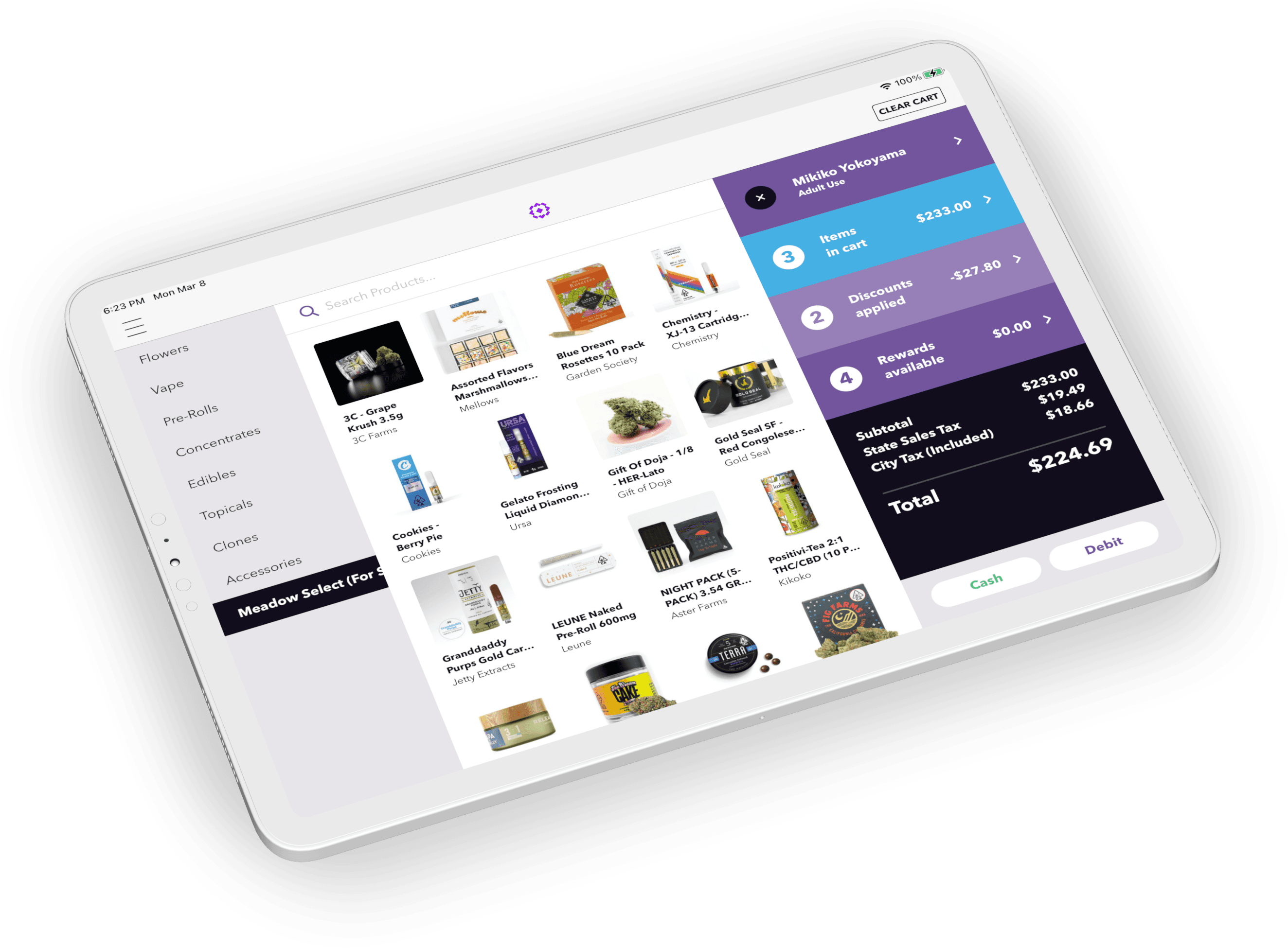
Meadow has built point-of-sale software for licensed cannabis retailers since 2014, as Y Combinator's first cannabis startup, with automated Metrc reporting, always-accurate inventory, and reporting you can pull in seconds. That's why we host these sessions. If any of this changes the math for your business, we're here to talk it through.

This recap is based on a DCC operator listening session held at Meadow HQ in San Francisco on June 5, 2026. It reflects statements made during that session and is provided for general information only. It is not legal, tax, or compliance advice. Regulatory details, dates, and bill references should be confirmed directly with the DCC or qualified counsel before you act on them.
Frequently Asked Questions
What Did the Federal Rescheduling Order Change?
On April 23, 2026, the U.S. Department of Justice and DEA placed FDA-approved marijuana products and marijuana regulated under a qualifying state medical license into Schedule III, and opened an expedited administrative hearing on broader rescheduling that begins June 29, 2026. Most downstream details, including DEA registration mechanics and IRS tax guidance, are still being worked out.
Do California Cultivators Get the New M Designation?
Cultivators don't need it. The emergency regulations let a retailer hold a medicinal-only license through a separate entity (identical ownership) while keeping their adult-use license, because retailers serve mostly adult-use customers and can't convert to M-only. A cultivator faces no such constraint: they can change their designation to medicinal-only and still sell to A and A&M licensees down the supply chain. Cultivators can also register with the DEA as manufacturers.
When Does Hemp Enter California's Cannabis Supply Chain?
Under AB 8, hemp biomass (0.3% THC or less) can enter the regulated cannabis supply chain beginning January 1, 2028, subject to the same testing, track-and-trace, and pesticide standards as cannabis. The law phases in from January 1, 2026, and prohibits converting hemp-derived CBD into THC.
What Is California Doing About Late Payments to Cannabis Suppliers?
Nothing binding yet. Operators urged the DCC to mirror California's alcohol credit law (Bus. & Prof. Code §25509), which caps supplier credit to retailers at 30 days and forces cash-on-delivery once a buyer is delinquent. The DCC is wary of arbitrating private disputes but floated acting against a licensee after a court ruling, and agreed to keep the conversation going.