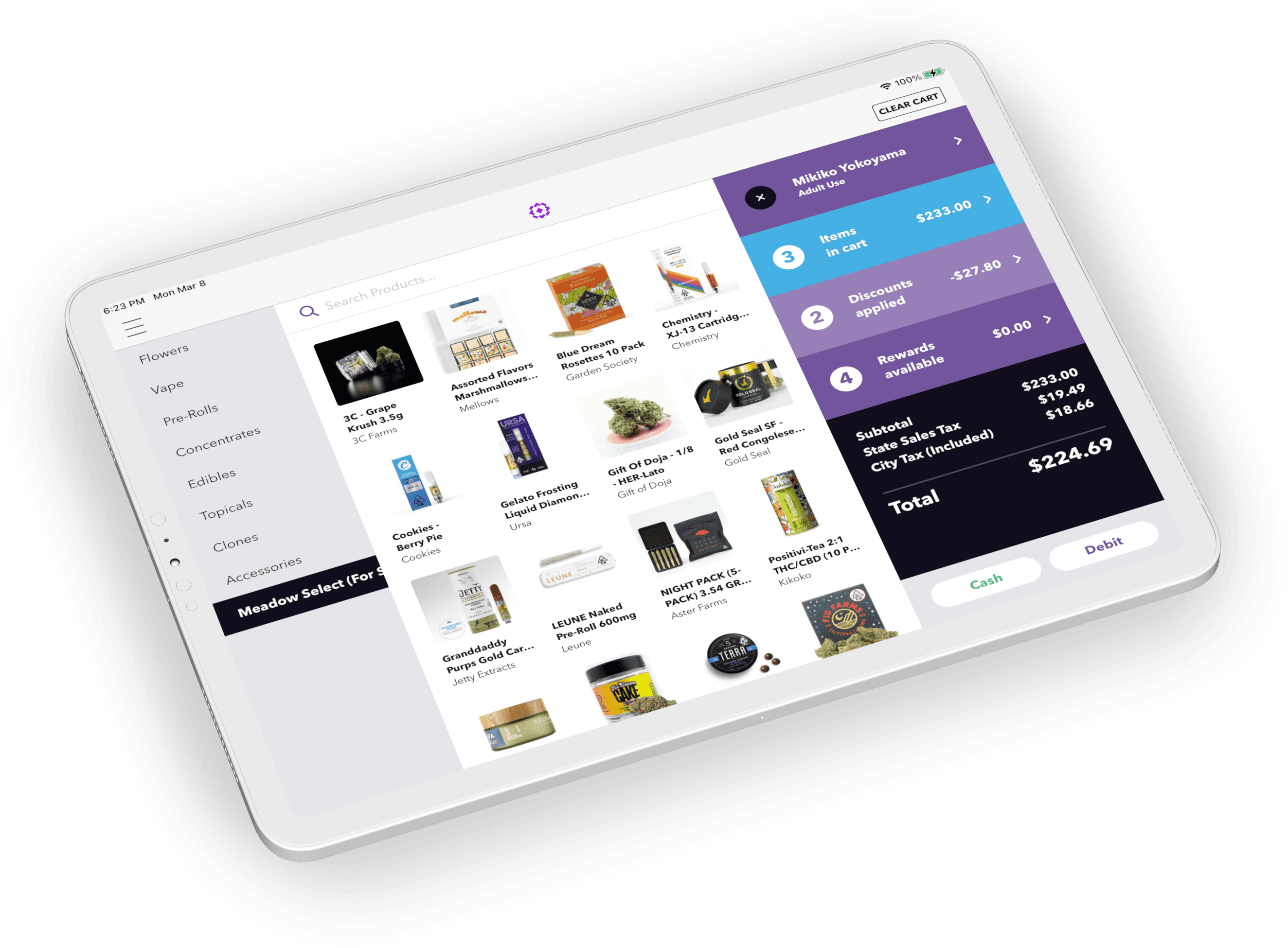

A cannabis ERP runs production, wholesale orders, inventory, and cost accounting for the businesses upstream of retail. Your dispensary POS is the system you sell on. They are built for different jobs, and the only place they meet is the Metrc transfer manifest that arrives with every delivery.
This guide covers what a cannabis ERP actually does, which system owns which part of your operation, where Distru fits as one of the ERPs on the supply side, how product crosses from one system to the other, whether you need both, and what changes when you hold a distribution license and a retail license at the same time.
In This Post
- What a Cannabis ERP Is
- Cannabis ERP vs POS: What Each System Owns
- What Distru Is and What It Handles
- Where the Two Systems Meet
- Do You Need a Cannabis ERP?
- If You Hold Both Licenses
- Common Questions
Key Takeaways
- A cannabis ERP runs the supply side, covering production, wholesale orders, and cost accounting across licenses. A dispensary POS runs the retail floor.
- The two systems meet at the Metrc transfer manifest, which is the only object both of them read.
- Metrc does not allow third party software to create or modify transfers, so a person at the supplier registers every transfer and a person at the dispensary receives it.
- Operators holding both a distribution license and a retail license still move product between their own licenses as a registered Metrc transfer, because Metrc tracks licenses rather than companies.

What a Cannabis ERP Is
A cannabis ERP is the operations system that cultivators, manufacturers, and distributors run to manage product before it reaches a store. ERP stands for enterprise resource planning, which in practice means one system holding inventory, production, orders, and costs for a business that makes or moves goods.
In cannabis specifically, an ERP handles the work between the plant and the dispensary door:
- Production runs, assemblies, and the recipes that turn inputs into finished goods
- Wholesale orders, fulfillment, and invoicing to retail accounts
- Inventory and compliance reporting across multiple licenses at once
- Cost of goods, so the business knows what a case actually cost to produce
Most dispensary operators meet an ERP indirectly. It is the system a distributor's sales rep is working in when they tell you what is available, and the system that generated the invoice in the box. You may never log into it, and what it does still shapes your receiving mornings. If your company also holds a cultivation, manufacturing, or distribution license, you are the one running it, and the question shifts from what an ERP does to where its job stops.
Cannabis ERP vs POS: What Each System Owns
A cannabis ERP and a dispensary point of sale system are organized around different events. An ERP is organized around product moving through stages, where inputs become outputs, costs accumulate, and several licenses roll up into one set of books. A POS is organized around a transaction at a counter, where a sale has to ring, comply, and close in seconds.
| Cannabis ERP owns | Dispensary POS owns |
|---|---|
| Production runs, assemblies, and bills of materials | Ringing sales in store, online, and on delivery |
| Wholesale orders, fulfillment, and invoicing | Compliance reporting on every sale |
| Procurement and inbound inventory across licenses | Loyalty, discounts, and customer records |
| Cost of goods and margin on manufactured product | Store level inventory, counts, and reconciliation |
What Distru Is and What It Handles
Distru is a cannabis ERP built for the supply side, serving cultivators, processors, manufacturers, and distributors. If a distributor delivers to your store, there is a reasonable chance their operation runs on something like it.
Distru reports more than 450 customers across 30 or more states, over $10 billion in wholesale sales processed, and more than 3.5 million Metrc events synced since 2016. The platform covers inventory and production on one side and wholesale ordering on the other, with a live Metrc integration (and BioTrack in BioTrack states) reporting inventory and sales changes to the state as they happen.

One problem it is built to solve will be familiar to anyone who has placed a wholesale order:
Retailers aren't all going to order through the same portal. They'll text, email, or send a spreadsheet. Good distribution software should be able to turn those requests into clear, accurate orders your team can check before anything ships. The more someone has to retype, the more chances there are for a quantity or product to get missed.
Azam Khan, COO, Distru
That retyping is where quantities go wrong, and a wrong quantity upstream becomes a manifest that does not match the invoice at your receiving door.
Where the Two Systems Meet
The two systems meet at the Metrc transfer manifest and nowhere else. The ERP prepares the shipment on the supply side, your POS reads the packages on the retail side, and the manifest is the only object both of them can see, whether the two licenses belong to one company or two.
The sequence is always the same:
- Someone at the supplier registers an outgoing transfer in Metrc naming your license as the destination.
- The transfer appears in your Metrc incoming tab, where you verify the physical shipment against the manifest and receive it.
- Your POS reads the received packages and they become sellable inventory.
Metrc does not allow third party software to create or modify transfers on a user's behalf. Software can prepare a transfer and read it afterward. A person registers it, and a person receives it.
What the manifest does not carry is the business paperwork. Wholesale cost per unit, invoice numbers, payment terms, and the sales rep's notes all live in the supplier's ERP, which is why the invoice and the manifest can describe the same delivery differently. Keeping those two pictures aligned is most of the job on both sides of the dock:
Look for software where your inventory and ordering stay in sync. If a buyer sees one thing on the menu and your team sees another in the warehouse, someone has to catch the difference by hand. That's time your team shouldn't have to spend, and it's an easy way to lose a retailer's trust.
Azam Khan, COO, Distru
💡 How Meadow handles this: Once a received transfer lands in retail inventory, every downstream sale and adjustment reports to Metrc without a manual entry, so receiving is the only Metrc action your store team takes. Metrc Reporting for Dispensaries →

Do You Need a Cannabis ERP?
Most dispensaries do not need a cannabis ERP, because the businesses selling to them already run one. If your license is retail only, you buy finished product, you do not manufacture, and you do not sell wholesale, then the production and cost rollup an ERP exists to handle is work you never do. A POS that reads Metrc transfers cleanly covers your side of the seam.
You need both systems when you hold a license that produces or moves product as well as one that sells it. At that point somebody in your company is running production or wholesale orders, and that work has nowhere to live in a retail system.
If your license is retail only, receiving is the part worth getting right. Meadow builds purchase orders directly from Metrc transfers and carries vendor costs forward from previous receipts, so intake does not become a retyping job. Book a Demo to Learn More
If You Hold Both Licenses
Operators holding both a distribution license and a retail license run both systems themselves, and the seam between them works the same way it does between two separate companies. Moving product from your distribution license to your retail license is a registered Metrc transfer with a manifest, a listed driver, and a receiving step, because Metrc tracks licenses rather than companies.
Common Questions
What is a cannabis ERP?
A cannabis ERP is the operations system cultivators, manufacturers, and distributors run to manage product before it reaches a dispensary. It holds production runs, wholesale orders, inventory, and cost accounting across one or more licenses, and reports to Metrc. Distru is one example of a cannabis ERP built for that supply side work.
What is the difference between a cannabis ERP and a dispensary POS?
A cannabis ERP runs the supply side: production, bills of materials, wholesale orders, fulfillment, invoicing, and cost accounting across licenses. A dispensary POS runs the retail floor: ringing sales in store, online and on delivery, per sale compliance reporting, loyalty and discounts, and store level inventory. They meet at the Metrc transfer manifest.
Do I need a cannabis ERP if I only have a retail license?
No. If you buy finished product and sell it at retail, the production and wholesale work an ERP exists to handle is work you never do, and your suppliers already run one. What you need is a POS that reads Metrc transfers cleanly so receiving does not become a manual data entry job.
Do I need a Metrc manifest to move product between my own licenses?
Yes, in any Metrc state. Metrc tracks licenses rather than companies, so a transfer from your distribution license to your retail license is a registered transfer with a manifest, a listed driver and vehicle, and a receiving step at the destination. Owning both licenses changes who signs and nothing else.
Does Meadow work with Distru?
Meadow dispensaries receive product from Distru operations the way they receive it from any supplier, through the Metrc transfer manifest. Meadow reads the received transfer, builds the purchase order from it, and carries vendor costs forward from previous receipts.
Keep the Retail Half Clean
Receiving is where inventory accuracy is won or lost, whoever is on the other end of the manifest. Meadow builds purchase orders straight from Metrc transfers, carries vendor costs forward, and reports sales, adjustments, and reconciliations to Metrc automatically, so the numbers your retail license reports are ones you can defend. Meadow has been building cannabis retail software since 2014 as Y Combinator's first cannabis startup, and serves licensed retailers in California, New York, New Jersey, Michigan, Massachusetts, and Minnesota.